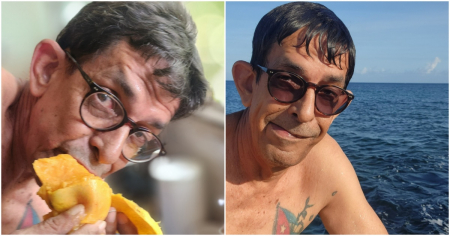
The desperation caused by power outages in Cuba no longer distinguishes between professions or public figures.
The renowned comedian Ulises Toirac exploded on social media due to the unbearable energy situation in Havana, where power cuts last up to 19 hours a day.
"Last night was disgraceful," Toirac said in a video posted on his Facebook profile.
"I’m waking up super late because of the... I just can’t sleep, man, I can’t sleep. They turn off the power on me, and it feels like I’ve been hit in the face with a bat. Mosquitoes, no fan, heat... 'Good morning!'" he exclaimed, visibly annoyed as he walked down the street.
This is not the first time the artist has spoken out about the energy crisis and its effects on the Cuban population.
"The current situation: it's no longer 20 hours of blackouts in the provinces... It's 30 or more (due to the same two hours of electricity) because there is no power system and no money to meet the demand. Money that can only be made by producing and not 'hunting', but we can't produce because... there is no electricity!" he expressed days ago.
The actor is no longer hesitant to openly criticize the Cuban government.
His posts criticizing the inefficiency of the authorities even earned him a citation from State Security in June. "It seems they don't like what I'm saying," he remarked ironically at the time.
His new outburst reflects a weariness shared by millions of Cubans who, like him, struggle to sleep due to the high temperatures, the mosquito plague, and the inability to turn on a simple fan.
Havana, increasingly in the dark
On Thursday, the electric service was disrupted for an average of 19 hours in the capital, as confirmed by the Electric Company of Havana.
At 11:50 PM, a maximum impact of 87 MW was recorded, and although supply was partially restored in the early hours of Friday, the outages continue to be longer and more frequent than announced.
The electric company itself published a new blackout schedule at the end of June that confirms the worsening of the energy crisis.
According to the official schedule shared on social media, power outages will now last for eight hours a day, including periods in the early morning, severely impacting the daily life of Havana residents.
Although the official schedule anticipated eight-hour blackouts per block, in practice, the outages have far exceeded that limit, at times tripling it.
Public outrage erupts on the company's official social media.
"In my area, we were without power from 2:00 am to 6:00 am," wrote a user, denying the alleged restoration of service. "They're taking us for fools; they say they didn't cut the power, and here we are with the refrigerator thawed out," added another.
Residents from different neighborhoods are reporting interruptions of up to three times in a single day, at unplanned times, with no technical explanation provided. "They restored the power, and ten minutes later it was cut off again. That's how equipment gets damaged," warned a resident of Centro Habana.
An emergency that transcends electricity
Blackouts in Cuba have ceased to be merely a technical issue. With temperatures exceeding 35 degrees, shortages of water and medicine, and outbreaks of diseases such as dengue and the Oropouche virus, the lack of electricity has turned into a direct threat to public health.
Specialists warn that the inability to sleep at night has devastating effects on physical and mental health: chronic exhaustion, hormonal disruptions, anxiety, depression, and a general weakening of the immune system.
"My son cries all night from the heat and the mosquitos, and the next day he goes to school exhausted," says Laura, a mother of two children in Old Havana.
Furthermore, without electricity, food preservation becomes nearly impossible, refrigerated medications spoil, and the proliferation of mosquitoes finds the perfect breeding ground in stagnant water containers.
The most affected are children, the elderly, and those with chronic illnesses, whose survival often depends on continuous access to electricity.
A structural crisis with no solution in sight
Despite the constant reports of blackouts, the authorities do not provide concrete structural solutions, and the justifications—lack of fuel, pending maintenance, or "unexpected breakdowns"—are repeated endlessly.
Meanwhile, everyday life in Cuba is gradually fading away: there is no light to cook, study, or work.
Discontent is growing in all corners of the country, while the Government looks the other way or prioritizes sectors like tourism instead of ensuring a basic level of stability for the population.
Ulises Toirac's complaint is not a joke or an exaggeration: it is the cry of millions. "I can't sleep," he said, and alongside him, those who see their dignity erode with every night without a fan, every thawed refrigerator, and every unfulfilled promise from the authorities echo his sentiment.
Today in Cuba, what is least lacking is darkness.
Frequently Asked Questions about Blackouts and the Energy Crisis in Cuba
What is causing the prolonged blackouts in Havana?
Power outages in Havana are due to a severe energy crisis affecting the entire country. The lack of an efficient electricity system and the shortage of financial resources to meet demand are the main causes. Despite official schedules indicating eight-hour cuts, in practice, the outages greatly exceed that limit, lasting up to 19 hours a day.
How do these blackouts affect daily life in Cuba?
Blackouts severely impact daily life in Cuba, generating a negative effect on the health and well-being of the population. The lack of electricity prevents the use of fans during high temperatures, which affects sleep and causes anxiety and exhaustion. Furthermore, the preservation of food and medications becomes nearly impossible, and the proliferation of mosquitoes contributes to the spread of diseases.
Why does Ulises Toirac criticize the Cuban government for the energy crisis?
Ulises Toirac criticizes the Cuban government for its inefficiency in managing the energy crisis and for prioritizing other sectors over the well-being of the population. The comedian points out that the lack of structural solutions and the focus on attracting foreign currency without generating real production have worsened the situation. Additionally, Toirac denounces that the government's measures do not address the underlying causes of the crisis, leaving the population in an increasingly precarious situation.
What consequences does the energy crisis have on public health in Cuba?
The energy crisis in Cuba poses a direct threat to public health. High temperatures without adequate ventilation can lead to exhaustion and anxiety, while the lack of refrigeration for food and medication is critical. Additionally, the proliferation of mosquitoes in stagnant water conditions increases the risk of diseases such as dengue. The most vulnerable populations are children, the elderly, and those with chronic illnesses.
Filed under: