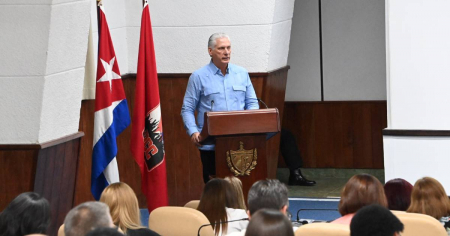
The leader Miguel Díaz-Canel urged Cubans to embrace “Fidel's revolutionary doctrine” to overcome the challenges.
“It’s not about remembering Fidel; it’s about bringing him into this moment; about immersing ourselves in his revolutionary doctrine to confront the colossal challenges of these times,” said Díaz-Canel at the close of the X Plenary of the Central Committee of the Communist Party of Cuba (PCC) this Saturday.
The leader reiterated the clichés of the regime's propaganda in a speech where he called for sacrifices, blamed the U.S. and the international situation for the circumstances in Cuba, and called to celebrate the centenary of the late dictator.
Referring to the elite he nominally leads, Díaz-Canel stated that "what the people are expecting from us, their main representatives and public servants, are concrete and immediate actions that will help overcome the deep economic crisis that is causing significant harm to the spiritual fabric of our nation."
"Today more than ever, it is reaffirmed that these solutions depend entirely on us, in a highly challenging and threatening context," he added, then shielded himself behind external sanctions and threats.
"We are a country at war. Cuba has been living and resisting for over 60 years under conditions of war. Every day, around us, fall the bombs of economic warfare, which block, hinder, slow down, or delay all efforts, and the bombs of disinformation, distortion, and hatred that surround the former," he said.
The leader 다시 mentioned "imagination" as a solution to the profound crisis that Cubans are experiencing, which is causing daily protests against his management.
"Steadfast, without boasting about their own acts of heroism, with a dignity that is beyond any possible negotiation, the Cuban people are living through extremely challenging days. They do so by testing all their knowledge, even unleashing their imagination on that complex, earthly path that requires inventiveness and adaptability," he said.
On Friday, before the same Assembly, the regime's Prime Minister Manuel Marrero had assured that his government feels the "deepest dissatisfaction for not being able to" resolve the crisis affecting the Cuban people.
The government expresses its "deepest dissatisfaction at not achieving the expected outcomes in the most sensitive issues affecting our people," said Marrero.
He also admitted that "2025 is proving to be challenging" and nothing will change for Cubans for the remainder of the year.
After the economic failures of the regime's planning in recent years, Marrero is now focused on the "Government Program to correct distortions and relaunch the economy in the first half of the year," which, according to him, will lead to a gradual recovery of the economy.
Now, the leader is discussing 10 ambitious goals to overcome the crisis affecting the island, outlined with generalizations that do not explain how they plan to implement them.
Among the objectives are to advance in macroeconomic stabilization; increase and diversify the country's external revenues; boost national production, with an emphasis on food; progress in resizing and developing the socialist state enterprise; and recover the National Electric Power System (SEN).
Frequently Asked Questions about the Economic and Political Crisis in Cuba
What does Díaz-Canel propose as a solution to the crisis in Cuba?
Díaz-Canel calls on Cubans to embrace Fidel's "revolutionary doctrine" to overcome problems. In his speech, he insisted on the need for sacrifice and blamed external factors such as the U.S. embargo for the current situation, while appealing to the imagination and creativity of the people to tackle the crisis. However, his speech lacks concrete proposals to address structural issues such as food and medicine shortages, and the collapse of the energy system.
What are the main economic challenges facing Cuba in 2025?
Cuba is facing a deep economic crisis characterized by inflation, shortages of food, medicine, and fuel, and a collapse of the energy system. Despite Díaz-Canel's claims about advancing in macroeconomic stabilization and income diversification, the general measures announced lack concrete details on their implementation. The situation is further exacerbated by the de facto dollarization of the economy and the absence of structural reforms.
How does the Cuban political system affect the current economic situation?
The Cuban political system, characterized by a centralized socialist model and lack of pluralism, restricts the implementation of the structural reforms necessary for economic recovery. Despite the severe crisis, the regime insists on continuing socialism as the only path, which hinders the development of more flexible economic policies tailored to the current needs of the country. This political rigidity exacerbates the economic and social situation.
What role does the U.S. embargo play in the Cuban crisis?
The Cuban government blames the U.S. embargo as the main culprit for the country's critical situation. However, economists and analysts point out that the crisis is also a result of ineffective internal policies, a lack of structural reforms, and a centralized economic management that does not adapt to current needs. The embargo contributes to the challenges, but it is not the sole cause of Cuba's economic problems.
Filed under: