
Related videos:
The Minister of Foreign Affairs, Bruno Rodríguez Parrilla, stated on his X account that, although the United States has imposed migration sanctions on Cuban political and military leaders, and maintains a "prolonged and ruthless economic war," it will not succeed in bending "the will of this people or its leaders."
Shortly before, Deputy Foreign Minister Carlos Fernández de Cossío emphasized the idea on the social network itself, describing the measure as an act of "arrogance and impotence" on the part of Washington.
"The supposed sanction is accepted with pride, as an expression of one who serves a dignified, rebellious, and indomitable people," Fernández de Cossío stated.
Both officials attempted to present the visa denial as a kind of badge of honor. However, the reaction on social media was not one of support or national pride. The responses flooded the posts with mockery, pointed contradictions, and a common question: if they despise the “empire” so much, why do they insist on traveling there?
"They've already started... But if the United States is so bad, keeps us 'blocked,' and so on, why does your president or any leader want to go there?" questioned a user.
Another response was more direct: "If they hate the empire, they shouldn't have to travel there. So the withdrawal of the visas doesn't affect them at all."
Many comments agreed that the will of the people has not been broken by the United States, but by the Cuban government itself, which has repressed, censored, and impoverished the population for decades.
“The United States has not been able to bend the will of the Cuban people, it’s true. But those who have trampled it for decades are the same leaders who today play the victims while they repress, lie, and live like kings. Don’t talk about dignity when what you defend is your power, not the people,” wrote a user in direct response to Rodríguez.
Another commentator pointed out that on July 11, 2021, "it was shown that the people do not want them, and the United States has no sanctions against the Cuban people; the Cuban people are not the PCC nor the gang of criminals that govern the country. Focus on tackling the garbage that is consuming you alive," and accompanied his opinion with images of trash dumps and debris that are rampant in Havana.
The contrast between the official discourse and public perception is once again evident. While those in power aim to create a narrative of ideological firmness, the streets - even if virtual - sense opportunism, incoherence, and victimhood.
The United States government sanctioned Cuban leader Miguel Díaz-Canel on Friday for his involvement in "serious human rights violations," marking the anniversary of the protests on July 11, 2021, on the island. The measure, announced by the State Department, includes a ban on entry to the country for both the leader and his immediate family members.
These sanctions could prevent Díaz-Canel from attending international events, such as the UN General Assembly, where he has been present on previous occasions. His presidential term is expected to end in 2028.
The measure also revives similar precedents: in 2019, former President Donald Trump imposed comparable sanctions on Raúl Castro and his children.
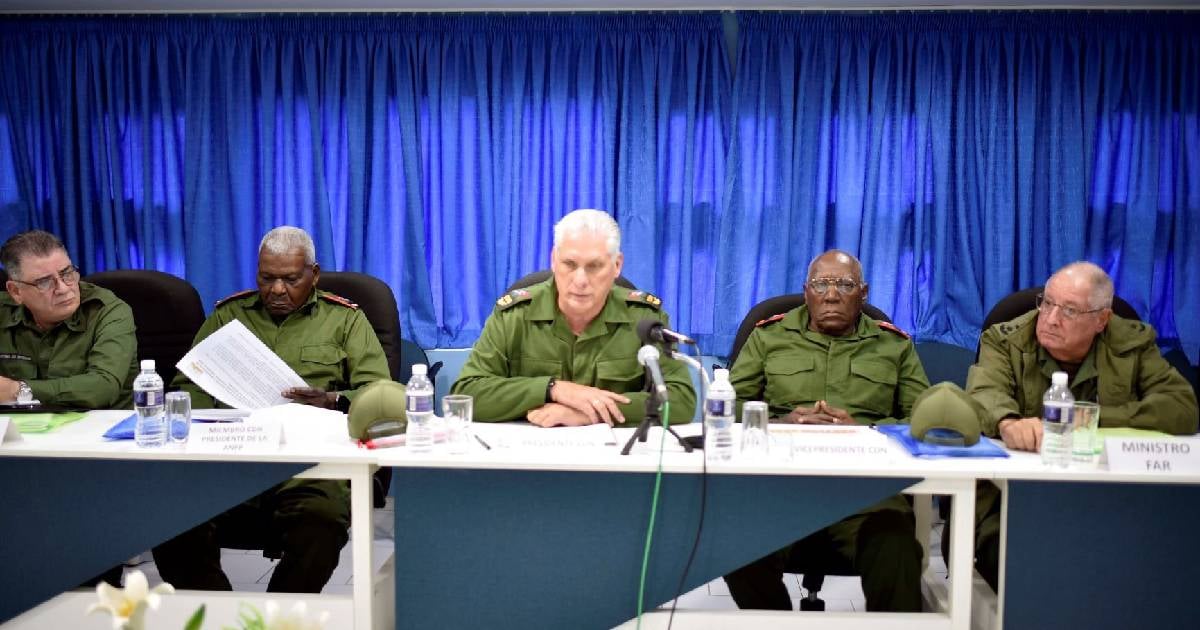
Washington also sanctioned the Minister of the Revolutionary Armed Forces of Cuba (FAR), Álvaro López Miera, and the Minister of the Interior (MININT), Lázaro Alberto Álvarez Casas, prohibiting them from entering the country along with their immediate family members.
The measure, announced by the Miami Herald based on statements from a senior official at the State Department, is part of a series of actions aimed at holding high-ranking officials of the Cuban regime accountable for systematic human rights violations.
The sanctions, which include the revocation or denial of visas, were imposed under section 7031(c) of the Department of State Appropriations Act for fiscal year 2025. This legislation establishes that foreign officials involved in significant acts of corruption or serious human rights abuses are ineligible to enter U.S. territory.
Additionally, visa restrictions were imposed on several unidentified Cuban judicial and penitentiary officials accused of being responsible or complicit in arbitrary detentions and acts of torture against the protesters from July 11. For reasons of immigration confidentiality, the names of those affected were not disclosed.
As part of the diplomatic offensive, the State Department also updated its List of Prohibited Accommodations in Cuba, adding 11 new hotels, including the well-known “Torre K” in the Havana neighborhood of Vedado, along with other luxury properties recently opened, associated with the military conglomerate GAESA.
Frequently Asked Questions about U.S. Sanctions on the Cuban Government
Why did the U.S. impose sanctions on the Cuban government?
The U.S. imposed sanctions on the Cuban government due to its involvement in serious human rights violations, especially in the context of the protests on July 11, 2021, on the island. These measures include the revocation of visas for high-ranking officials of the regime and their families, as a way to hold the Cuban government accountable for its repressive actions.
What has been the Cuban government's response to the sanctions from the U.S.?
The Cuban government, through its officials, has labeled the sanctions as an act of "arrogance and impotence" on the part of Washington. Officials such as Bruno Rodríguez Parrilla and Carlos Fernández de Cossío have attempted to turn the sanctions into a sort of badge of honor, arguing that the United States will not be able to bend the will of the Cuban people or its leaders.
How has the Cuban population reacted to the sanctions and the government's rhetoric?
The response from the Cuban population on social media has been largely critical of the government. Many Cubans have pointed out the hypocrisy of the regime in criticizing the U.S. while seeking to travel there and have accused their leaders of using the embargo as an excuse for the repression and mismanagement that have impoverished and oppressed the people for decades.
What impact do the sanctions have on the relations between Cuba and the United States?
The sanctions further exacerbate tensions between Cuba and the United States, affecting the chances for dialogue and cooperation between both countries. Furthermore, these measures contribute to a climate of confrontation that hinders the possibility of improving bilateral relations, which are already marked by a long history of distrust and political conflict.
What other actions has the U.S. taken against the Cuban regime?
In addition to sanctions on specific leaders, the U.S. has updated its List of Prohibited Accommodations in Cuba, adding hotels linked to GAESA, a military conglomerate that controls a significant portion of the Cuban economy. These actions are part of a broader effort to hold the Cuban regime accountable for human rights violations and political repression on the island.
Filed under: