
Related videos:
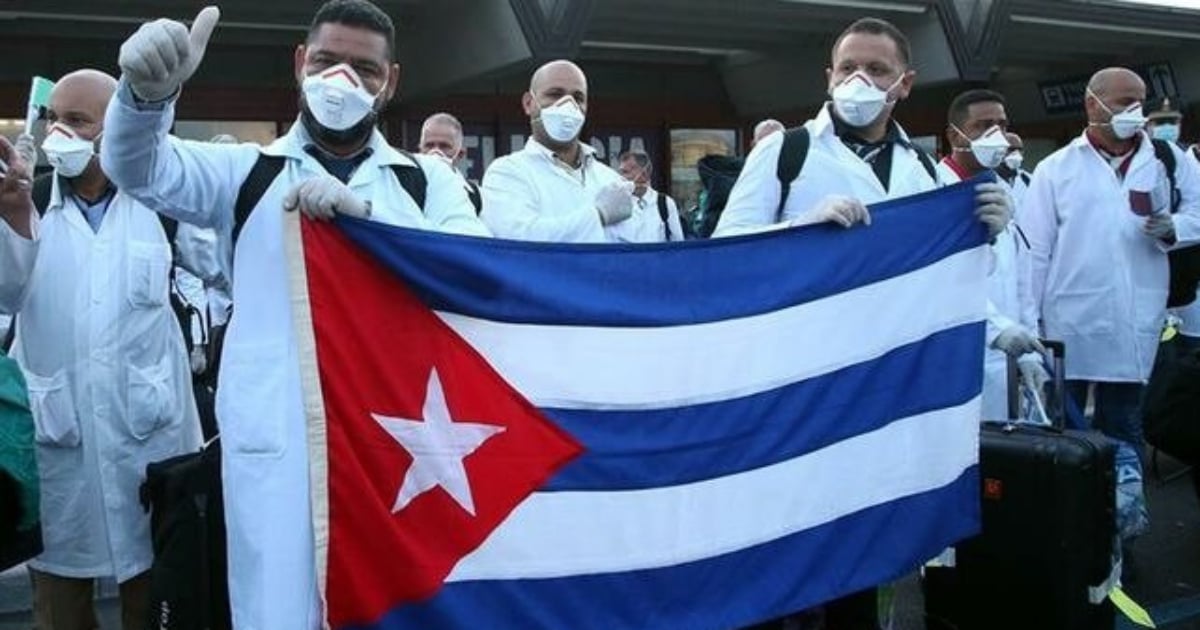
The Cuban government confirmed this Thursday that more than 24,000 health sector workers are currently providing services abroad as part of its system of modern slavery, disguised as an international cooperation policy.
The figure was revealed during the parliamentary debate on the foreign policy guidelines for the period 2025-2028, held in the National Assembly of People's Power, reported the official Cubadebate.
In that session, the Minister of Foreign Affairs, Bruno Rodríguez Parrilla, defended the regime's foreign policy as a "revolutionary and popular" diplomacy, stating that it is in line with "the foundational principles from the struggles for independence," and is directed by the political power leadership, headed by the First Secretary of the Communist Party and the country's president.
Rodríguez stated that all state bodies, including the Parliament, ministries, mass organizations, and the Party, play an active role in this foreign policy, which, he said, has "the people as its main protagonist."
However, in practice, the model described leaves thousands of healthcare professionals forcibly sent abroad on the sidelines, voiceless, without rights, and under state control, while the doctors who remain on the island must work in abysmal conditions and are regulated without the possibility of leaving the country.
During the debates, the regime's deputies reaffirmed that the priorities of this policy focus on the preservation of the socialist model, the defense of the Cuban political system, and the pursuit of economic opportunities that accelerate the country's recovery.
In this context, the foreign minister acknowledged that one of the fundamental objectives is to strengthen financial relations, exports, investments, and international cooperation, which centrally includes the export of medical services.
According to Rodríguez, the participation of Cuban leaders and delegations in international events is part of a strategy to "deepen economic ties" and reinforce the regime's leadership in multilateral organizations such as the Group of 77 plus China or the Non-Aligned Movement.
Nevertheless, the official avoided addressing the international criticisms received by the medical mission program, nor did he mention the working conditions faced by the professionals sent abroad.
Instead, he merely characterized his work as a demonstration of "solidarity" and "revolutionary commitment."
In the same vein, the Deputy Director General for the United States at the Ministry of Foreign Affairs, Johana Tablada, stated that "the people are the inspiration behind the work of Cuban diplomats."
The regime's defender justified the actions of the Foreign Ministry as an effort to explain to the world "what is happening in Cuba, what we are suffering, and what the severe impact of the policies of the United States government is."
El vínculo con los cubanos residentes en el exterior también fue abordado en la sesión parlamentaria.
According to official statements, the regime seeks to involve them in the nation's economic development while urging them to "defend the independence and sovereignty" of the country.
For her part, Ana Teresita González, the Director General of Consular Affairs and Cubans Residing Abroad, stated that one of the current objectives of foreign policy is to "deepen the ties" with emigrants, who are being asked to contribute raw materials and supplies to reactivate national industry amidst an economic crisis that has depleted hospitals, collapsed basic services, and driven thousands of professionals, including doctors, to emigrate.
González acknowledged that, although there have been advances, "we are still far from achieving the desired level of participation" from Cubans abroad.
However, the issue of migratory mistreatment and the bureaucratic obstacles imposed by the regime on those trying to maintain ties with the island from exile was not mentioned, aside from the obvious: most Cubans in the diaspora reside in other nations after fleeing the regime.
The parliamentary debate concluded with a final message from Chancellor Rodríguez Parrilla, who praised the work of Cuban workers abroad and reaffirmed that "millions of Cubans, inside and outside the country, are essential actors in foreign policy."
The reality, however, shows that many of them are bound by imposed contracts, under surveillance and without minimum guarantees of freedom or labor justice.
Despite the official discourse on "solidarity," the system continues to generate doubts both inside and outside the island, especially amid the deep crisis facing the Cuban public health system, characterized by hospitals lacking resources, a shortage of personnel, and thousands of professionals emigrating or leaving the sector.
Last April, it was reported that 91.6% of the money that Bahamas pays for each Cuban doctor is pocketed by the regime, leaving the professional with a minimal fraction of their salary.
In May, it was reported that the Government of Bahamas demanded direct payment to doctors, in an effort to reduce the opacity of the system.
However, the Cuban administration resisted, insisting that the funds be transferred to the Ministry of Public Health of Cuba.
This model has been described by the U.S. Secretary of State, Marco Rubio, as "an atrocious practice of modern slavery", which deprives Cuban doctors of basic freedoms such as choosing their destination, resigning freely, or retaining their passports during missions.
Frequently asked questions about Cuban medical missions abroad
How many Cuban healthcare workers are providing services abroad?
More than 24,000 Cuban healthcare workers are currently providing services abroad, as confirmed by the Cuban government during a parliamentary debate on foreign policy.
What are the criticisms of Cuban medical missions abroad?
Cuban medical missions have been internationally criticized for being seen as a form of "modern slavery". Cuban doctors face exploitative working conditions, such as withholding of wages and movement restrictions, while the Cuban government profits economically from their services.
How much money does the Cuban regime earn from medical missions?
The Cuban regime receives more than 4.9 billion dollars a year from international medical missions, according to allegations from the United States government.
Why do some countries continue to hire Cuban doctors despite the criticism?
Despite the criticism, some countries view Cuban medical cooperation as essential to their health systems and prefer to maintain it, even if that means facing sanctions or losing access to American services. The lack of local medical personnel in some countries justifies this dependence.
What measures has the United States taken against Cuban medical missions?
The United States has imposed sanctions and visa restrictions on officials from countries that hire Cuban doctors under abusive conditions, claiming that these missions constitute a form of human trafficking and forced labor.
Filed under: