
Related videos:
A complete family ended up at the center of a criminal investigation in Cienfuegos after being linked to a network selling synthetic drugs that impacted about twenty young people, including several minors.
Four of the six individuals involved (two men and two women) are relatives, including a teenager of only 16 years old, who were selling the drug known as "papelito," reported the official newspaper 5 de Septiembre.
"They sold drugs from their own house and also on the street. They did not consume themselves, but they encouraged others to do so in order to reap the profits from a business that destroys human lives," detailed First Lieutenant Ana Diasmyn Díaz Hernández, criminal instructor at the Provincial Unit of Criminal Investigations
The substances, according to the forensic analysis, were laced with 5-FLUORO ADB, a synthetic cannabinoid of high toxicity, capable of causing anything from seizures and strokes to multiple organ failure.
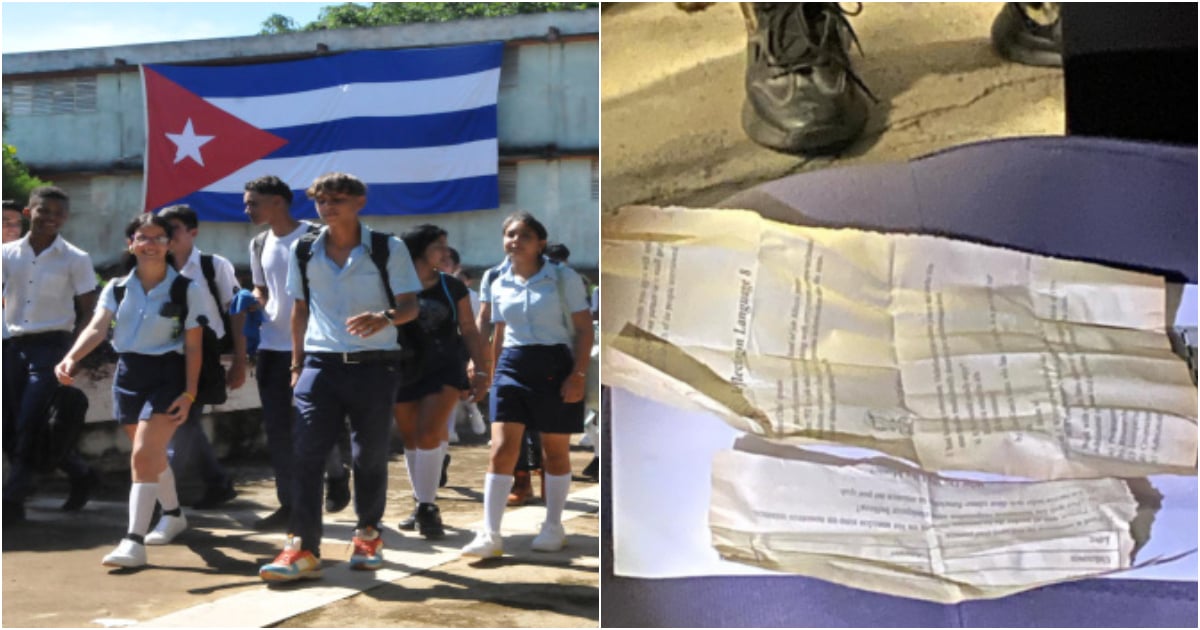
The material used to transport and distribute the drug was simple sheets of school notebook paper, seemingly harmless, but saturated with thousands of doses of a lethal substance.
The network was dismantled when one of the accused was returning from Havana with the goods hidden in a taxi. A team from the Ministry of the Interior (MININT) was waiting for him. The investigation is still ongoing, but they are already being charged under Article 235.1a of the Penal Code, related to crimes involving drug trafficking or similar substances.
Authorities have identified at least 20 young users related to this case, four of whom are minors (one under 15, one under 16, and two under 17). Most have dropped out of school, do not have employment, and quickly fell into addiction, the media stated.
Some, the younger ones, would consume three or four doses in a single night, and the older ones even more, which created a strong level of dependence. According to their accounts, they experienced tremors and irritability if they were unable to access the substance.
Major Annia María Gil Rodríguez, a specialist from MININT, stated that many of the consumers ended up becoming distributors, a spiral that exacerbates the problem and extends the scope of the damage. She also warned about the passivity of relatives who knew or suspected trafficking but did not take action.
The popular councils of Centro Histórico, La Juanita, La Gloria, and San Lázaro, in the city of Cienfuegos, were areas where activity related to this case was identified.
The government insists on its "zero tolerance" policy towards drug-related crimes, although the reality on the ground points to an unstoppable social disintegration.
Two sheets of a school notebook were enough to reveal how deeply hell can seep in when impunity is cultivated at home.
Cuban Customs authorities reported this Friday about the detection of liquid narcotics inside the body of a man at José Martí International Airport in Havana, amidst a crackdown by the regime against drugs.
Customs agents detected last weekend attempts to smuggle drugs for personal use hidden inside gummies and electronic cigarettes at Jardines del Rey International Airport, located in the tourist area of Cayo Coco.
During 2023 and the early months of 2024, the institution reported a increase in the sophistication of concealment methods and reiterated that the most frequently detected substances are marijuana, cocaine, synthetic cannabinoids, and methamphetamines.
The regime's fight against drug trafficking has led in recent years to the and the use of specialized technology at the main entry points to the country.
An increasing number of videos shared on social media display the visible deterioration of several young people under the influence of a drug commonly known as "el químico", raising social alarm regarding the consumption of synthetic substances in Cuban communities.
Although authorities have conducted raids and arrests related to the trafficking of this substance, access remains widespread, as it is a low-cost synthetic drug that is easy to distribute in school environments, peripheral neighborhoods, and through informal networks.
At the end of June, the Cuban government launched its Third National Exercise for the Prevention and Countering of Crime, Corruption, Drugs, and Social Indiscipline, which included actions such as public monitoring, fiscal audits, energy inspections, and public trials of cases deemed "noteworthy", including drug trafficking.
Official media reported the holding of multiple trials and the imposition of lengthy sentences, exemplary punishments, confiscations, and public exposure.
However, beyond the official discourse, what is not openly discussed is why more and more people -mostly young individuals- are risking involvement in these activities. In an environment of sustained crisis, inflation, and scarcity, the punitive approach does not seem to stop the problem; it merely amplifies its visibility.
Frequently Asked Questions about Synthetic Drug Trafficking in Cienfuegos
How did the synthetic drug trafficking network operate in Cienfuegos?
The synthetic drug trafficking network in Cienfuegos was made up of a family that sold a drug known as “papelito,” which was impregnated with the synthetic cannabinoid 5-FLUORO ADB. This highly toxic substance was distributed in sheets of school notebook paper, and was sold both at their home and on the street. Among those involved was a 16-year-old girl.
What effects does the "chemical" have on young consumers?
The "chemical," a type of synthetic drug, produces devastating effects in young consumers, such as seizures, strokes, and multiple organ failure. Young people who use it experience tremors, irritability, and a strong dependence, which has led many to drop out of school and quickly fall into addiction.
What has been the Cuban government's response to the issue of synthetic drug trafficking?
The Cuban government has adopted a "zero tolerance" policy towards drug trafficking, conducting raids, arrests, and exemplary trials. However, these actions focus on repression and do not address the underlying causes of the problem, such as poverty, lack of opportunities, and marginalization, which limits their long-term effectiveness.
What alternatives are proposed to address the problem of drug consumption in Cuba?
Alternatives are proposed that include preventive campaigns, specialized medical assistance, and emergency protocols for poisoning. Experts and civil organizations suggest that the approach should be comprehensive, addressing the issue from a public health and education perspective, moving beyond current punitive and repressive measures.
Filed under: