
Related videos:
While Cuba is facing a prolonged housing crisis and a shortage of construction materials, Pinar del Río is embracing an ancestral alternative: building with earth, lime, and clay, which, according to specialists, can also withstand hurricanes.
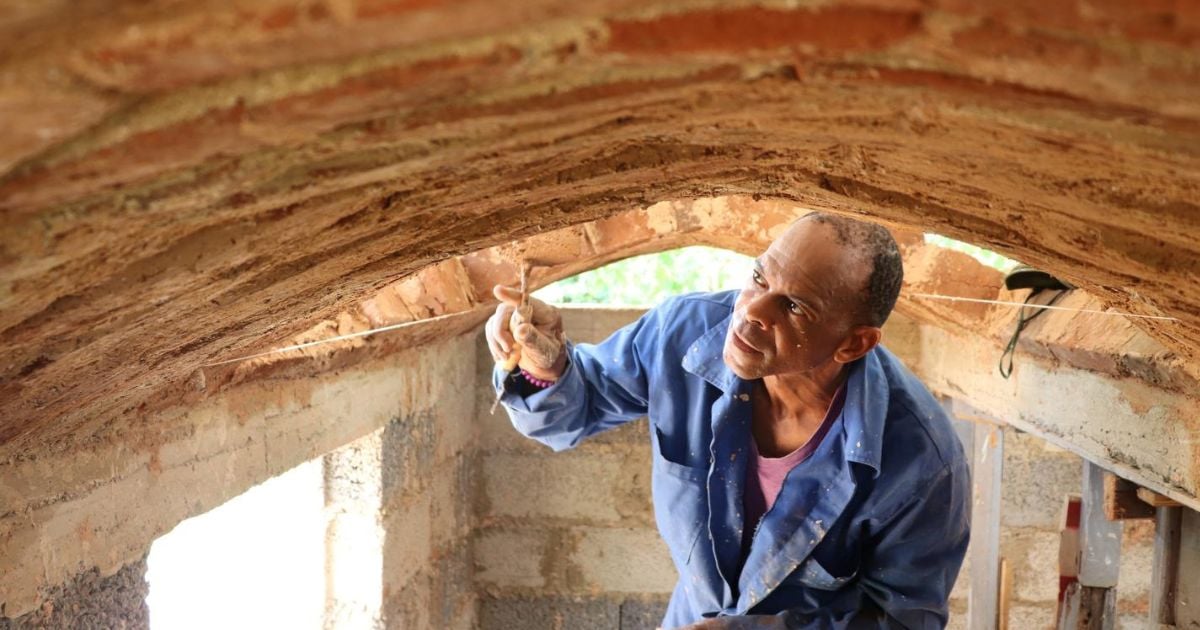
A practical training session led by Mexican specialists, supported by the United Nations Development Programme (UNDP), demonstrated to technicians, bricklayers, and students in the province how to construct arched roofs using locally sourced materials.
“We want to revive traditional construction systems that have already proven to be useful and resilient,” said Ramón Aguirre, a Mexican architect and director of the Institute of Mexican Vaults and Regional Technologies (IBOMEX), one of the trainers.
During the training week, dome and barrel vault structures were constructed using handmade bricks and mortars made without cement, using mixtures of lime, soil, and clay.
Workers from the housing system, students from the Pedro Téllez Polytechnic Institute, and local producers participated.
A module on the production of solid clay bricks was also included, led by a master from the province of Guantánamo.
The objective is to diversify local production of construction materials in response to the ongoing scarcity and reliance on imported supplies, such as cement and steel, the absence of which in the Cuban market hinders the already precarious housing recovery.
The context that gives meaning to this initiative—clearly a desperate effort by the regime—is the passage of Hurricane Ian in 2022, which caused severe damage to the housing stock in Pinar del Río, and whose effects are still evident in the geography of that province.
Almost two years later, many families have still not been able to recover their homes, and in this context, these techniques emerge as a possible, albeit limited, response to a structural problem that the State has not been able to resolve.
"Today it is very important to generate this knowledge and to make use of it in the houses that are being rebuilt," said Jesús Nilo Soca Muñiz, coordinator of programs for the Provincial Government.
The project, implemented with the support of the Civil Defense, the Ministry of Construction, and funds from the European Union, is part of a broader strategy to strengthen local disaster response capacities.
However, beyond institutional enthusiasm, the precariousness becomes evident, compelling us to look to the past to find solutions for the present.
Although techniques like these may represent a practical and contextualized approach for certain rural communities, they do not replace a comprehensive public housing policy nor do they address the lack of resources that continues to affect thousands of Cuban families.
But is this the first time the regime has encouraged such practices? Surprisingly, the answer is no.
In 2022, amid the housing crisis that was prevailing in the country at that time –and continues to this day– in Trinidad, Sancti Spíritus province, the construction of adobe houses was being promoted.
"Oneida Ortiz, a resident of the town of San Pedro, sees her earthen house come to life thanks to the efforts of many Cuban and foreign friends who are attending the 20th Ibero-American Seminar on Architecture and Earth Construction in Trinidad, Cuba," shared a journalist from Radio Trinidad on Facebook.
That same year, in Pinar del Río, the construction of homes with vault roofs was resumed as an “alternative” in response to the severe shortage of construction materials in Cuba.
More recently, in 2025, the regime began to promote several projects that include buildings made from shipping containers, as part of its proposals to alleviate the housing shortage in the province of Holguín.
The underlying issue behind all these "initiatives" is a single one: the housing construction sector in Cuba is experiencing a long and deep crisis.
The significant decline in housing construction in Cuba is an unmistakable sign of the economic and social collapse the country is experiencing: in 2024, fewer houses were built than in the worst years of the Special Period, highlighting the sustained collapse of the State's ability to meet one of the most basic needs of the population.
Another revealing fact is that the housing deficit in Cuba exceeds 800,000 units, yet the regime only manages to construct a minimal fraction: the lack of materials, the collapse of the local industry, and poor state management exacerbate a structural crisis that directly impacts the quality of life for hundreds of thousands of Cubans.
Frequently Asked Questions about Housing Construction Using Ancestral Techniques in Cuba
Why are ancestral techniques being used for housing construction in Pinar del Río?
The use of ancestral techniques in Pinar del Río is due to the scarcity of modern construction materials in Cuba and the need to find sustainable alternatives that can withstand natural phenomena such as hurricanes. This initiative is an effort to diversify local material production in light of dependence on imported supplies.
What materials are being used in these alternative constructions?
Earth, lime, and clay are used to construct structures such as vaulted roofs and handmade bricks. These materials are locally accessible and do not require cement, which is critically scarce in Cuba.
What organizations support the construction project using traditional techniques in Cuba?
The project is supported by the United Nations Development Programme (UNDP), the Ministry of Construction, Civil Defense, and funds from the European Union. Additionally, the training is led by Mexican specialists from the Institute of Mexican Vaults and Regional Technologies (IBOMEX).
Can these construction techniques really withstand hurricanes?
According to specialists, ancestral construction techniques using earth, lime, and clay are capable of withstanding hurricanes. The aim is to revert to methods that have historically proven to be useful and resilient, suitable for facing natural disasters in the region.
What is the context of the housing crisis in Cuba?
Cuba is facing a deep housing crisis due to a shortage of construction materials such as cement, lack of investment, and ineffective government management. Projects like the use of shipping containers and ancestral techniques are attempts by the regime to alleviate the housing deficit, although they do not replace a comprehensive housing policy.
Filed under: