
Related videos:
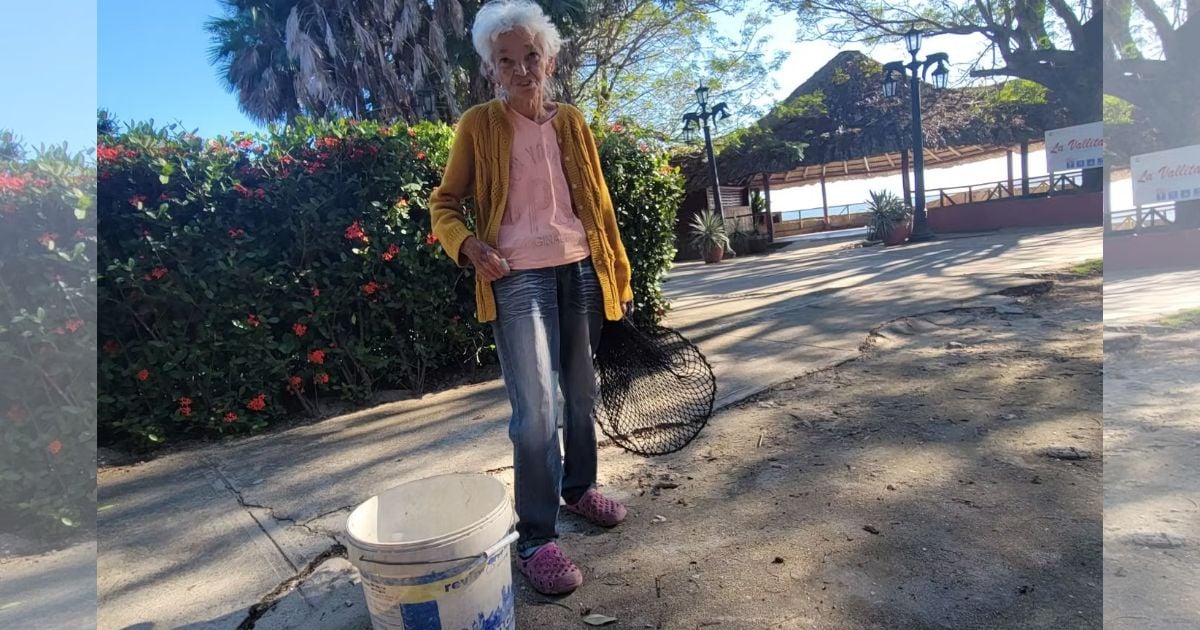
Every evening, as the sun starts to set over the Cuban coast, a woman named María, over 70 years old, wades alone into the murky waters to catch crabs and shellfish. She does this unassisted, carrying a bucket of more than 10 liters that, with a bit of luck, she sometimes manages to fill.
Her small, aged body faces physical pain, insecurity, and institutional neglect every day. Each dawn, far from the peace and tranquility her age demands, is instead a new day of survival in Cuba.
The story was collected by Food Monitor Program (FMP), which warns about the increase in extreme survival practices among the most vulnerable sectors of the Cuban population, especially elderly individuals without family support and with no income.
María lives about 800 meters from the coast, and each day begins by searching for fish or seafood remains to use as bait.
Then he throws the bait into the sea and patiently waits for the crustaceans to appear, and with a net, he captures them with difficulty. Sometimes he manages to catch several; other times, he returns empty-handed, and the anxiety that his life depends on luck.
The procedure requires forced physical postures, contact with slippery areas, and the constant possibility of falling or getting injured.
If the journey extends into the night, she must return alone through secluded areas where assaults have occurred; yet, she continues on as she has no other option.
María asserts that she has no family to help her and that her only support is her Christian faith.
A FMP said, "I am my own support," and like her, many other women have had to break the boundaries of gender, age, and physical condition to seek alternative means of subsistence in the face of the severe economic crisis that the island is experiencing.
Artisanal crab fishing, besides being exhausting, has an unstable economic value: a kilogram of crab meat can sell for between 400 and 800 pesos, but that amount is not always reached.
And when it is achieved, it barely covers a portion of the basic basket, whose prices have skyrocketed uncontrollably.
María's case is no exception, FMP emphasized, adding that it reflects a growing trend.
Although the government has promoted initiatives such as the National System for Comprehensive Life Care, the implementation is limited and lacks structural solutions that ensure food security and dignity for the elderly.
In many communities, especially coastal ones, nature has once again become the last refuge. However, even this option becomes unfeasible with age, illness, and a lack of basic resources.
María's life is, in fact, a living testament to the precariousness in which thousands of Cubans survive today.
Amid one of the most severe economic crises Cuba has faced, the elderly manage to survive as best as they can, defying state neglect and everyday hardship.
An example of this struggle is a retired university professor who has had to sell cigarettes and coffee in his neighborhood to afford his meals, as the state pension he receives does not cover even the most basic needs.
Despite her academic background, today she relies on the kindness of neighbors and street vending to get by.
Meanwhile, the authorities are attempting to justify the situation with speeches that are not grounded in reality. An independent economist recently refuted the claims about the supposed increase in pensions announced by the government, revealing that these increases barely amount to a few pesos that do not offset inflation or the rising prices of essential goods.
The situation is especially critical in the provinces. In Santiago de Cuba, a grandmother faces blackouts and shortages with admirable resilience: she looks after her grandchildren in unsanitary conditions, without stable electricity or sufficient food, relying on candles, firewood, and barter to try to keep her family afloat.
These stories reflect a prevalent reality among the elderly in Cuba, where retirement no longer represents rest, but a new beginning marked by daily struggles for survival.
Old age in Cuba has become synonymous with exclusion and abandonment, in a country where public institutions have failed to provide an effective safety net for its most vulnerable citizens.
Frequently Asked Questions about the Vulnerability Situation in Cuba
How does María, the elderly Cuban who catches crabs, survive?
María survives by fishing for crabs and shellfish on the Cuban coast. At over 70 years old, she carries out this activity alone, facing danger and physical pain, as a reflection of the precarious situation many elderly people live in Cuba. Without family support or adequate income, her only assistance is her Christian faith.
What is the current situation of the elderly in Cuba?
The situation of the elderly in Cuba is critical, characterized by loneliness, institutional abandonment, and precarious food security. Despite the government's promises, the solutions are insufficient, leaving many in conditions of extreme vulnerability and forced to seek means of survival as María does.
What does the Food Monitor Program report reveal about food insecurity in Cuba?
The Food Monitor Program report reveals that food insecurity in Cuba is alarming. One in four Cubans goes to bed without dinner, and 96.91% have lost access to food due to inflation and low purchasing power. The situation particularly affects vulnerable groups, such as the elderly and people with disabilities.
What impact does the energy crisis have on food in Cuba?
The energy crisis in Cuba has worsened the food situation, forcing many families to cook under precarious conditions. With extended power outages and a lack of liquefied gas, many resort to old methods such as cooking with firewood or charcoal, which poses health risks and further limits food security.
Filed under: