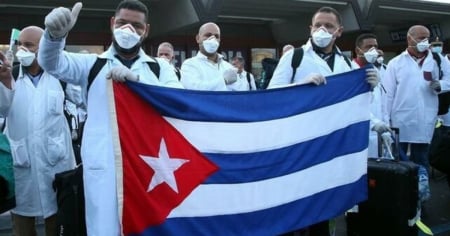
At least five Cuban doctors have recently left the regime's official mission in the Italian region of Calabria, in a wave of departures that reignites concerns about the working conditions imposed by Havana on its health professionals abroad.
One of the most visible cases occurred in Vibo Valentia, where an orthopedic surgeon switched from the public hospital Jazzolino to the private clinic Villa dei Gerani in search of better working conditions. The clinic confirmed that the doctor was hired with all the necessary documentation, supported by an Italian regulation that allows practice without title validation until 2027.
However, this case is not isolated. According to Italian media such as Il Vibonese and LaC News24, other doctors have left their positions in public hospitals in Corigliano Rossano, Paola, and Cetraro, with some not even returning after their vacations.
Others, according to reports, emigrated to France or Spain, while one married a colleague from Calabria, a decision that could prevent him from returning to Cuba forever.
Beyond the silent exodus, the controversy centers on the conditions under which these doctors provide services in Italy. Although the agreement signed between the Calabria region and the Cuban Medical Services Commercializer (CSMC) stipulates a salary of 4,700 euros per month, the doctors only receive about 1,200 euros. The remainder, approximately 3,500 euros, is retained by the Cuban regime.
A study by CubaNet revealed that, after deductions and state control, professionals barely receive 22% of the gross base salary, and between 60% and 71% of overtime is also confiscated by the CSMC.
This is compounded by contractual clauses that limit freedom of association, confidentiality, and even the ability to marry or travel freely, all while facing surveillance in their social networks and private lives.
Desertion has sparked a political storm. Ernesto Alecci, regional advisor for the Democratic Party, submitted an inquiry to the president of Calabria, Roberto Occhiuto, demanding transparency regarding how many doctors remain active, how many have left the mission, and whether there are plans to review the contractual conditions governing the bilateral agreement.
The former president of the Regional Council, Domenico Tallini, went further: he demanded the cancellation of the agreement with Cuba and suggested reallocating the more than 150 million euros assigned to the program until 2027 to the hiring of young Calabrian doctors. “Perhaps the Cuban doctors decided to leave because they couldn’t stand paying 2,500 euros a month to Havana?”, he joked, emphasizing the unfair and oppressive nature of the scheme.
Unauthorized access and ideological control
Tallini also reported that the Italo-Cuban association Sierra Maestra, aligned with the island's regime, disclosed confidential information about the performance of doctors in Calabria without the authorization of the Regional Health Department.
The report mentioned over 104,000 consultations and more than 7,000 surgeries, but it used the ambiguous term "participated," which raises questions about whether the procedures were performed directly by Cubans or if they simply assisted as helpers.
“The difference between participating and executing is key. If they only attended, then the Cuban experiment is nothing more than an expensive internship,” Tallini stated.
For many, the medical mission represented an opportunity to escape state control. What began as an international contract ultimately opened the doors to Europe for professionals trained under a regime that monitors them and seizes a significant portion of their salary. The streets of Calabria, once a professional refuge, have also become the stage for their liberation.
In the story of these five doctors, and those who may follow in their footsteps, vocation, the desire for freedom, and the rejection of a system that turns its most qualified professionals into diplomatic tools at the service of the State intertwine.
Frequently Asked Questions About the Desertion of Cuban Doctors in Italy
Why are Cuban doctors deserting the mission in Italy?
Cuban doctors are deserting in search of better working conditions and greater personal freedom. The conditions imposed by the Cuban regime include withholding most of their salaries and restrictions on their freedom, which has led many to leave their positions in search of better opportunities in Italy and other European countries.
What salary do Cuban doctors really receive in Italy?
Although the agreement establishes a salary of 4,700 euros per month, Cuban doctors only receive around 1,200 euros, as the Cuban regime retains the rest of the money. This retention is justified by tax deductions that lack legal backing, leading to criticism regarding the labor exploitation of these professionals.
Is it legal for the Cuban regime to withhold part of the salary of doctors on international missions?
Legally, contracts in Italy are signed directly with the regional health system, and salaries are deposited entirely into the doctors' accounts. However, in practice, the Cuban regime imposes a dual employment system that forces them to transfer a significant portion of their income to the Cuban Medical Services Marketing Company (CSMC), which lacks legal backing under European and international labor rights regulations.
What measures are being taken in Italy in response to the desertion of Cuban doctors?
The desertion of Cuban doctors has caused a political storm in Italy, with calls for transparency regarding the agreement with Cuba. Parliament members and human rights organizations are demanding a review of the contractual conditions and an audit of the public money allocated to these contracts, given the reports of labor exploitation.
Filed under: