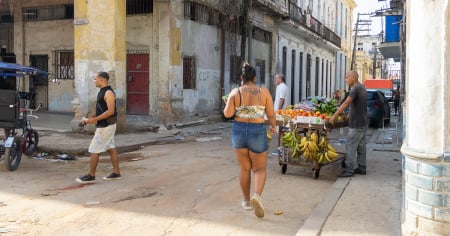
The creator Sheyla Reyes (@sheyreyes032) put into words what millions experience every day in Cuba. Her video went viral and sparked a conversation filled with comparisons, criticisms, and resignation.
In a recent video posted on her account, she candidly showcased the daily challenges faced by many families on the island: food that is not always available, power outages that disrupt everything, insufficient transportation, and expensive, unstable internet.
In the recording, which has garnered thousands of interactions, Reyes explains: “The food isn’t what you want to eat, but what is available that day, one day you have oil but no rice, the next you have rice but no oil, and when you have everything, there’s no electricity, and you can’t cook.”
Regarding the power outages, he adds: “You could be cooking, taking a shower, or just watching a soap opera, and boom, it’s gone, and of course, the internet goes out with it.”
El transporte tampoco se salva: “Moverse es una odisea… y si vas en una máquina, prepárate para soltar la mitad de tu salario”. Y sobre la conectividad: “El internet es caro, lento y se cae, pero aún así lo pagamos porque es la única forma de poder estar conectada con el mundo”.
The video ends with a message that seems to explain the daily life of many: “Living in Cuba is not easy, but Cubans have something that is unmatched—the ability to adapt and move forward.”
The TikTok quickly surpassed 6,000 reactions and over 160 comments. Most were not surprised, but they did engage in debate. “In Venezuela, we’re almost the same, but we have to survive,” said one user. Others disagreed: “I think I live in a different Venezuela… we’re not that bad.”
Criticism of complacency was not lacking: "It is because of our ability to adapt and keep moving forward that Cuba is in its current state," wrote one user. Another was more direct: "That's not ability, it's complacency... there should have been an evolution, and that regime should have been overthrown by now."
There was also sarcasm: "Doesn't anyone talk about that in Cuba? That's the only thing that gets talked about," and naive questions: "So you can't come to Cuba?" or "How do they manage to live there?"
The issues mentioned by Sheyla sadly characterize daily life in Cuba. A basic grocery purchase can cost more than 10,000 pesos, four times the minimum wage, and still not include meat.
Blackouts exceed 16 hours a day in some provinces, due to a lack of generation and breakdowns in key plants.
Transport offers no relief either: national trains are delaying departures due to a lack of locomotives, and transfers in private taxis are prohibitive for most.
Others from Cuba or foreign voices have already denounced the suffering of Cubans; such was the case of Spanish youtuber Juanjo Dalmau (@jdalmau_), who documented his stay on the island where “you don't choose what you want to eat, you survive with the little that is available”.
Frequently Asked Questions about Daily Life in Cuba
How does food scarcity affect Cubans?
The food shortage in Cuba forces citizens to adapt to what is available each day. Food is not what you want to eat, but rather what shows up. This means that one day you might have oil but no rice, and the next day it could be the other way around. Furthermore, when they manage to gather all the ingredients, they often cannot cook them due to blackouts.
What are the main issues with the electricity supply in Cuba?
In Cuba, power outages are frequent and prolonged, lasting up to 16 hours daily in some provinces. Power outages disrupt everyday activities such as cooking, bathing, or simply watching television, and they also impact internet connectivity. The scarcity of fuel and the poor condition of thermal power plants exacerbate the country's energy crisis.
What is transportation like in Cuba and what challenges do Cubans face?
Transportation in Cuba is insufficient and expensive. Getting around is an odyssey and taking a private taxi can consume half of a monthly salary. The lack of locomotives causes delays in national trains, further complicating the mobility of citizens on the island.
How does the economic situation affect professionals in Cuba?
In Cuba, even professionals such as doctors, teachers, or engineers face economic difficulties. The salary is not enough to meet basic needs, forcing many to seek alternatives in the informal market, which is also penalized. The majority of professionals cannot support their families solely on their salary.
Filed under: