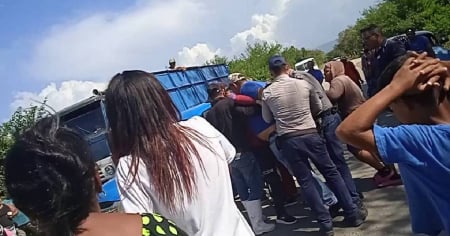
The Cuban regime has requested sentences of three to seven years in prison for 16 citizens from the province of Granma who participated in the peaceful protests on March 17 and 18, 2024, when thousands of Cubans took to the streets in various cities across the country demanding food, electricity, medicine, and a dignified life.
Julio César Vega, activist of the Patriotic Union of Cuba (UNPACU) and political prisoner, denounced from prison that these prosecutorial requests aim to instill fear, stated the independent media CubaNet.
“They want to frighten everyone who, like them, demands a constitutional right”, he stated in an audio released by the Cuban Observatory of Human Rights.
The March Protests, considered by Cubalex to be the climax of a series of citizen mobilizations, erupted due to the deep economic crisis, the endless blackouts lasting over 15 hours, and the ongoing scarcity of food and medicine that continues to overwhelm Cuban families.
The protests began in Santiago de Cuba and spread to Matanzas and Sancti Spíritus, as well as Granma, being suppressed with arrests, internet outages, and threats to the families of the participants.
More than a year after these events, those involved are facing severe prosecution requests without procedural guarantees. Among them, Dalis Zamora Rondón could receive a seven-year prison sentence; René Aguilera Aguilar, six years; Mario Luis Espinoza Cedeño, five; and other activists face similar penalties, including restrictions on freedom and house arrest.
"All [were condemned] for merely demanding their rights to a normal, stable, and healthy life, tired of so much desperation, so much hunger, and so much evil promoted by the regime," Vega emphasized.
This week it was reported that the Cuban Prosecutor's Office also requested sentences of up to nine years in prison for peaceful protesters who participated in civic demonstrations in Encrucijada, Villa Clara, where they protested on November 7, 2024, against the endless blackouts that have been disrupting daily life across the country for several years.
Armed only with pots and their voices, they shouted slogans like "Turn on the electricity!" and "We want electricity!". The result has been up to nine years in prison, as reported on Friday by the organization Cubalex.
Yandri Torres Quintana and Rafael Javier Camacho Herrera are facing nine years; José Gabriel Barrenechea Chávez, six years; Rodel Bárbaro Rodríguez Espinosa, five years; Yuniesky Lorences Domínguez, four years; and Marcos Daniel Díaz Rodríguez, five years of freedom restriction.
The accusation against Barrenechea, a well-known Cuban writer, goes beyond the moment of the protest; it is also based on his “behavior on social media,” his political ideas, and even his “relationships with morally questionable individuals.” A punishment for thinking differently, disguised as legality.
In July 2025 alone, 845 protests were documented across the country, a 38% increase compared to the same month the previous year, of which 209 involved direct confrontations with the political police, according to the Cuban Conflict Observatory.
A report from the organization emphasizes that repression has now become a constant rather than an exception. Throughout July, neighborhoods such as Guanabacoa and El Diezmero witnessed pot-banging protests, street blockades, and clashes with riot police, all motivated by power outages lasting up to 30 hours, rampant inflation, food shortages, and a crumbling healthcare system.
Among the factors that have ignited public outrage are also the official statements denying the existence of homeless individuals, the rising cost of the basic basket, which exceeds 90,000 pesos per month, and the increasing number of feminicides and deaths in police custody.
Frequently Asked Questions about the Suppression of Protests in Cuba
Why is the Cuban regime seeking prison sentences for peaceful protesters?
The Cuban regime seeks to instill fear and criminalize social discontent by requesting prison sentences for peaceful protesters. These actions are seen as an attempt to suppress citizen protests demanding basic rights and a dignified life amid a deep economic and social crisis in the country.
What are the causes of the protests in Cuba?
The protests in Cuba have been driven by the economic crisis, prolonged blackouts, shortages of food and medicine, and the lack of decent living conditions. The population takes to the streets to demand solutions to these issues, which have been exacerbated by the government's management.
How has the Cuban government responded to the protests?
The Cuban government has responded to the protests with repression, arbitrary detentions, internet shutdowns, and threats to participants. Furthermore, it employs propaganda campaigns to project an image of calm and control, while silencing critical voices and criminalizing the demonstrators.
What is the current human rights situation in Cuba?
The human rights situation in Cuba is critical, with an increase in judicial repression against peaceful protest and the criminalization of political dissent. Human rights organizations report that the regime uses the penal system to punish those who express opposition to government policies.
Filed under: