
Related videos:
At 10 years old, Evian David Herrera Almeida has never known life in a home due to a degenerative neuromuscular disease he suffers from: since his birth, he has remained hospitalized at the José Luis Miranda Pediatric Hospital in Villa Clara, a situation his father, Yenis Herrera Rodríguez, describes as an injustice and a sign of abandonment by the Cuban authorities.
In recent days, Herrera has revisited her complaint on social media, highlighting the indifference of government authorities and demanding a concrete solution that would allow her son, for the first time in his life, to leave the hospital environment and experience the warmth of a home.
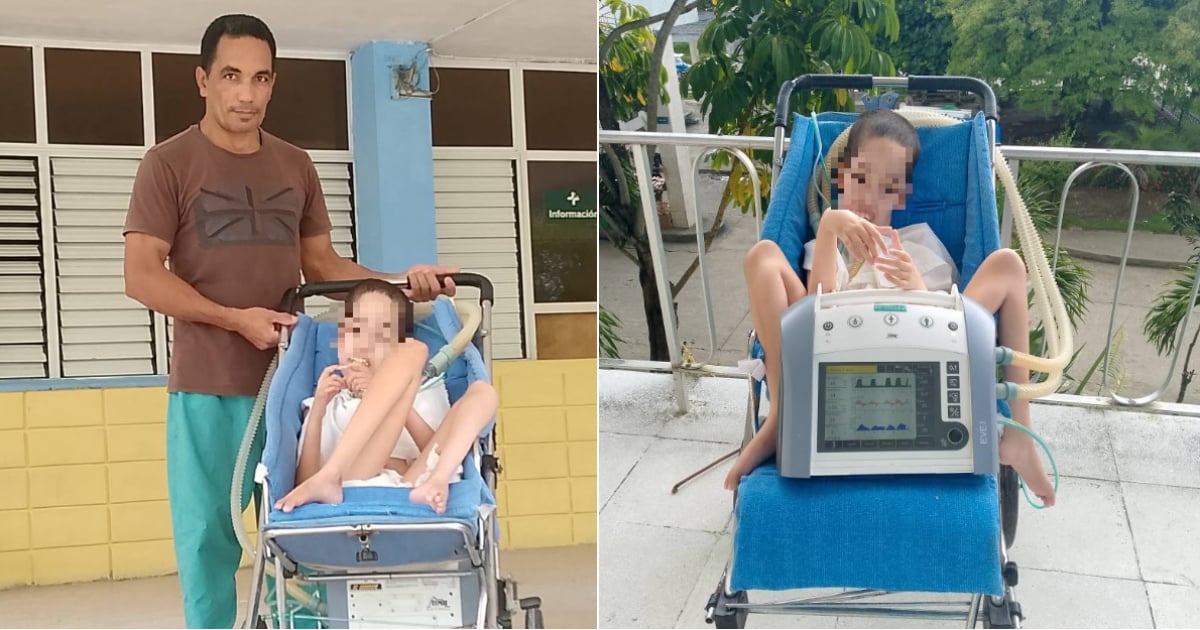
"Today I once again turn to social media to desperately plead with you to help me continue raising my voice, because as a father, I will not tire of demanding my child's rights," wrote Herrera, who shared images of the little one who apparently is connected to a respirator.
Her complaint is not new, but it is more urgent: she claims to have knocked on all possible doors in the province without obtaining real solutions, while seeing other children with similar conditions already being relocated to their homes with institutional support.
"It is proven that there are solar panels and air conditioners... I don’t want any more lies. My child needs to know what the warmth of a family home feels like. He deserves it, like everyone else, as at just 10 years old he has never experienced it," he lamented.
In previous posts, the father has reported discrimination in the handling of his case: “Other children in the same condition have been given priority and have arrived much later than him. They have received support from high-ranking officials, but I have not received any support. They have mocked me and my son as they pleased," he wrote, naming the authorities of Villa Clara, with no responses so far.
Evian was born with a medical condition that requires specialized technical assistance, but his father assures that with basic equipment—such as stable electrical power, climate control, and certain devices—he could live at home without risk.
"I only ask the government to allow me to be with my son at home. Is it too much to ask after ten years?" he expressed in one of his recent posts.
Yenis has also directed her complaint to the Cuban president himself, Miguel Díaz-Canel, due to the inaction of the provincial officials.
"I demand that Miguel Díaz-Canel Bermúdez do something since his subordinates have not, if he deigns to do so," he wrote.
The father's pain goes beyond institutional criticism; it is intertwined with an anguish accumulated over years of solitary struggle.
"Today, when despair and pain once again touch the heart of a desperate father, I ask the government of this country to help me bring my son home," he wrote.
Her insistence is unyielding: “My child deserves to know what it is like to live in a family, to feel love beyond a medical room. I am not asking for luxury, I am asking for dignity.”
Evian, who is already walking through the hospital corridors and is regularly exposed to the environment, as shown by his father in shared images, has spent ten years within four clinical walls, never having experienced sleeping in his own bed, watching television at home, or simply sharing a meal with his family.
The case of this child, who could have remained overlooked in yet another bureaucratic file, has transformed into a sustained cry that resonates from social media, driven by a father who refuses to accept resignation.
Yenis Herrera not only demands a solution: she demands respect, accountability, and justice for her son.
Although painful, this is not a reality that has never been seen in Cuba, and many times it finds a solution in solidarity, not in the regime's management.
Marielys Pérez, mother of little Ahittana, who suffers from Lennox-Gastaut syndrome, expressed her gratitude to those who, last March, made it possible to acquire a home to provide better living conditions for her child.
Ahittana, due to her illness, needs to be close to the Pediatric Hospital of Pinar del Río because of the constant care and attention her condition requires.
In a video shared on her social media, Marielys excitedly showed the new home, mentioning the necessary adaptations to ensure her daughter's well-being.
"I want to thank you all from the bottom of my heart because without you, we wouldn't have been able to make sure Ahittana has her little house to leave the hospital," expressed Marielys, acknowledging the efforts and donations of those who joined her cause.
The new house has features that will allow for the creation of a suitable space for Ahittana, including a room that can be climate-controlled to meet her needs.
The mother also emphasized the importance of this home in her daily life, as it will facilitate the use of medical equipment and provide a more comfortable and safe environment for her daughter.
This gesture of solidarity demonstrates how collective support can transform a family's life in times of extreme difficulty, paving a path of hope for those struggling against rare diseases under challenging conditions.
Days before, Pérez posted an emotional message on his social media expressing his deep gratitude.
The story of this Cuban mother is a testament to unbreakable love and sacrifice. In an effort to cover her daughter's medical expenses, she was compelled to sell her hair, showing the lengths a mother will go for the well-being of her child.
In addition to this act of generosity, she has sought help on various occasions to ensure her daughter's health. In March 2024, she requested support to obtain a ventilator, which is essential for the child's stability, facing the harsh reality of shortages in Cuba.
The struggle did not end there. In May of the same year, she once again appealed for solidarity to acquire an essential medical device for her daughter. Through social networks and media, she requested support to purchase equipment that would ensure her well-being, highlighting the difficulties faced by many Cuban families in accessing vital medical supplies.
Her story is a reflection of the resilience and love of a mother who, despite the obstacles, continues to fight tirelessly for her daughter's life.
Frequently asked questions about the situation of the healthcare system in Cuba and the case of Evian David Herrera Almeida
Why has Evian David Herrera Almeida spent his entire life in a hospital?
Evian has spent his entire life in the José Luis Miranda Pediatric Hospital due to his medical condition, which requires specialized technical assistance. Although his father, Yenis Herrera Rodríguez, claims that he could live at home with basic equipment, the Cuban government has not provided the necessary conditions for his transfer.
What has Evian's father done to try to get his son out of the hospital?
Yenis Herrera Rodríguez has repeatedly reported the situation through social media and has attempted to contact various authorities in the province of Villa Clara, demanding a solution so that her son can live in a home. However, she has not received concrete responses or effective solutions from the Cuban government.
Are there other similar cases in Cuba where children cannot return home due to a lack of resources?
Yes, there are several similar cases in Cuba. For example, the girl Yeilin López Labrador cannot return home due to constant blackouts and the lack of a solar panel to ensure stable electricity for her medical equipment. These cases highlight a severe crisis in the country's healthcare system and energy infrastructure.
What demands has Evian's father made to the Cuban president, Miguel Díaz-Canel?
Yenis Herrera Rodríguez has directed his demands straight to President Miguel Díaz-Canel, urging him to intervene in order to resolve the situation concerning his son, as provincial officials have not taken action. The father demands respect, justice, and a solution that allows Evian to live in a home.
Filed under: