
Related videos:
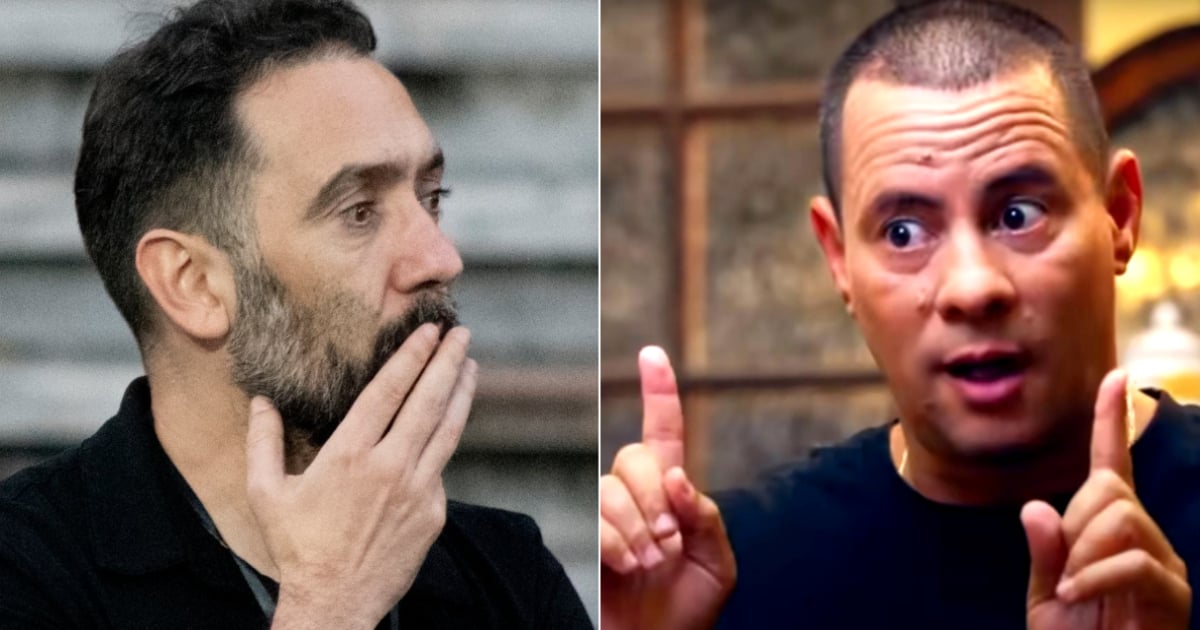
The recent interview of Israel Rojas in La Joven Cuba, where the leader of Buena Fe spoke about reconciliation, dialogue, and the possibility of a pardon for some of the prisoners from 11J, not only unleashed a wave of criticism and skepticism among Cuban civil society but also triggered a swift response from the regime's ideological apparatus.
This came through an article published on Cubadebate and signed by the Spanish communist Carlos González Penalva, who acts as a joyful spokesperson for official dogmatism, dressed up as a political analyst and expert in communication and social networks.
Titled 'The Trap of Equidistance', the text not only seeks to discredit La Joven Cuba, but also issues a subtle warning to figures like Rojas and to any attempts at dialogue with sectors outside the control of the Communist Party.
The ideological operation is clear: although Rojas did not directly question the regime, his mere presence in a critical and independent space was seen as a dangerous concession. González Penalva, in the name of revolutionary purity, takes it upon himself to remind that even the nuances will be monitored.
A controlled false opening
The contradiction between the falsely conciliatory tone of Israel Rojas and the dogmatic reaction from Cubadebate is not coincidental, but rather part of a broader strategy by the Cuban regime, which aims to prolong the fierce control it has maintained over public discourse for decades, by simulating an "opening" to debate on social media and independent spaces.
Both speeches, although they appear to be opposing, serve complementary functions: Rojas presents a more amiable and "dialogic" face, useful for improving the government's image in a society weary of repression; González Penalva, from Cubadebate, acts as the stern voice that points out the boundaries of permitted dissent.
The scoundrel pretends to be open; the ideological colonizer draws the red line and raises the banners of a dogma of which he claims to be a champion. In reality, what disturbs the regime is not the content of what Rojas said—which was carefully ambiguous and tepid—but the platform from which he said it: an independent media outlet that many attribute to having strategic origins designed by the very State Security of the totalitarian regime.
As González Penalva pointed out in an inquisitorial tone, “in politics [...] there is no innocent dialogue when the script is written by the adversary.” In other words, the problem, seemingly, is not what you say, but where and with whom you say it. For the government and its supporters, anything that escapes direct state control is potentially counter-revolutionary.
"Equidistance" as Heresy
With poorly digested Gramscian rhetoric, González Penalva accused La Joven Cuba of staging a false symmetry between "besieged and aggressor," and of being part of a supposed international strategy to strip the Cuban public space of "revolutionary" content.
The key term of their attack is "equidistance," which they define as a form of "soft counter-revolution," cloaked in pluralism and tolerance, but functional to the dismantling of socialism.
This speech is, in itself, profoundly authoritarian: it challenges not just the open enemy, but nuance, doubt, and conversation. For González Penalva, criticism is only legitimate if it occurs "within the revolutionary process".
And by "inside," it does not refer to a cultural or identity belonging, but rather to a political submission to the Communist Party. What is at stake is not an ideological debate, but a demand for unconditional loyalty.
The paradox is that such positions do not even represent a clear defense of the socialist ideal, but rather its dogmatization. They are fossilized ideologies, incapable of renewal or dialogue, confusing criticism with betrayal, and reform with conspiracy. One can expect this when it comes from a stubborn communist and a resentful militant of the failed political project of Izquierda Unida in Spain.
In his crusade against pluralism, González Penalva reveals what the regime truly fears: that someone will propose a change from within, without accepting the impositions of the so-called "revolution" and its exclusionary "inside and outside."
With the arrogance of a conqueror, the Spanish communist offers lessons to the Taínos on how to conduct Cuban social dialogue, who the valid actors are, and when they can be allowed to speak. His "erudition" serves the official narrative and a supposed progressive "cause" that Havana has made the banner and talisman of the dictatorship.
The strategy of the external enemy
As is often the case in official speeches, the article relies on the theory of the external enemy to discredit everything that is not under its control.
González Penalva accuses La Joven Cuba of receiving financial support from the Norwegian Embassy and being part of a global network designed by the U.S. and its allies to promote an "alternative civil society" aimed at fostering capitalist restoration on the island. He mentions the NED, USAID, and "bourgeois liberalism" as part of the enemy machinery.
This type of rhetoric deliberately ignores the real reasons behind public discontent: repression, hunger, lack of freedom, economic collapse, and mass emigration.
There is not a single mention in your article of the prisoners from 11J, nor of Decree Law 35, nor of the multiple violations of freedom of expression, nor of the systematic censorship of independent media. Instead, it talks about embassies and Gramsci.
The censor disguised as a philosopher
González Penalva presents himself as a defender of critical thinking, but what he actually does is replicate the old role of the censor who, in the name of "sovereignty," imposes the limits of legitimate thought.
By denouncing that La Joven Cuba "artificially equates the defender of the Revolution with its strategic adversaries," what it proposes is that there should be no room for disagreement within the revolutionary field.
Their concern is neither the truth nor sovereignty, nor the right to debate. Their obsession is control. They say it plainly: “Defending the Cuban Revolution today means [...] not giving away ground. It’s not about censorship, but about unmasking.” Yet, what their article does is exactly that: censoring, cloaked in the guise of "tolerant openness."
The farce of the opening
Both the statements from Israel Rojas and the "militant" response from Cubadebate are part of a simulation strategy.
The regime needs to appear as though it listens, engages in dialogue, debates, and allows dissent, but only if it occurs on its terms, under its watch, and with actors that fit its narrative. Otherwise, the apparatus reacts, as it did this time, through its network of foreign ideologues.
Carlos González Penalva writes not only as an activist but as part of a communication structure that advises, justifies, and shields the discourse of the regime of Miguel Díaz-Canel. His insistence on warning against “the carefully staged scene” reveals that even the most innocuous gestures, such as an interview, can be perceived as threats if they deviate from the official script.
And it is that power, when it fears dialogue, is no longer defending an idea or social project: it is defending its interests and its continuity at any cost.
Filed under: