
Related videos:
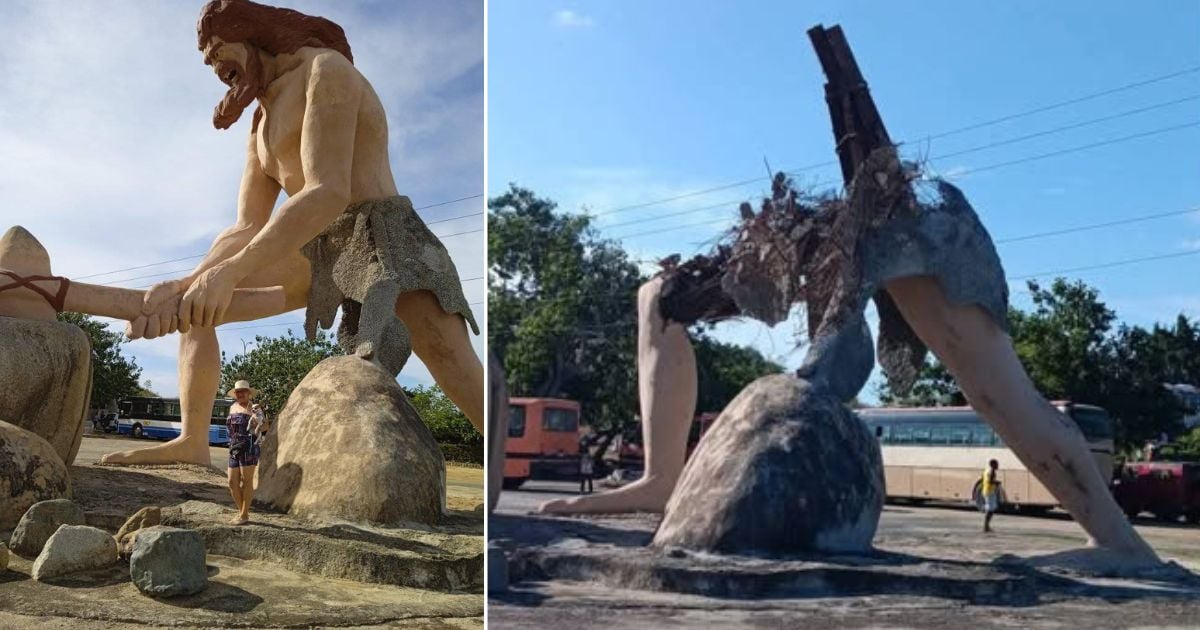
The province of Santiago de Cuba loses one of its most recognized monumental pieces: the sculpture of the “Stone Man” or “Cromagnon Man,” located in the Valley of Prehistory at Baconao Park. This event symbolizes the decline of the regime, unable to sustain and preserve its cultural and tourist heritage.
According to what was reported this Saturday on Facebook by user Aris Arias Batalla, the structure, which stands about 12 meters tall and was built by prisoners in the 1980s, was removed after facing progressive deterioration. It would have reached 45 years of age in 2025.
The author lamented that, more than the effects of the climate, the true reason for the disappearance was the lack of maintenance and restoration.
"The stone man became increasingly complex, and his structural condition deteriorated even further, leading to a general metastasis. Someone decided on his total destruction, something that could have been salvaged with special and multidisciplinary treatment," wrote Arias, who recalled that the sculpture was a symbol for both national and foreign visitors.
The Valley of Prehistory, located in the Gran Piedra area –designated as a National Geopark of Cuba in April 2024– and part of the Baconao Biosphere Reserve, was once one of the main tourist attractions in Santiago de Cuba.
In 2023, it received investments for infrastructure improvements, although no specific work on the sculptures was recorded.
The removal of the “Man of Stone” leaves a visible void in the park's landscape and in the memories of those who took pictures beside it.
"My deepest condolences to all who knew and admired Cromañón," Arias concluded in his message, ironically describing the pain that overwhelms many Santiago residents who, in recent years, have witnessed the attractions of Baconao Park deteriorate due to neglect and abandonment.
However, this case of neglect is not unique in the country or in the province. Just a few days ago in Santiago de Cuba, images circulated of a barge that once served as a recreational center, sinking in the bay of the city, visible to all.
Frequently asked questions about the disappearance of the sculpture "Hombre de Piedra" in Parque Baconao
Why was the sculpture of the "Man of Stone" removed from Baconao Park?
The sculpture of the "Stone Man," a symbol of Baconao Park, was removed due to a progressive deterioration caused mainly by a lack of maintenance and restoration, rather than by the effects of the weather. This neglect reflects the Cuban regime's inability to preserve its cultural and tourist heritage.
What is the importance of Baconao Park in Santiago de Cuba?
The Baconao Park is considered one of the main tourist attractions of Santiago de Cuba, known for its Valley of Prehistory and the Great Stone, which is part of the Baconao Biosphere Reserve. Despite its significance, the park has suffered from neglect and a lack of investment in its sculptures and other infrastructure.
What other places in Cuba are at risk of deterioration due to lack of maintenance?
In Cuba, many heritage sites are in danger due to abandonment and lack of maintenance. Examples of this include the amusement park Isla del Coco in Havana, the Carlos Baliño Museum in Artemisa, and the old Hotel Venus in Santiago de Cuba. These places, among others, reflect governmental neglect and the economic crisis that hinders their proper preservation.
Filed under: