
Related videos:
The National Hurricane Center (NHC) confirmed on Monday the formation of tropical storm Erin in the eastern tropical Atlantic, located just west of the Cape Verde Islands.
In an update released on X at 11:00 a.m. EDT (15:00 UTC), the NHC published Advisory No. 1 regarding the system, which just hours earlier was a low pressure area with high development potential. Erin thus marks the official start of its monitoring as a tropical cyclone.
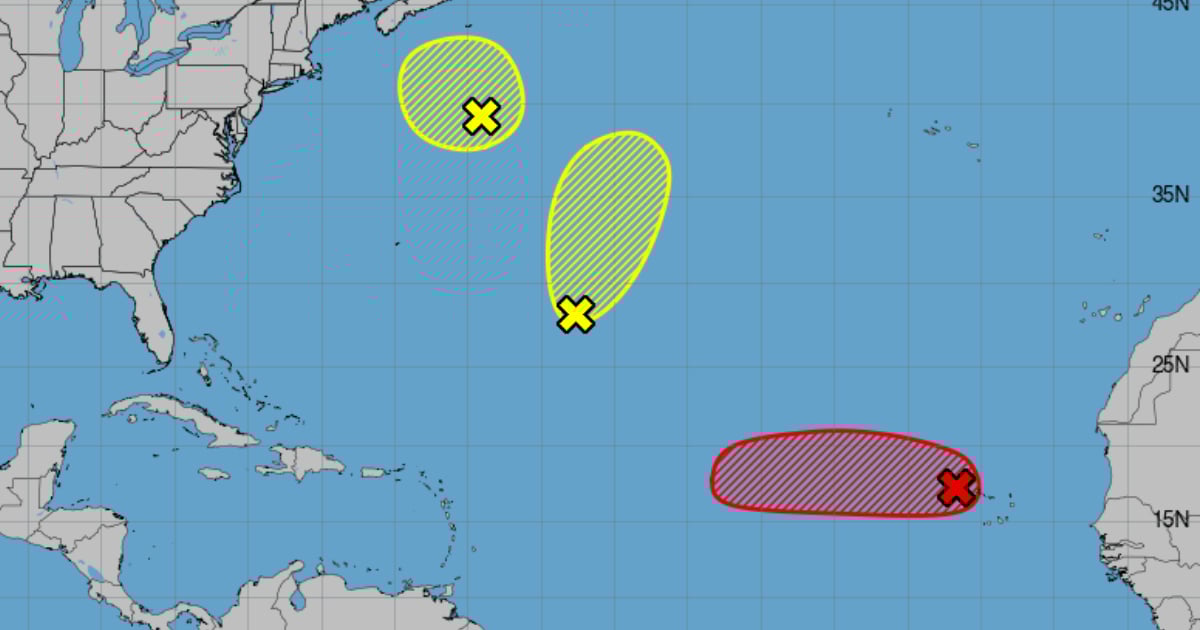
Previously, the NHC had stated that it was closely monitoring a low-pressure system located to the west of the Cape Verde Islands, with a 90% chance of developing into a tropical depression or tropical storm—initial forms of a tropical cyclone—within the next 48 hours.
In its bulletin at 8:00 a.m. (Eastern Time), the NHC detailed that the area of rain and storms had shown clear signs of organization and features a well-defined circulation.
If this trend continues, the system had warned that it would reach the status of a depression or tropical storm this morning, while moving west or west-northwest at speeds between 24 and 32 kilometers per hour over the eastern and central tropical Atlantic.
The islands of Cape Verde are experiencing intense rainfall and strong gusty winds this Monday, conditions that could persist throughout the day. Local authorities are advising residents to closely monitor official warnings.
The NHC is also monitoring other systems in the Atlantic. One of them is a weak trough over the central Atlantic, which has only a 10% chance of development in the next seven days.
The other is located in the northwest Atlantic, to the south-southeast of Nova Scotia, and is a non-tropical system with a low potential to become a cyclone before moving over cold waters.
The hurricane season in the Atlantic runs until November 30, and August marks the beginning of the peak activity period.
The Cuban Institute of Meteorology recently reported that the 2025 hurricane season in the North Atlantic is expected to be active, with the formation of 11 tropical storms anticipated for the remainder of the period, of which seven could reach hurricane status.
The forecast, updated on August 4th, warns of a high probability of impacts in the Caribbean and Cuba. According to the weather report, seven of the storms will develop in the Atlantic, one in the Gulf of Mexico, and three in the Caribbean Sea.
The probability of at least one hurricane forming in the Caribbean is 85%, while the risk of an Atlantic-origin hurricane entering this region is 70%.
Frequently Asked Questions about Tropical Storm Erin and the 2025 Hurricane Season
Where did Tropical Storm Erin form?
Tropical Storm Erin formed in the eastern tropical Atlantic, just west of the Cape Verde Islands. The National Hurricane Center (NHC) confirmed its formation and issued the first official advisory regarding this system.
What is the forecast for the 2025 hurricane season in the Atlantic?
The 2025 hurricane season in the Atlantic is expected to be active, with the formation of up to 19 named storms and 10 hurricanes. Ocean warming and the absence of the El Niño phenomenon are factors contributing to these forecasts.
What impact could tropical storm Erin have on the Cape Verde islands?
The Cape Verde islands are experiencing heavy rainfall and strong gusty winds due to tropical storm Erin. Local authorities advise the population to closely monitor official warnings to stay safe.
What is the probability of a hurricane forming in the Caribbean this year?
There is an 85% chance that at least one hurricane will develop in the Caribbean during the 2025 hurricane season. This high risk serves as a reminder for communities in the region to stay alert and prepared.
Filed under: