
Related videos:
The United States government made a strong accusation against the Cuban regime on Tuesday, holding it responsible for the loss of one of its last reliable sources of electricity and for the worsening blackouts that are suffocating the island.
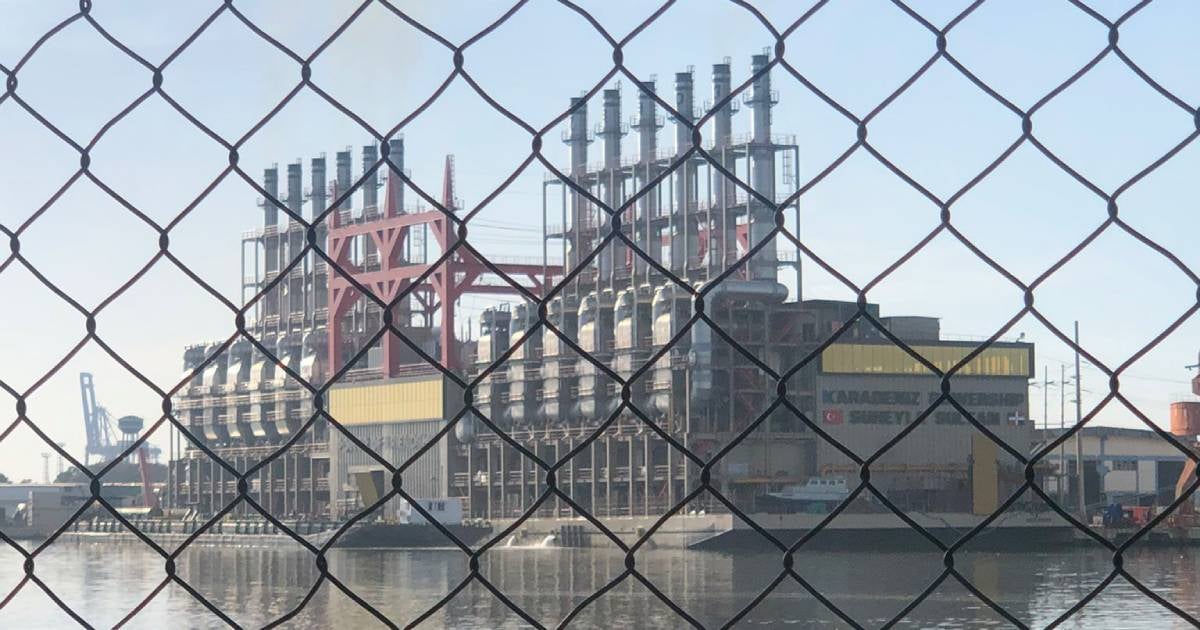
In a message posted on X (formerly Twitter), the Office of Western Hemisphere Affairs of the Department of State warned that “its officials have stolen so much that the regime no longer pays its bills”, and noted that the recent departure of the Turkish vessel Suheyla Sultan, capable of generating 240 megawatts, leaves Cuba with only one unit of this type, which is also partially out of service.
In the end, it is the Cuban people who pay the true price of the regime's criminal incompetence, enduring even more daily hours without electricity, emphasized the message.
At the peak of Turkish presence, Cuba had eight floating power plants from the company Karpowership. Today, only one remains, anchored in Regla, with 37 MW out of service due to a lack of fuel.
The Suheyla Sultan, the most powerful of them all, left the port of Havana last Wednesday, assisted by a tugboat and amid complete silence from the official press.
According to sources close to the operation, the real reason for the withdrawal was the Cuban government's failure to pay, despite the fact that in May the authorities denied that the ship would leave. Its departure coincides with critical days in the National Electric System.
A report that dismantles the official narrative
The statement from the Department of State is part of a recent report that directly assigns responsibility to the regimes of Cuba and Venezuela for their economic crises, rejecting the argument that they are due to sanctions or blockades.
In the Cuban case, the report highlights that in 2024 the government allocated more than 37% of the entire national investment to tourism and hospitality, more than eleven times the amount invested in health and education combined, while millions of Cubans faced shortages of medicine, food, and energy.
Washington accuses military conglomerates such as GAESA, FINCIMEX, and CIMEX of benefiting from these resources, in a scheme that prioritizes political control and the enrichment of the elite over collective well-being.
With no short-term alternatives, the old thermoelectric plants in the country are unable to meet the demand. The official plan for "energy sovereignty" based on national and renewable sources has yet to materialize, leaving the population trapped between oppressive heat, endless blackouts, and daily uncertainty.
While the regime avoids acknowledging the energy collapse, the ships depart and darkness, both literal and metaphorical, remains in Cuba.
Frequently Asked Questions about the Energy Crisis in Cuba and the Withdrawal of the Turkish Vessel
Why did the Turkish ship Suheyla Sultan withdraw from Cuba?
The tanker Suheyla Sultan was withdrawn due to the Cuban government's non-payment. Despite previous official denials, the lack of payment led to its departure, leaving the Cuban energy system in a critical situation, with only one tanker operational and partially out of service due to a lack of fuel.
What is the impact of the withdrawal of the barge Suheyla Sultan on the Cuban electrical system?
The withdrawal of the Suheyla Sultan barge worsens the blackout crisis in Cuba. This generator ship provided 240 MW to the National Electric System (SEN), and its departure leaves the island with an even greater energy deficit, intensifying the blackouts that are already affecting the country.
What measures has the Cuban government taken to address the energy crisis following the withdrawal of the tanker?
Despite the seriousness of the situation, the Cuban government has not implemented effective short-term solutions. Although there is a "energy sovereignty" plan that includes renewable energies, it has not significantly materialized yet, leaving the population with prolonged blackouts and without clear alternatives.
What has the United States government said about the energy situation in Cuba?
The United States government has accused the Cuban regime of criminal incompetence, holding it responsible for the energy crisis due to corruption and mismanagement. The U.S. administration has warned international investors about the risks of doing business in Cuba, emphasizing that the economic system is designed to benefit the regime and its associates.
Filed under: