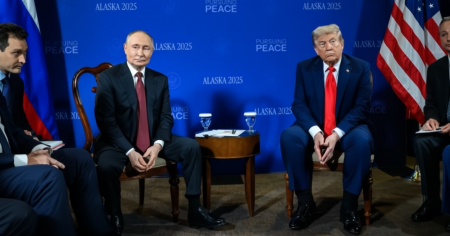
The President of Ukraine, Volodimir Zelenski, will travel to Washington next Monday to meet with Donald Trump at the White House, following the summit between the U.S. President and Vladimir Putin in Alaska, which concluded without any concrete progress on the conflict in Eastern Europe.
In a message released by Trump, the president stated that the best way to end the war is to reach a comprehensive peace agreement, rather than a mere ceasefire, which "often does not hold." Zelensky endorsed the initiative and confirmed that in his meeting with the Republican leader, he will seek to discuss ways to "end the deaths and the war."
The Republican also noted that if the talks on Monday succeed, it would pave the way for a future meeting with Putin to try to bridge differences.
European allies who participated in the series of phone contacts with Trump and Zelenski after the summit emphasized that any negotiations must respect Ukraine's sovereignty and territorial decisions. They also warned that the Kremlin continues to prolong the negotiations to buy time on the military front.
This will be Zelenski's first visit to the United States since the tense meeting on February 28, 2025, when Trump publicly accused him of being "disrespectful" during a meeting in the Oval Office.
Summit in Alaska: Trump and Putin show rapprochement without agreement on Ukraine
The summit this Friday between Trump and Putin in Anchorage, Alaska, was marked by tension and uncertainty regarding possible incentives from Washington to Moscow in exchange for progress in Ukraine.
The Russian leader landed on Friday at Joint Base Elmendorf-Richardson, where he was received by Trump amid a heavy military presence, with F-22 fighters and a B-2 stealth bomber flying overhead.
Although a private bilateral meeting was anticipated, it ultimately expanded to include high-level advisors. Russia was represented by Foreign Minister Serguéi Lavrov and advisor Yuri Ushakov, while the United States was represented by Secretary of State Marco Rubio and Special Envoy Steve Witkoff.
According to official sources, the White House had considered offering incentives to Moscow, such as new trade agreements or discussions on arms control, although without immediate results.
The meeting concluded with a brief press conference in which Trump admitted that “there is no agreement until there is an agreement” and reiterated that the outcome will depend on NATO and Zelenski.
Putin, for his part, called on Kiev and European capitals to act in a "constructive" manner and stated that lasting peace will require addressing what he referred to as the "root causes" of the conflict.
Analysts agree that, despite the willingness to engage in dialogue, the Kremlin is looking to buy time and avoid new sanctions, while in the United States, voices calling for increased military aid to Ukraine are growing in order to compel a negotiation on less favorable terms for Russia.
Filed under: