
Related videos:
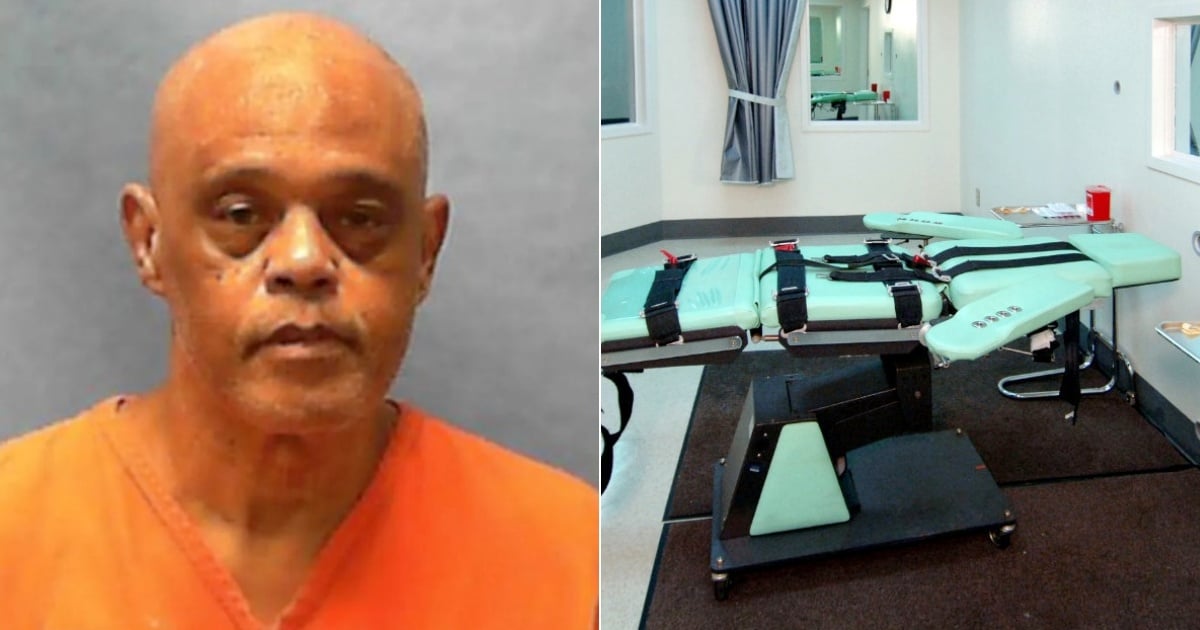
Florida executed Kayle Bates this Tuesday, a man convicted of kidnapping, assaulting, and brutally murdering a woman in 1982.
The execution, carried out by lethal injection at the Florida State Prison near Starke, took place at 6:17 PM (Eastern Time), closing a case that kept the victim's family waiting for justice for 43 years.
The crime that shook the Panhandle
On June 14, 1982, Janet White, an employee at an insurance office in Bay County, in the Florida Panhandle, was kidnapped by Bates while she was working.
According to the prosecutors, Bates took her to a wooded area behind the building with the intention of raping her. There, he fatally stabbed her and tore a diamond ring from her finger.
Bates was convicted of first-degree murder, kidnapping, armed robbery, and attempted sexual assault.
The crime shocked the community and became one of the most chilling cases in the region.
The brutality of the attack, coupled with the theft and the attempt of sexual assault, heightened the emotional impact for both the victim's family and public opinion.
An extensive judicial process filled with appeals
Since his sentencing, Bates has filed multiple legal appeals. His attorneys claimed irregularities in the process, including a lawsuit against Governor Ron DeSantis, arguing that the execution order signing procedure was discriminatory.
However, that lawsuit was recently dismissed by a judge.
Moreover, the legal team of Bates stated that during the sentencing phase, it was not properly considered that the defendant suffered from "organic brain damage."
However, this claim was rejected by the Florida Supreme Court.
Finally, last Friday, Governor DeSantis signed the execution order, and the state's Department of Corrections activated the protocol to carry it out.
The Last Hours of Kayle Bates
On the day of his execution, Kayle Bates was awakened at 5:15 in the morning.
He received three visitors: his daughter, his sister, and his brother-in-law.
According to the spokesperson for the Correctional Department, Ted Veerman, Bates declined a final meal and also declined to meet with a spiritual counselor.
Minutes before receiving the lethal injection consisting of three drugs—one sedative, one muscle relaxant, and one agent that stops the heart—he was asked if he wanted to say any last words. His response was simple: “no.”
The testimony of the victim's husband
Randy White, Janet White's husband, was present during the execution.
More than four decades after the crime, he was able to witness the fulfillment of the sentence.
In a subsequent press conference, visibly moved, he expressed his gratitude for the support received.
“I truly feel humbled by the outpouring of love and support from so many people who didn’t know either of us. I thank you from the bottom of my heart. It means more than you will ever know,” she declared.
He also expressed his gratitude to Governor Ron DeSantis for finally authorizing the execution, thus providing what he viewed as a delayed but necessary form of justice.
A year of record executions
The execution of Bates was the tenth carried out in Florida this year, setting a new record for the state.
On a national level, as of this Tuesday, there have been 29 executions in the United States.
According to data from organizations that monitor the use of the death penalty, at least nine more people are scheduled to be executed before the end of 2025 in seven different states.
In a span of just 30 days, the state of Florida has scheduled three executions, solidifying its position as the jurisdiction with the most executions in the United States this year.
In addition to the execution on July 31 of Edward J. Zakrzewski II and Kayle Bates this August 19, a third execution is still scheduled for August 28, that of Curtis Windom, which will raise the annual total of executions in the state to 11.
It is a figure that not only surpasses its own historical record - eight executions in 2014 - but also represents more than a third of the capital sentences in the entire country so far this year
A system that reduces waiting times
Most death row inmates in Florida spend decades waiting in the death corridor, but state authorities have expedited the appeal processes.
This strategy has been interpreted by analysts as a political maneuver aimed at reaffirming hardline positions on crime in a national context that is increasingly divided over the death penalty.
Florida not only leads in the number of executions in 2025, but it is also the second state with the most people on death row (278), surpassed only by California (585).
Paradoxically, it also holds the highest number of exonerations: 30 people sentenced to death have been subsequently declared innocent since 1973.
The lethal cocktail and the ethical debate
Florida uses a lethal injection protocol consisting of three drugs: a sedative, a paralytic agent, and a substance that stops the heart.
This procedure, although legal, has been questioned by medical experts and human rights organizations due to the risk of extreme suffering if not administered correctly.
Despite these criticisms, the state continues to employ this method as its legal standard for execution.
Protests and voices against
The wave of executions has sparked strong reactions from civil and religious groups. The organization Floridians for Alternatives to the Death Penalty (FADP) has launched campaigns calling for a suspension of executions, denouncing that “each execution dehumanizes us all.”
The Archbishop of Miami, Thomas Wenski, published an article strongly opposing the death penalty.
He argued that a life sentence without the possibility of parole represents a severe punishment, but one that is compatible with human dignity.
Wenski questioned whether a truly just society needs to resort to death as a means of justice.
Additionally, the Action Network organized a petition requesting clemency in the case of Zakrzewski, emphasizing that the jury would not have been able to impose the maximum sentence under current guidelines.
This resurgence of the death penalty in Florida contrasts with the national trend: support for capital punishment has fallen to one of its lowest levels since the 1970s.
A Gallup survey in 2024 revealed that only 53% of Americans support it, compared to peaks close to 80% in past decades.
Filed under: