
Related videos:
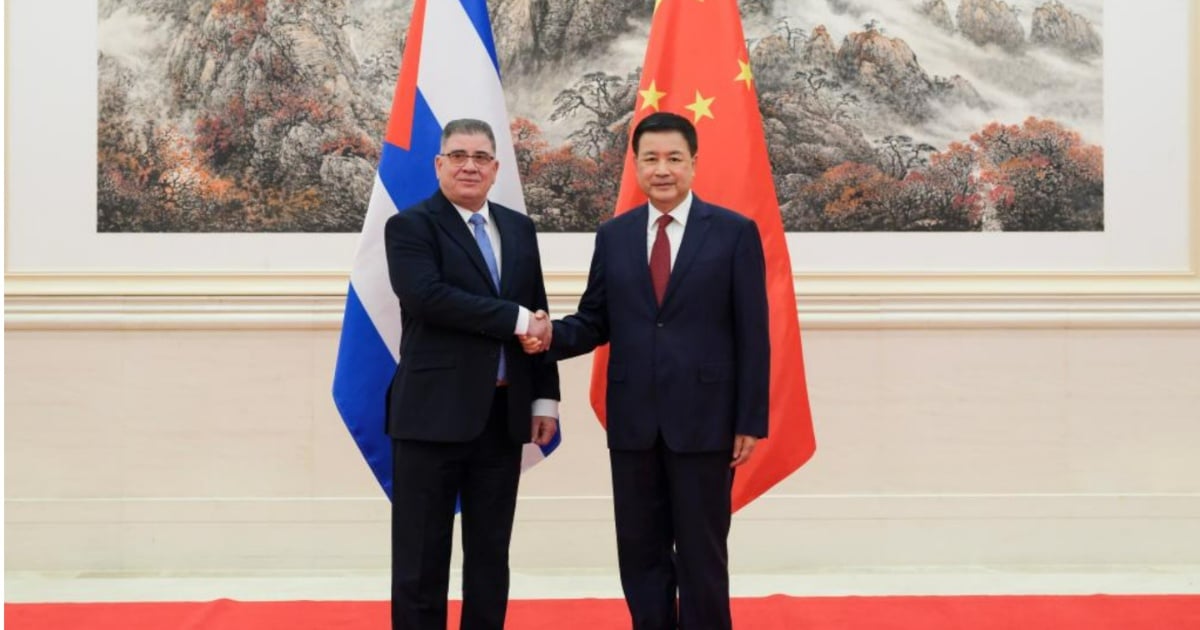
A meeting between the Interior Ministers of the Cuban and Chinese regimes took place last Friday in Beijing as part of Havana's efforts to seek support in "security and law enforcement."
The Chinese Minister of Public Security, Wang Xiaohong, conveyed to the Cuban Minister of the Interior, Lázaro Alberto Álvarez Casas, China's "readiness to work with Cuba to implement the important consensus reached by the leaders of both parties and countries," according to a report from the official Xinhua agency.
Wang also spoke about China's willingness to "further solidify the mechanism of the ministerial meeting, improve personnel exchanges, and enhance law enforcement capacity development."
Additionally, he expressed his willingness to "deepen practical cooperation in law enforcement and security, safeguard the security and interests of both countries, and make greater contributions to building a closer community with a shared future between China and Cuba."
For his part, Álvarez "expressed his country's willingness to further improve coordination and cooperation with China to jointly address security risks and challenges," the note concludes.
The Cuban regime has relied on its traditional allies for the purchase of equipment and training to suppress potential social unrest.
In addition, amid the structural crisis resulting from their disastrous management, Cuban leaders are seeking relief in China.
In June of last year, the Cuban government spoke of its intention to strengthen its alliance with China, to develop a "Community of Shared Future."
The statement came after a meeting between Foreign Minister Bruno Rodríguez Parrilla and Qiu Xiaoqi, China’s Special Representative for Latin American Affairs, who was visiting Cuba.
The presence of the representative of the Chinese Executive was part of the consensus reached between the presidents of both countries for the development of a Shared Future Community between Cuba and China, the Foreign Minister stated on the social media platform X, describing the exchange as "fruitful."
In May, Rodríguez participated in the V Ministerial Forum of China with the Community of Latin American and Caribbean States (CELAC).
Days earlier, the leader Miguel Díaz-Canel traveled to Russia, where he met with Chinese President Xi Jinping. There, he stated that relations between Cuba and China are in a "more solid" phase and called for "greater deepening."
Xi Jinping, for his part, offered the usual support: more cooperation, more "iron friendship," and a discourse of solidarity among socialist countries. He also reiterated his proposal to build a closer community between both governments as a model of collaboration for the Global South.
Frequently Asked Questions about Collaboration between Cuba and China in Security and Politics
Why is the Cuban regime seeking support from China for security and law enforcement?
The Cuban regime is seeking support from China to enhance "security and law enforcement" due to the structural crisis the country is facing. The Cuban government needs to strengthen its internal control mechanisms and sees China as a strategic ally to receive equipment and training. This collaboration also aims to jointly address the security risks and challenges that the regime faces amidst a disastrous management and growing internal dissent.
What does the "Community of Shared Future" between Cuba and China imply?
The "Community of Shared Future" is a concept promoted by Cuba and China to consolidate their strategic alliance, particularly in sectors such as biotechnology, alternative energies, and security. This alliance aims to deepen bilateral cooperation and present a united front against external pressures, such as those from the United States. In the context of an internal crisis, the Cuban regime sees this community as an opportunity to strengthen its international relations and gain economic and political support.
What is China's role in Cuba's energy crisis?
China is playing a crucial role in Cuba's energy crisis by donating equipment for photovoltaic solar parks. This joint project aims to add 120 megawatts to the Cuban national electric system, which is in a critical situation. Cooperation in solar energy is part of a broader effort by China to help Cuba diversify its energy matrix and reduce its dependence on fossil fuels.
Are there Chinese military bases in Cuba?
The presence of Chinese military bases in Cuba has been the subject of speculation and concern, especially in Washington. Although the Cuban regime denies the existence of foreign bases, the increasing presence of Chinese military delegations on the island reinforces suspicions about surveillance operations by Beijing aimed at the United States. This issue is part of the geopolitical tensions in which Cuba is immersed due to its alliances with China and Russia.
Filed under: