
Related videos:
The province of Santiago de Cuba is facing a critical situation due to a prolonged lack of rain, regarded as the worst drought in the last ten years, with serious impacts on water supply to the population and key sectors such as agriculture and livestock.
The information was published by the official newspaper Granma, which highlighted that the reservoirs in the region are at historical lows, with an average storage level below 30% of their capacity.
Some reservoirs barely exceed 10%, which necessitates extending water distribution cycles in several municipalities and implementing emergency measures.
In the city of Santiago de Cuba, supply cycles have extended to more than 20 days in some neighborhoods, increasing the discomfort of the population, although there are reports of some places where the service is even worse.
Meanwhile, in rural areas, the drought has drastically reduced the availability of water for human and animal consumption, as well as impacting grain, tuber, and vegetable crops.
Authorities from the National Institute of Hydraulic Resources (INRH) acknowledge that the rainfall deficit this season has exceeded the levels of previous years and that there are not enough reserves to ensure supply in the coming months if the rains do not improve.
The situation, deemed "the most difficult in the last decade" by specialists, coincides with the precariousness of the aqueduct system and the insufficient infrastructure to transport the available water, which exacerbates the direct impact on thousands of families in Santiago.
Meanwhile, measures for streamlining and increased control over water usage have been announced, although official reports do not specify immediate solutions for the accumulated deficit.
In several communities, there is an irony in the saying that “we have to wait for Columbus to see running water”, a phrase turned into popular sarcasm in the face of desperation.
The regime has recently acknowledged that the drought has led to an increase in water theft and diversion, as the residents of Santiago struggle to cope with increasingly long delivery cycles and inadequate services.
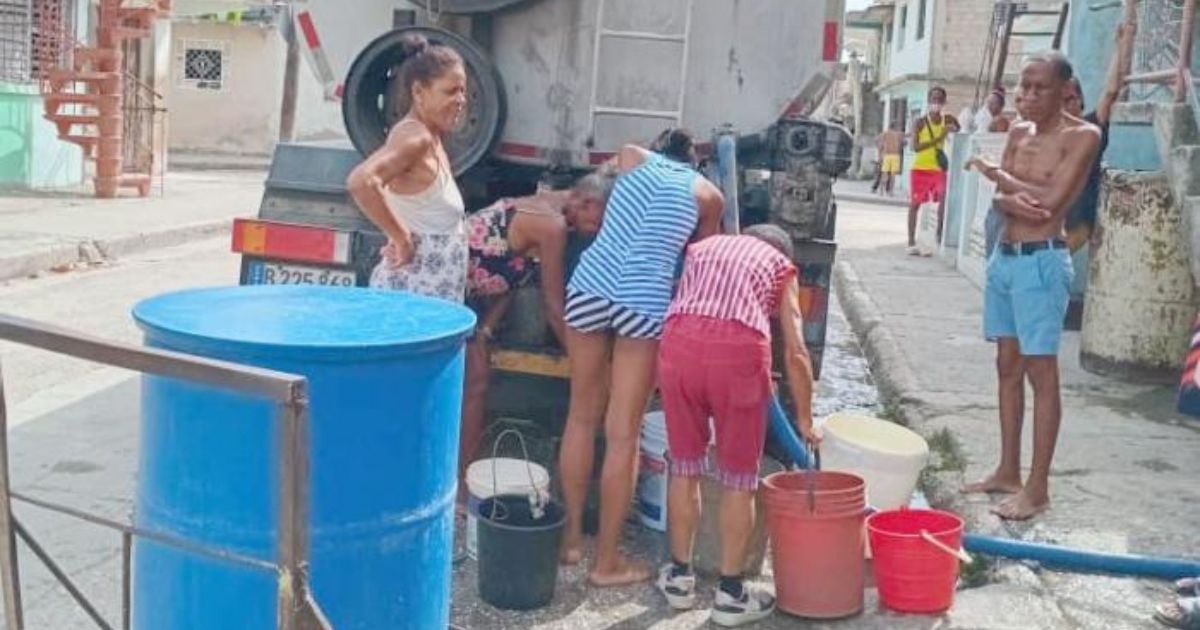
At the same time, images of families that run after a water truck to fill buckets have become the everyday portrait of the city.
Structural deterioration has also been highlighted in reports indicating that the hydraulic system is collapsed and lacks the capacity to ensure even the minimum distribution, even when there are specific reserves available.
This is compounded by uncertainty regarding forecasts, as even the predicted rains fail to alleviate the accumulated deficit in the reservoirs.
Frequently Asked Questions about the Drought Crisis in Santiago de Cuba
What is the current situation of the drought in Santiago de Cuba?
Santiago de Cuba faces the worst drought in the last decade, with reservoirs at historical lows and an extremely limited water supply. The lack of rainfall has resulted in a water deficit that severely impacts both the urban and rural population, as well as agriculture and livestock in the region.
How is the drought affecting the water supply in Santiago de Cuba?
The water supply in Santiago de Cuba has been severely impacted, with distribution cycles that can extend to more than 20 days without service in several communities. The city primarily relies on the Quintero system, which is currently operating below its capacity due to the decrease in flow from the main water sources.
What measures are the authorities taking to address the water crisis in Santiago de Cuba?
The authorities have implemented measures for rationalization, control of water use, and repairs at pumping stations. Additional pumping equipment and tankers are being used to alleviate the shortages, although these efforts have been insufficient to address the underlying problem. Improvements in infrastructure have been mentioned, but there are no visible immediate solutions.
What impact does the water crisis have on the population of Santiago de Cuba?
The water crisis has generated significant social unrest in Santiago de Cuba, with citizens facing serious difficulties in meeting basic needs for hygiene, food, and sanitation. The lack of potable water is especially critical in vulnerable areas, and desperation is growing due to the lack of effective solutions from the authorities.
Filed under: