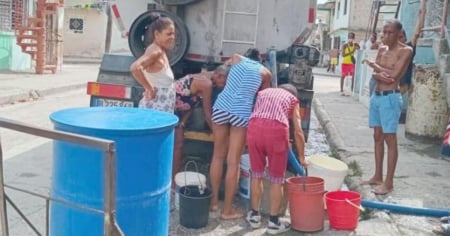
In the fascinating world of the euphemisms of the so-called "revolution," drought, leaks, and breakdowns no longer leave people without water.
No. What happens, according to the ever-creative Canal Caribe, is that "the little availability" of water in the supply sources is decreasing. Because of course, to say that there is no water or capacity to supply it would be an excessive honesty unbefitting the communication standards of the system.
During his latest report, Master Argelio Fernández —always punctual with his data, though somewhat distracted with language— stated, amidst technical jargon and circumlocutions, that more than 884,000 people in Cuba experience "restrictions" in water service.
But instead of speaking about "crisis," "emergency," or even "shortages," he chose this gem of official semantics: "tendency toward an increase in the impacts due to low availability".
What does that mean in plain language? That every day there are more people without water, more affected water collection works, and more provinces without a single drop. But don’t worry, fellow users of the supply network, everything is under lexical control.
The blame, as always, lies with the weather and the "blockade." It rains little, it's hot, and the "enemy" lurks. The drought, that counter-revolutionary circumstance, has been afflicting the island since "the beginning of the year," undermining all the brilliant strategies of the government of "continuity" led by Miguel Díaz-Canel.
But neither Argelio nor the official Cuban media dare to mention the impact of blackouts on supply, decades of disinvestment, state negligence, or the infrastructure that dates back to the colonial era. The problem is the lack of rain, not the lack of management.
Holguín, Santiago de Cuba, and Camagüey lead the disheartening ranking of water neglect, while the state media juggles words to avoid stating the obvious: there is no water, and even less so, solutions.
Because in Cuba's informational reports, a blackout is not a blackout; it's a "scheduled interruption." Inflation is not inflation; it's a "temporary price imbalance." And water is not lacking; it simply "increases its limited availability."
Once again, the state-run press fails to inform: it beautifies, conceals, and masks reality with a new language that would make Orwell blush. For the propagandists serving the regime, what matters is that confusion replaces information, and that the "creative resistance" flows through the pipes that they, the ones who have swimming pools and drink bottled water, have run dry.
As it dries up, little by little, the patience of the Cubans is wearing thin.
Filed under: