
Related videos:
The Cuban government defended its public health model and the so-called "international medical missions" this Monday at the United Nations General Assembly, amid growing criticisms from international organizations that have described these programs as a form of human trafficking and forced labor.
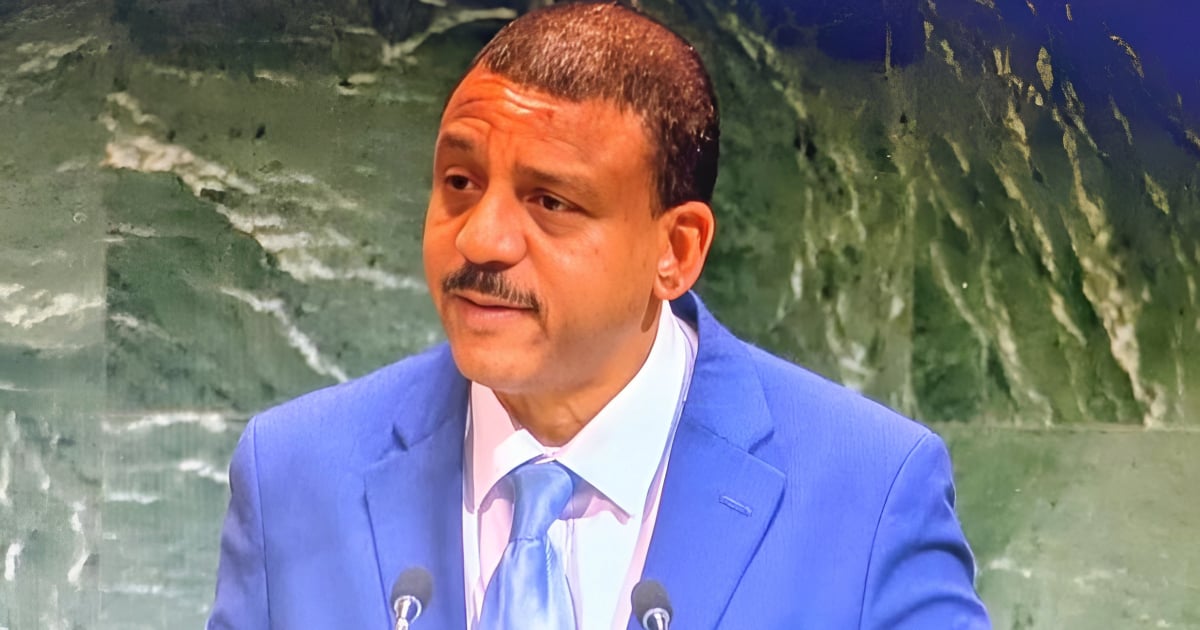
During the debate on the topic "Global Health and Foreign Policy," Ambassador Yuri Ariel Gala López, Chargé d'Affaires of the Permanent Mission of Cuba to the UN, stated that the island maintains an "unwavering commitment to solidarity-based cooperation" and to the idea that health is "a human right and not a commodity."
The diplomat stated that, despite what he called the "devastating impact of the United States' economic blockade," Cuba has guaranteed a universal and free healthcare system for more than six decades.
Gala denounced the "arbitrary inclusion" of the island on the U.S. list of countries sponsoring terrorism and accused Washington of conducting campaigns to discredit Cuban medical services.
According to the statement from the Ministry of Foreign Affairs (MINREX), Gala López's speech argued that these actions aim to prevent the presence of brigades of Cuban professionals in other countries and negatively affect vulnerable communities that rely on this cooperation.
The regime's representative emphasized that Cuba's international medical cooperation is based on solidarity rather than economic interests. He recalled that since 1963, more than 605,000 health collaborators have provided services in 165 countries, and that the island has contributed to the training of tens of thousands of doctors in Latin America, Africa, and Asia.
"Nothing and no one will prevent Cuba from being there wherever help is requested and human life is in need," he concluded.
International reports of labor exploitation
The official discourse contrasts sharply with multiple reports from international organizations that have heavily criticized the conditions faced by Cuban doctors sent abroad.
In recent years, United Nations special rapporteurs on contemporary forms of slavery and human trafficking have warned that medical service export programs exhibit "signs of forced labor" and restrict fundamental rights of professionals.
Experts have pointed out practices such as the confiscation of passports, the retention of between 75% and 90% of the salaries paid by recipient countries, and monitoring or threats against those who decide to leave their assignments.
The Organization of American States (OAS) has been even more categorical, describing these missions as a "form of modern slavery". Its former Secretary General, Luis Almagro, has denounced that the Cuban medical cooperation model constitutes labor exploitation under state control and violates basic human rights standards.
The issue has also generated controversy within the European Union itself, whose Parliament approved in 2021 and reaffirmed in 2025 amendments that recognize medical brigades as forced labor and human trafficking. MEPs denounced that, in addition to the appropriation of wages, doctors are subjected to a regime of militarized discipline and political coercion.
The Pan American Health Organization (PAHO), the regional office of the WHO, even faced a lawsuit in U.S. courts for acting as an intermediary in the Mais Médicos program in Brazil, where thousands of Cuban professionals worked under questioned conditions. The organization had to pay a million-dollar compensation to settle the litigation, although it avoided admitting liability.
Doctors' rebellion in Angola against GAESA
While at the UN the Cuban government insists on presenting its medical missions as an example of solidary cooperation, discontent is growing among the professionals themselves.
In Angola, hundreds of Cuban doctors have recently reported the "theft" of their salaries and are preparing for an unprecedented lawsuit against the Antillana Exportadora S.A. (Antex) corporation, which is part of the GAESA military conglomerate.
The doctors claim that the regime is breaching signed contracts by denying them cash payments in dollars that Angola pays for their services. Instead, they receive a portion of their stipend on a restricted-use bank card in Cuba and barely 100 dollars in hand, which is half of what was initially agreed upon for their support in the African country.
According to the company, the difference is transferred in freely convertible currency (MLC) to accounts on the island, even though this money loses real value in an internal market that prioritizes physical dollars.
The protests by the doctors, documented by independent media such as 14ymedio and CubaNet, led to tense meetings in Luanda where even military specialists openly questioned the administrators of Antex.
Violated, robbed, disappointed, that's how I feel, confessed a doctor with over four years on a mission. Another colleague summed it up: “I didn't come to Angola to buy tomato puree or toilet paper; I came to improve my family's economy.”
The economic background points to GAESA, sanctioned by the United States and indicated by the Cuban Observatory for Social Audit (OCAC) for having plundered the public health system in Cuba for more than 69 billion dollars between 2009 and 2022.
According to that report, the resources gathered through the medical brigades have not been allocated to the healthcare sector but rather to hotel and business investments under military control.
The lawyer Laritza Diversent, director of Cubalex, stated that the situation of doctors in Angola fits the definition of modern slavery established by the International Labour Organization.
"They do not share their salary voluntarily; they do it because they are in a state of poverty. It is a form of exploitation," he stated in recent comments.
Those affected claim that their savings turn into figures with no real value, while they must survive on barely 200 dollars in local kwanzas to cover basic needs in a country where they also face health risks such as malaria and forced separation from their families.
In the absence of official responses, they have decided to take their case against Antex to court, an unprecedented step that could legally expose the exploitation system that underpins the business of medical missions.
Between the discourse of solidarity and accusations of trafficking
The Cuban government systematically rejects these accusations and blames Washington for leading a campaign of political manipulation against what it portrays as an "example of internationalist solidarity."
For Havana, the criticisms aim to dismantle one of its main sources of foreign currency, as the export of medical services is the country's primary source of external income, even surpassing tourism.
While at the UN, Ambassador Gala López reiterated Cuba's support for the World Health Organization and defended its medical cooperation as "genuine and humanitarian," independent reports and international statements continue to describe these missions as a practice of labor exploitation organized by the State.
The duality was evident in New York: on one hand, the official discourse that presents Cuba as a benchmark for health solidarity; on the other hand, the criticisms from experts from the United Nations, the OAS, the European Union, and human rights organizations, who see those same brigades as a mechanism for political control and generating income under conditions that violate the fundamental rights of the Cuban doctors themselves.
Global reports of forced labor in Cuba's medical brigades are increasing
Reports of labor exploitation in the so-called Cuban "medical missions" are not new and have featured in international reports and numerous journalistic investigations in recent years.
In January 2020, CiberCuba reported that United Nations rapporteurs could consider medical missions as a form of forced labor, after receiving testimonies from doctors who described movement restrictions, surveillance, and confiscation of identification documents during their work abroad.
A year later, in February 2021, the media reported the inclusion of the Cuban government in the United States Department of State's reports, which accused Havana of being responsible for human trafficking through the exportation of healthcare professionals.
According to these reports, the regime retains the majority of the income generated from contracts with recipient governments, keeping up to 90% of the doctors' salaries.
In June 2021, Cuban-American researcher María Werlau, director of the NGO Archivo Cuba, warned in an interview with CiberCuba that reports against medical brigades were on the rise in international forums and human rights organizations. Werlau emphasized that the system was designed to politically control the doctors and ensure foreign currency for the Cuban state.
The year 2022 marked a new milestone. In January, the organization Prisoners Defenders submitted an expanded complaint to the United Nations accusing Cuba of subjecting its doctors abroad to conditions of modern slavery, with testimonies from professionals who reported pressures, constant surveillance, and reprisals against their families in the event of defection.
Few days later, in February 2022, CiberCuba reported that the United States once again highlighted Cuba in its annual report on human trafficking, reiterating that the medical missions scheme constitutes one of the main sources of labor exploitation organized by the state.
These pronouncements, along with the subsequent resolutions from the European Parliament and the OAS, establish a pattern of international denunciations against the medical services export program that the Cuban government insists on presenting as an example of international solidarity.
Filed under: