
Related videos:
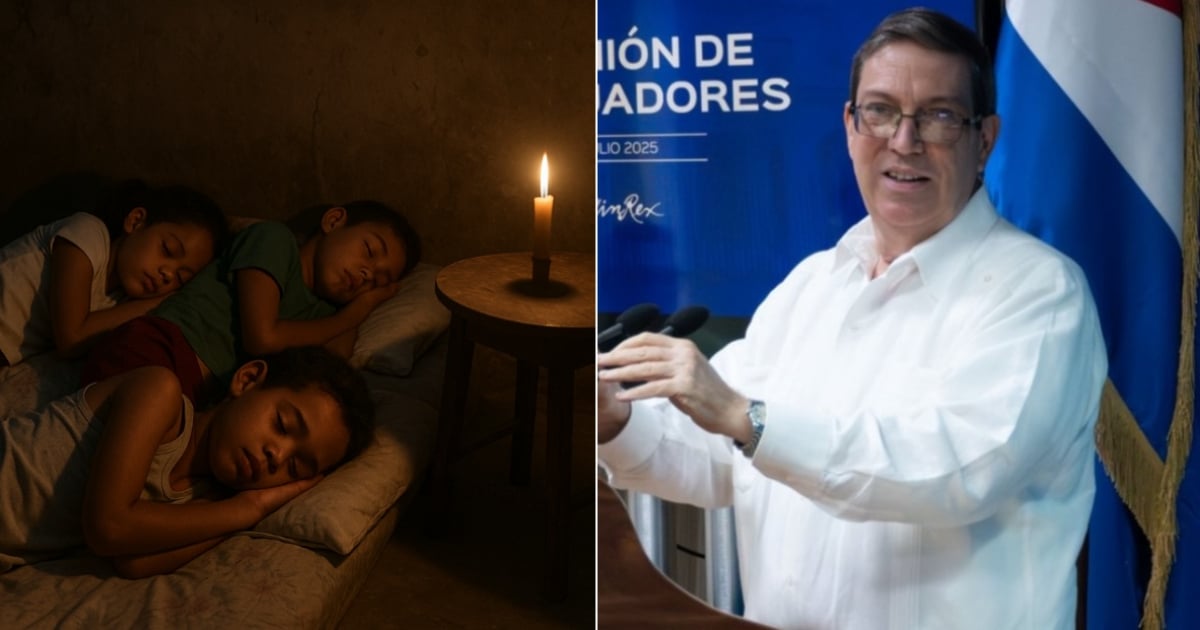
The statements made by Cuban Foreign Minister Bruno Rodríguez Parrilla, celebrating the start of the school year with the phrase “today joy floods Cuban schools once again”, have sparked a , where hundreds of Cuban families have come forward to dismantle what they consider a mockery of their everyday reality.
Rodríguez shared the message on his official X account on September 1, coinciding with the return of over 1.5 million students to the classrooms. Instead of generating enthusiasm, his comment has been perceived as an act of cynicism, disconnected from the struggles faced by thousands of Cuban households trying to cope with a school year filled with shortages.
"Isn't it true that you are beyond help? Joy is something that very few Cubans feel these days, and even less so for children, most of whom spent their vacations amidst blackouts and unable to enjoy anything due to the high prices of everything," a user responded. Another was even clearer: "Do you think our children are happy? With hardly any food, no milk, no places to distract themselves, no toys, unable to sleep because of the massive blackouts, no water, no freedom, nothing, nothing, nothing."
The anger and frustration expressed on social media have not been isolated. Hundreds of parents, grandparents, and teachers have shared images, testimonies, and experiences that refute the supposed atmosphere of joy that the official discourse tried to portray. “Another impious mockery of the pain and suffering of the people. Even crueler, knowing what the children are going through... Down with communism! Homeland and Life and Freedom!” wrote one commentator, outraged at what he defined as “another attempt to impose a triumphalist narrative amid the disaster.”
In multiple provinces, the complaints are repeating: prolonged blackouts, classrooms without minimal conditions, a shortage of teachers, and a total lack of school supplies. In a school in Florida, Camagüey, “there were no guides, the tables were broken, and children who did not have chairs. Now they are asking parents to repair them and buy paint for classrooms that lack even teachers. This is a great achievement of the revolution, while the president enjoys his good life with his 'machi'.”
"I don't know what country you live in, but here the children didn't even get their eight hours of sleep. Many left without having breakfast. Our children have even lost their innocence. They haven't even had a vacation," lamented another mother.
In Bahía, Havana del Este, a fifth-grade classroom was described as follows: “It leaks, there is no electricity, and the door, infested with termites, cannot be closed. That brought us tremendous joy.”
More than joy, what has been observed is an extreme sacrifice on the part of families. A mother wrote: “Joy… which joy? I have seen mothers suffering to ensure backpacks, shoes, school supplies, and money for snacks and lunch supplements. What joy, please? Families are bleeding out.”
Many others shared scenes that reflect a national pattern: “Since this morning, all I’ve seen are posts from mothers saying: ‘What an abuse, the first day of classes and my child hasn’t slept because there’s no power since yesterday…’ or ‘I had to get them ready by candlelight because there was no electricity.’ Is that the joy you are celebrating?”
"What a lack of shame they have" is one of the most repeated phrases. A grandmother added, "It would have been better if they had stayed quiet, but they insist on making fools of themselves every time they say or do something."
In a classroom, they say, parents have to bring their own lamp because there is no installed lighting. And the children "are suffocating from the heat. Tremendous happiness, right?" concluded a user who couldn't contain her anger.
In contrast to the optimism imposed from those in power, reality reveals a country where the start of the school year is not a reason for celebration, but rather a new episode of resilience. While leaders publish messages of self-satisfaction, parents are improvising desks, cutting notebooks in half, and going into debt to ensure the bare minimum for their children. Instead of joy, what fills Cuban schools is exhaustion, sacrifice, precariousness, and frustration.
Structural deficiencies and official makeup
The reports from the families are supported by the official figures themselves. The government acknowledged that only 2.2 million of the 3.6 million uniforms planned for this school year were produced, and only about 20% of students would be wearing new clothes. The rest depended on inherited garments or the black market, where a uniform costs over 5,000 pesos.
Additionally, a “revised standard” was implemented that limits the provision of notebooks: three per child in primary school to cover six subjects. In secondary school, they must be divided in half. Those who cannot afford the 200 CUP that a notebook costs on the informal market simply will not be able to take notes in their classes.
The problems also affect the teaching staff. In Matanzas, there is a shortage of over 2,000 teachers, and the solution has been to fill classrooms with university students, hourly contracts, and untrained personnel. The deficit is similar in provinces like Camagüey and Sancti Spíritus, which seriously compromises educational quality.
The Minister of Education, Naima Trujillo, has emphasized that the reopening was made possible due to "collective effort," but even acknowledged that many schools could only open after emergency repairs carried out by parents, cooperatives, and local businesses. Leaky roofs, insufficient furniture, out-of-service bathrooms, and dark classrooms continue to be a part of the school landscape.
Meanwhile, power outages affected a large part of the country just before the start of the school year. Many students arrived without having slept or without being able to heat their breakfast. The return to classes, far from being a celebration, has been another chapter of exhaustion.
And while the government tries to promote the start of the school year as a "victory," Cuban families continue to ask, time and again, what exactly is there to celebrate.
Frequently Asked Questions about the Start of the School Year in Cuba
How has the Cuban population reacted to Bruno Rodríguez's statements about the start of the school year?
The Cuban population has reacted with rejection and criticism to the statements made by Bruno Rodríguez, who claimed that "joy floods Cuban schools." Comments on social media reflect the outrage of families facing a reality marked by blackouts, food shortages, and a lack of basic resources for the start of the school year.
What are the main challenges faced by Cuban schools at the beginning of the school year?
Cuban schools face serious shortages such as a lack of school supplies, a shortage of teachers, deteriorating infrastructures, and inadequate conditions like classrooms without electricity. Moreover, many families cannot afford uniforms or school supplies due to high prices in the black market.
What measures has the Cuban government taken to address the issues in the education sector?
The Cuban government has implemented measures such as the "adjusted norm," which requires dividing the notebooks by subjects, and has acknowledged the lack of sufficient uniform production. However, these measures have been insufficient to meet the basic needs of the educational system, and families continue to face a significant financial burden to ensure their children's education.
Why is it considered that the official discourse on education in Cuba is a form of propaganda?
The official Cuban discourse presents the start of the school year as a "conquest of the Revolution" and highlights achievements that are not reflected in the daily reality of families. It is considered propaganda because it ignores the real problems of the education sector, such as the shortage of resources and poor infrastructure, while being used to exalt the values of the regime and perpetuate its political narrative.
Filed under: