
Related videos:
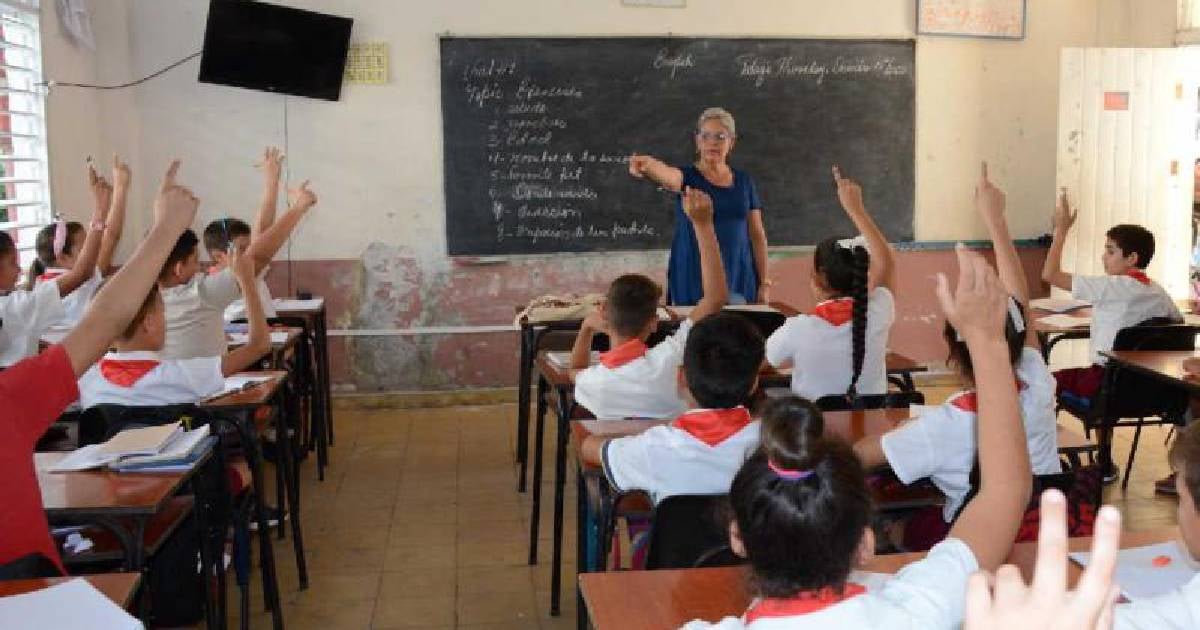
Just like in the province of Camagüey, Sancti Spíritus will begin the 2025-2026 school year with around 2,000 teaching positions unfilled, which directly affects the quality of education.
This will result in retirees being required to return to the classroom, professionals retrained as teachers, and students forced to learn under inadequate conditions.
According to the official newspaper Escambray, the province of Sancti Spíritus enters September with only 68% of teacher coverage, making it one of the most affected in the country, and it faces a problem that it has not been able to resolve despite years of plans, strategies, and official speeches.
Among the measures adopted, more than 300 retired teachers will return to the classrooms, while other teachers will take on additional workloads due to payments that remain insufficient against the cost of living in Cuba.
This is compounded by the improvised inclusion of economists and accountants to teach Mathematics, one of the subjects hardest hit by the shortages.
The pool of teacher training does not ensure a solid succession either: of more than 400 available positions in schools, only half were filled, many young individuals entered by default, and only 48% manage to graduate.
This year, it is expected that nearly 300 graduates from pedagogical schools from the previous year will join, along with 70 graduates from higher education or those who begin their internships starting from the third and fourth years of their academic training, although this number still falls short of meeting the demand.
Similarly, the initiative "Educating for Love" involves only 50 university students from technical fields and the Humanities, aimed at supporting the teaching and educational process.
But the reality is that, despite these alternatives, "there remains a deficit of 162 teaching positions for which there is currently no alternative," the media outlet emphasized.
The shortage of educators is reflected in low grades and increasingly poor entrance exams, a decline directly linked to the lack of qualified teachers or the suitability of those taking on educational processes.
The situation worsens with unresolved old problems: scarcity of uniforms, 45 schools assessed as average or poor in their structural condition -nine in critical condition due to lack of hygiene-, deteriorated books that have not been able to be replaced, and digital resources out of reach for many families.
In internal centers, such as pedagogical schools and the Eusebio Olivera Rodríguez Pre-University Vocational Institute of Exact Sciences (Ipvce), the poor conditions of transportation and food discourage students -they refuse to stay in internal centers far from their municipalities of residence-, which further complicates the training of future professionals.
Despite this scenario, next Monday thousands of children and young people from Sancti Spíritus will return to the classrooms, supported by the efforts of weary teachers, re-employed retirees, and families who bear the weight of a system that stumbles upon the same issues every September.
Recently, it has come to light that the province of Camagüey is facing the new school year with an excess of 2,000 teachers missing, which amounts to only 75.5% coverage, highlighting the system's inability to ensure complete classes for approximately 98,000 enrolled students.
Cuba started the 2024-2025 school year with a deficit of 24,000 teachers, against the backdrop of significant migratory exodus, rampant inflation, and low salaries and pensions, as part of the multisystemic crisis that has engulfed the island.
The shortage of teachers is primarily concentrated in secondary education and in pre-university programs for exact sciences, both in Havana and in other provinces in the west and center of the country.
More than 1.5 million Cuban students are preparing to start a new school year on September 1st amid power outages, uniform shortages, and the deterioration of educational infrastructures.
Cited by the official portal Cubadebate, the Minister of Education, Naima Ariatne Trujillo Barreto, acknowledged that the opening depends on “creative solutions” and community support.
It was noted that, for example, Santiago de Cuba claims a 99% coverage of teachers, but there is no uniformity across the country, and many classrooms could only be prepared thanks to cooperatives, local businesses, and families.
The textile industry also failed to meet the demand. Of the more than 3.6 million uniforms planned, only 2.2 million were produced.
Last Wednesday, the television program Mesa Redonda featured Trujillo, who stated that Cuban students will have to share a single notebook between two subjects, due to what is called the "adjusted norm," reflecting the precarious state of public education.
What sounds technical in official language actually means that a primary school child will have three notebooks for six subjects, or that in secondary school they will have to cut them in half to make do. And if the family cannot afford the 200 CUP that a notebook costs on the black market, the student will have to manage as best as they can.
Frequently Asked Questions about the Educational Crisis in Sancti Spíritus
Why is there a teacher shortage in Sancti Spíritus?
The teacher shortage in Sancti Spíritus is due to a lack of teaching coverage, which only reaches 68%. This translates into a deficit of 2,000 unfilled positions, exacerbated by the exodus of professionals to the private sector, low enrollment in educational careers, and dissatisfaction with low salaries. Despite measures taken, such as re-hiring retired teachers and hiring professionals from other fields, the situation does not improve and continues to affect the quality of education.
What impact does the teacher shortage have on students in Sancti Spíritus?
The shortage of teachers directly impacts the quality of education, reflected in low grades and poorer results in entrance exams. Students are forced to learn in precarious conditions, lacking qualified teachers, which undermines the educational process and the academic future of young people. Furthermore, the scarcity of resources and the dilapidated state of educational infrastructures exacerbate the situation.
What measures has the Cuban government taken to address the shortage of teachers?
The Cuban government has implemented measures such as reinstating over 300 retired teachers, hiring professionals from other fields, and overburdening current teachers. However, these solutions have proven to be temporary and do not address the root of the problem. The lack of salary incentives and the precariousness of working conditions have made these measures insufficient to effectively stabilize the education system.
How does Cuba's economic situation affect the educational crisis in Sancti Spíritus?
The economic crisis in Cuba, marked by inflation and low wages, has intensified the educational crisis in Sancti Spíritus. Economic hardship limits the ability of the educational system to attract and retain qualified teachers. Furthermore, the lack of basic resources, such as uniforms and school supplies, along with deteriorating infrastructure, reflects the direct impact of the economic situation on education in the province.
Filed under: