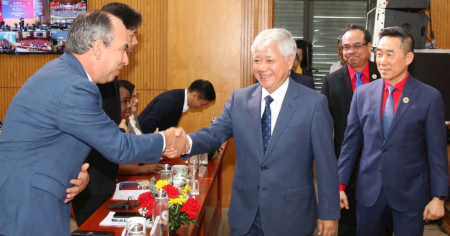
The Cuban Vice President Salvador Valdés Mesa defended in Cienfuegos the allocation of land parcels to individuals with financial resources, in a desperate attempt to boost national rice production amidst a crisis characterized by dependence on imports.
Over 400 million dollars are spent annually on importing the cereal, while the country produces barely 11% of what Cubans consume.
The rice program, affected after the pandemic by a lack of supplies, has lands and infrastructure, but it fails to reverse external dependence, a report from the provincial telecentre Perlavisión acknowledged.
During a discussion with executives, producers, and representatives from the Party and the Government, Valdés Mesa mentioned that 50 to 60 hectares have already been allocated to “people with money” who have even acquired their own machinery, which reflects the emphasis on prioritizing those who have the income to support planting.
The official stated that if more than 120,000 hectares are cultivated this year and an average yield of two tons per hectare is achieved, the country could see a 20% increase in production.
However, the reality in provinces like Cienfuegos highlights the obstacles: in 2023 only 10,000 tons were harvested, half of what is needed for self-sufficiency.
In the Juan Manuel Márquez cooperative in Aguada de Pasajeros, producers highlighted critical issues hindering planting, such as drought, lack of electricity, and the shortage of cash to pay workers.
Nevertheless, only 17 hectares of rice were planted, clearly demonstrating the limitations faced by Cuban agriculture, despite official speeches about food sovereignty, the source pointed out.
According to the official newspaper 5 de Septiembre, the government purchases a ton of rice on the international market for over 800 dollars, selling it in Cuban stores at 10 pesos per pound, while domestically produced cereal is sold in agricultural markets for about 155 pesos per pound.
"We must produce all the rice consumed in the territory. We need to analyze the contracts and the plantings. We can become self-sufficient," Valdés Mesa urged during a discussion on the Rice Program and the recovery of the sugar harvest at the 5 de Septiembre sugar mill in the municipality of Rodas, Cienfuegos.
The Vice President visited Pinar del Río in February to review the rice program and emphasized the urgency of expanding cultivated areas and increasing yields. During his tour at the Agroindustrial Grain Company of Los Palacios, he acknowledged that rice is the central food in the diet of Cubans and pointed out that its high demand is the main incentive for planting.
In May, rice reached 340 pesos per pound in Havana, an evident reflection of the soaring inflation that Cubans are suffering.
During the fifth month, in four provinces - Havana, Guantánamo, Santa Clara, and Holguín - the price of a pound of rice exceeded 300 pesos; while in Ciego de Ávila, Camagüey, and Bayamo, the minimum prices dropped below 200 pesos.
But even the state-run press acknowledged that in Cienfuegos a pound of rice was being sold for 270 pesos (just 10 pesos less than the maximum price recorded by ONEI in May) and accused private sellers of price gouging.
Rice, an essential food in the diet of Cubans, has become one of the scarcest and hardest products to obtain on the island.
While the government insists that the quota is guaranteed, the reality for many families is that they face uncertainty and long waits to receive a basic food item in their monthly basket.
In March, a government official from the province of Artemisa requested “trust” from the population regarding the delivery of rice corresponding to the basic basket.
A month earlier, the decision of the Provincial Administrative Council of Camagüey to set a price cap on rice at 155 Cuban pesos per pound led to the mass closure of sales stalls in the Hatibonico market, due to the refusal of cooperative representatives to sell the product at that price.
In the last 15 years, the island has become increasingly dependent on rice imports, a situation that has worsened in recent years and has forced the government to rely on donations and allocate hard currency resources to ensure the purchase of this food on the international market, where its price has increased significantly.
In 2024, rice production in Cuba reached only 30% of what was harvested in 2018, according to official data from the state-run newspaper Granma.
A joint agricultural project led by the Vietnamese company Agri VMA is making progress in the municipality of Los Palacios, in the province of Pinar del Río, aiming to plant 1,000 hectares of rice.
Similarly, a memorandum signed in August between the Agroforestry Business Group (GEAF) of Artemisa and the Vietnamese company Viet Royal includes the cultivation of approximately 2,000 hectares of idle land in Alquízar, San Antonio de los Baños, and San Cristóbal for planting soybean, green beans, peanuts, taro, potatoes, and cashews, with a large portion aimed at the international market.
Since 2023, the Cuban government has also offered Russian companies the right to utilize the land of the island in usufruct for a period of 30 years.
Filed under: