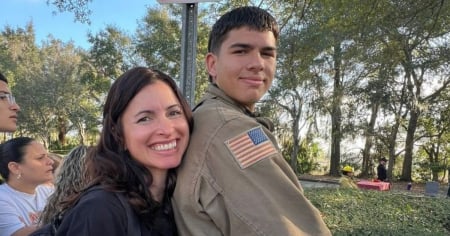
“I have to self-deport because there is no other option. If I don’t leave, I will never have my status in the United States. This is no way to live,” said a shocked Deivy Alemán Oropesa.
This Cuban father, residing in Orlando, Florida, has to voluntarily leave the United States after receiving a deportation order from the Immigration and Customs Enforcement (ICE).
The decision leaves the family in deep uncertainty, especially because their daughter suffers from a serious heart condition that requires new open-heart surgeries soon.
" It will be difficult. I am worried that our daughter will become depressed and have a relapse. I can practically see myself living on the street because how am I going to care for my little girl and work to pay the rent and the bills," expressed Yisel Miguel Sarduy, Deivy's wife, her voice breaking with desperation.
"Nobody represents me in this country. I have sought help from senators, congressmen, and nothing. My case is not made up; it is a real situation, a matter of life or death. (...) The little girl greets her dad with a hug every day, and on Monday she won't be able to do that," he lamented.
The journalist Javier Díaz shared a video on social media this Friday featuring the statements of the Cuban father, in which he appears visibly affected while explaining why he made this drastic decision and shows how he has already packed his bags for his flight to Cuba on Sunday.
An appointment with ICE that changed her fate
Deivy Alemán Oropesa attended a routine appointment with ICE on September 8. There, he was informed that he must leave the country before September 14 or he would be arrested and forcibly deported.
"During the appointment with ICE, I was informed that if I stayed, they would have to detain me and deport me on their own. Otherwise, I had to present my exit ticket from the United States this Sunday. I believe the best option is to leave voluntarily," he explained in statements to Díaz.
The family did not expect such an abrupt outcome. The youngest has undergone three open-heart surgeries and needs more medical procedures. While the mother takes care of her, Deivy was the sole breadwinner of the household.
"What worries me the most is leaving my family."
For Deivy, the pain of leaving is not only in exile but also in the forced separation from his sick daughter. “What worries me the most is leaving my family here, the little girl who is waiting for another surgery,” he confessed with a trembling voice.
Alemán Oropesa has no criminal record. He entered the country irregularly through the border seven years ago and has since lived with an active deportation order. ICE offered him the option of voluntary departure, with the warning that if he did not comply, he could be arrested and sent to an immigration detention center.
Javier Díaz, who has closely followed the case, questioned the harshness of the migration system on his social media. "It is a sad case where having humanitarian reasons or being an exemplary migrant makes no difference; if you have a deportation order, you will be deported," said the journalist.
A hope: family reunification
Despite the pain, Deivy keeps the faith. “The hope that remains for me is that when I am in Cuba, I receive the reunification request submitted by my wife. And to be together here as soon as possible,” he said with determination.
The family has an approved I-130 petition, which is part of the family reunification process. However, the path is fraught with obstacles. According to Yisel, neither the medical evidence nor the humanitarian arguments were effective in halting the deportation. "It was all for nothing," she lamented.
Solidarity on social media and questions for ICE
The case has sparked a wave of solidarity on social media, where many users criticize the lack of sensitivity from U.S. immigration authorities.
The tragedy of this family puts a human face on a reality that thousands of Cubans in the United States experience, trapped in an inflexible immigration system, even after years of residence and exemplary behavior.
Deivy Alemán Oropesa is scheduled to leave the United States this Sunday, September 14. From that moment on, any attempt to remain could lead to his immediate arrest and deportation without return.
Frequently Asked Questions about the Deportation of Deivy Alemán Oropesa and Its Impact on Cuban Families in the U.S.
Why does Deivy Alemán Oropesa self-deport from the United States?
Deivy Alemán Oropesa self-deports from the United States to avoid detention and forced deportation by ICE. Despite having no criminal record and having lived in the country for seven years, ICE gave him a deadline to leave the country voluntarily, after which he would be arrested and forcibly deported.
What legal options does Deivy Alemán's family have to reunite?
The family of Deivy Alemán has an approved I-130 petition, which is part of the family reunification process. They hope that this petition will allow Deivy to return to the United States soon. However, the path is fraught with obstacles, as humanitarian reasons and medical evidence have not been enough to halt the deportation.
How does Deivy Alemán's deportation affect his family, especially his daughter?
The deportation of Deivy Alemán severely impacts his family, plunging them into economic and emotional uncertainty. His daughter, who needs heart surgeries, will be deprived of her father's support, as he was the primary breadwinner of the household, while her mother takes care of her full time.
What criticisms has ICE received regarding the case of Deivy Alemán Oropesa?
The case of Deivy Alemán Oropesa has sparked a wave of criticism towards ICE for its lack of sensitivity to humanitarian situations. Users on social media and journalist Javier Díaz have expressed their outrage over the harshness of the immigration system, which does not take into account humanitarian reasons or the exemplary behavior of migrants when executing deportation orders.
Filed under: