
Related videos:
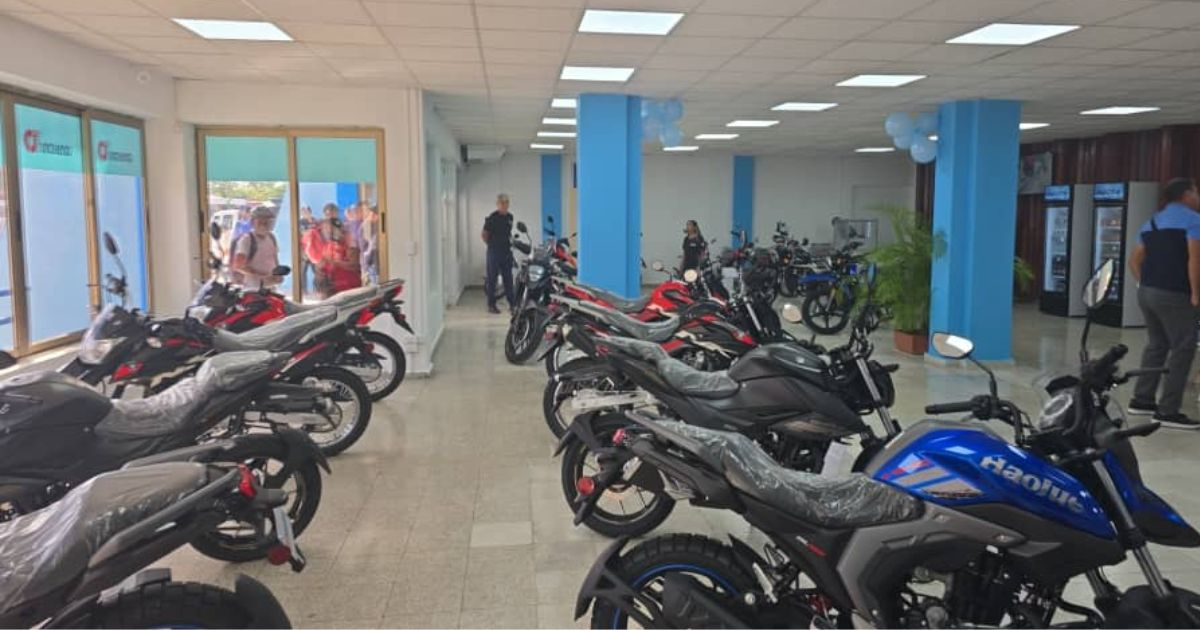
The Cuban regime promises improvements in the sale of vehicles for foreign currency, following growing criticism over long lines, resellers, and deficiencies in service at various retailers across the country.
The information was published this Sunday on Facebook by the Minister of Transport, who described a tour of several sales points in Havana, where he noted issues with customer service and the purchasing process, as well as hearing complaints from customers and workers.
At the 23 and C store (SASA), the executives confirmed that they are preparing to begin assembling motorcycles, which would allow—according to the statement from the head of the sector—to reduce prices and increase supply.
It was also recommended to install a generator to avoid interruptions in sales during power outages, as well as to improve the payment system.
At 1ra y 20 (CIMEX), the minister acknowledged that certain models, such as the "Leopardo" motorcycles, sell out quickly and result in the presence of scalpers.
To counter it, there are plans to increase the availability of the most in-demand models, shift vehicle sales to state-owned companies, and enable online recharges and payments so that customers do not have to rely on the bank.
At the Dongfeng dealership, located at 7th and 20th, the upcoming opening of a parts store and direct delivery of spare parts to buyers was announced, with plans to expand this model to other regions.
A new facility is also being prepared in Playa, featuring a showroom, workshops, a warehouse, and an Office of Vehicle Registration to expedite license plate processing.
The tour included the store La Copita (TRD Caribe), where pre-sales and online purchases are implemented, although limitations such as a lack of affordable models and issues with IT management persist.
The minister assured that a plan is being developed to increase transparency in sales processes, streamline procedures, and improve customer service.
He also mentioned the need to advance more rapidly in renewable energy charging station projects for electric transportation.
Although the authorities insist that there is "commitment and a willingness to improve," issues of scarcity, reselling, and long queues continue to be major obstacles for the population trying to access motorcycles and cars in foreign currency.
Although Eduardo Rodríguez is one of the Cuban ministers who most often turns to social media for communication, the post about motorcycles and cars was dominated by praise for the minister in charge, as well as by challenges and criticism from users.
The profile Infotransporte stated: “The main thing is to start fighting against those resellers or coleros who only disrupt the purchasing process. In the Cimex store in San Miguel del Padrón (Caballo Blanco), you can see them sleeping on benches outside, as if they have information on when motorcycles will be allowed in.”
It also noted that consumer rights are being violated because "the store claims that any issues with the motorcycle are the supplier's responsibility, when it is the store that should honor the warranty."
Elizabeth González Aznar questioned that access to these products is only available to a select few: “Everything continues to be designed for those who have money in this Cuba. What Cubans have those opportunities? Almost no professionals. Instead of thinking about the workers who have devoted their lives to this country, the State excludes them by selling exclusively in foreign currency.”
Others focused on unfulfilled promises. Luis Milian wrote: “That’s very good, but when will the VAPs be available, Minister? Many of us are using our limited resources for tires and batteries, and in a few days it will be a year since the approval and the process is still stalled.”
There were also complaints about the lack of access from the national currency. Yandu Dabm stated: “It would be good to consider the workers of state enterprises who do not have access to foreign currency. The acquisition of motorcycles in CUP through bank loans must be guaranteed, because many of those who purchase do not have a stable connection with the State.”
The user Yunier Ledesma Álvarez shared his experience at the store on 1st and 20th, where he stated that the organization of the lines has facilitated resellers: “The main allies of the lists and the line waiters are the terrible sales mechanisms. The computer system is outdated, everything is slow, and they even ask for photocopies of the ID and the payment card, which should be illegal. Additionally, no motorcycle is ready for actual sale: dead batteries, visible defects, and they even require customers to bring gasoline to test the motorcycle.”
For Ledesma, "the after-sales and warranty system is chaotic and completely violative of the buyer's rights."
Yunier summarized what many expressed: that bad practices cannot be corrected with speeches, but rather with real changes in sales and warranties, two of the most sensitive points for those who manage to acquire these vehicles at prices in foreign currency.
Frequently asked questions about the sale of vehicles in foreign currencies in Cuba
What changes has the Cuban government promised regarding the sale of vehicles in foreign currency?
The Cuban government has promised improvements in the sale of vehicles for hard currency, following criticism over long lines, resellers, and deficiencies in service. The assembly of motorcycles is expected to reduce prices and increase supply, and efforts are being made to enhance customer service and the payment system.
How does the Cuban government plan to combat resellers and intermediaries in vehicle sales?
To combat resellers and ticket scalpers, the government plans to increase the availability of in-demand models and transfer sales to state-owned enterprises, in addition to enabling online payments to reduce reliance on the bank, although this issue persists due to the lack of effective measures.
What is the current situation regarding access to vehicles in foreign currency for Cubans?
Access to vehicles in foreign currency remains limited for the majority of Cubans, as sales are aimed at those with dollar income, which is unattainable for many workers and professionals earning in Cuban pesos (CUP).
What criticisms has the Cuban government received regarding the sale of motorcycles in foreign currency?
Criticism of the Cuban government regarding the sale of motorcycles in foreign currency focuses on the exclusion of the majority of the population who earn in CUP, as well as the high prices and lack of adequate warranties. Citizens criticize that domestic products are more expensive than imported ones and that the stores do not take responsibility for the warranties.
Filed under: