Following one of the largest deficits in the current energy crisis, the Cuban government has once again promised that blackouts will be reduced during the day, thanks to the activation of new generation capacities and progress in the maintenance of several thermoelectric plants.
At a press conference, the Minister of Energy and Mines, Vicente de la O Levy, acknowledged that the situation of the electric system is "tense" and that on Tuesday, the outages exceeded 2,000 megawatts nationwide.
He assured, however, that with the synchronization of engines in Mariel and the anticipated incorporation of unit 1 of the Lidio Ramón Pérez thermoelectric plant, better known as Felton, the outlook will improve… although most Cubans no longer believe in such “promises.”
"This weekend, Felton is coming in, and that will improve the situation. It's not that blackouts will be eliminated, but we believe that during the day the impact will lessen significantly, thanks to the contribution of that plant, Mariel, and the solar parks. We are going back to levels below 1,000 megawatts," the official stated.
De la O Levy explained that the recent problems were exacerbated by the unexpected shutdown of several power plants, including Renté and 10 de Octubre, as well as a malfunction in the seawater system at the Mariel Fuel site, which removed over 100 megawatts.
According to him, the engines in Mariel are already synchronized with the system after repairs that received support from workshops of the Ministry of Industries and the Union of Military Industries.
The minister also recounted an episode that occurred on Monday, when a unit from Nuevitas went offline and caused significant fluctuations that threatened the stability of the national electricity grid.
"In order to prevent the system from collapsing, the office acted urgently and had to open the circuits of Havana, the ones with the highest consumption, until the frequency was restored. A general blackout was avoided," assured the head of the department, who insists that this event was a revolutionary "achievement."
Regarding Felton, he indicated that its maintenance, initially scheduled for 20 days, is progressing in such a way that it could finish earlier.
The addition of that unit will help reduce the generation capacity deficit, especially during peak consumption hours.
De la O Levy acknowledged, however, that the nights will continue to be the most critical period, as the support from solar energy disappears and peak demands concentrate. "Just in summer, when you talk about 1,700 megawatts of impact, that lasts for hours; in winter, that same figure can be concentrated in minutes because demand rises and falls very quickly," he explained.
The official emphasized that the country has a major investment program in photovoltaic energy, with parks that already total more than 600 megawatts installed.
He said that this capacity, combined with the recovery of thermal blocks, will partially alleviate the situation in the short term, although it will not mean the end of the blackouts.
"What we anticipate is that during the day the impacts will decrease significantly, but at night they will remain high. The situation will continue to be tense, although with greater stability than in recent days," he concluded.
Massive blackouts continue to affect the Cuban population, with a generation deficit that keeps thousands of households in darkness for extended periods.
Despite official promises, the energy landscape remains one of the most critical in recent years.
In the midst of this crisis, the Minister of Energy reiterated his commitment to an imminent improvement of the electrical system, assuring that new additions to generation capacity and maintenance in thermoelectric plants would partially ease the situation.
However, the advertisements have generated more skepticism than trust among the population.
A few days ago, the minister himself acknowledged that without the solar parks, the country would be even worse off, confirming the fragility of the system and the high dependence on renewable sources amid constant breakdowns in thermal power plants.
Social tension has also been on the rise. A blackout in Cojímar triggered a popular protest that forced authorities to deploy a heavy response to control the situation, reflecting the growing public discontent regarding the lack of real solutions.
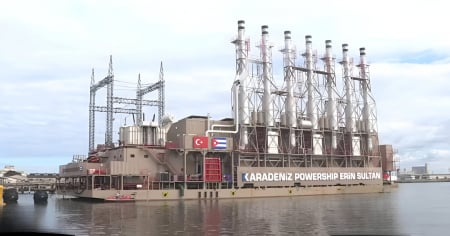
Meanwhile, the government acknowledged difficulties in covering the rental of the Turkish barges, which have been one of the main sources of energy support in recent times. The inability to meet those international costs leaves the country even more vulnerable to prolonged blackouts.
Frequently Asked Questions about the Energy Crisis in Cuba
What measures is the Cuban government taking to reduce blackouts?
The Cuban government is trying to reduce blackouts by incorporating new generation capacities, maintaining thermoelectric plants, and synchronizing engines in Mariel. However, despite these measures, it is acknowledged that blackouts will continue, particularly during nighttime when demand is higher and there is no solar energy available.
What are the main causes of blackouts in Cuba?
The main causes of blackouts in Cuba include a lack of fuel, breakdowns at generation plants, aging equipment, postponed maintenance, and financial issues for carrying out repairs. The combination of these factors has resulted in an electricity generation deficit that exceeds 2,000 MW at times, forcing the implementation of prolonged and rotating electricity cuts.
How do solar parks impact the energy crisis in Cuba?
Solar parks contribute over 600 megawatts to the Cuban electrical system, which helps reduce disruptions during the day. However, their impact is limited, as the lack of energy storage systems prevents their use at night, when demand is highest.
What are the Cuban government's expectations regarding the improvement of the electrical system?
The Cuban government expects that the electrical situation will partially improve with the operation of new units and the increase in solar energy. However, they acknowledge that nights will remain critical and that there will be no immediate solution for blackouts, as the system continues to be fragile and dependent on fuel imports.
Filed under: