
Related videos:
The Cuban government once again spoke of "energy sovereignty" as the country faces the worst electricity supply crisis in its recent history, characterized by blackouts lasting up to 40 hours and unprecedented social unrest.
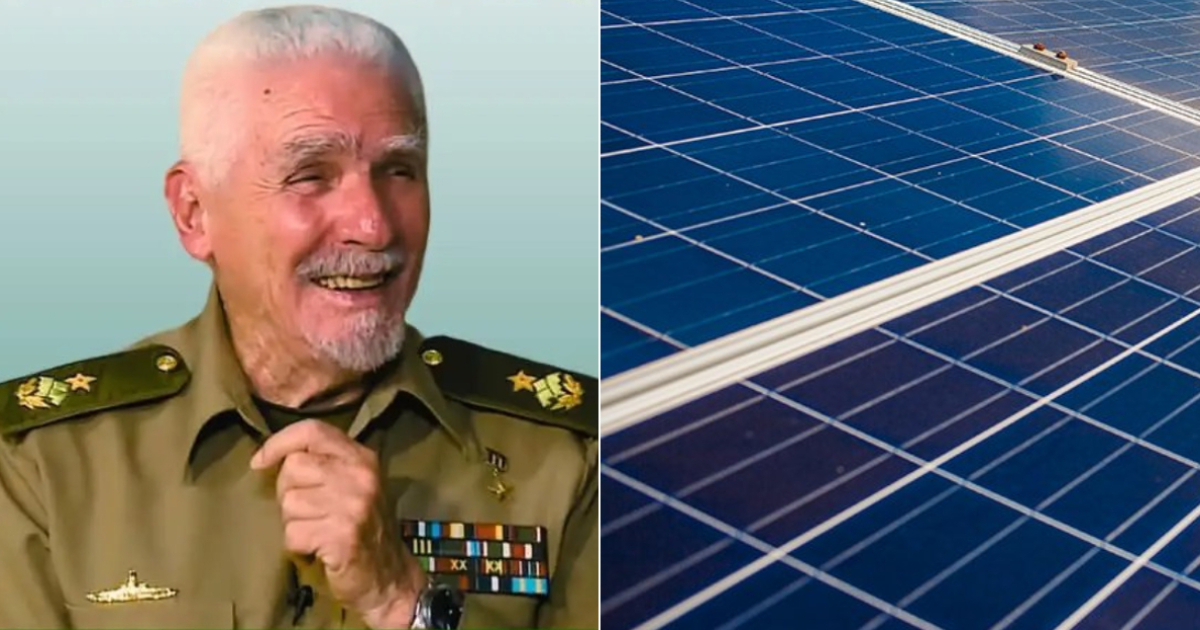
The Ministry of Energy and Mines (MINEM) announced on social media that 30 photovoltaic parks with a capacity of 21.8 MW have already been synchronized across the territory, which, combined with over 500 MW from renewable sources and the exploitation of national oil and gas, “allows progress on the path to energy sovereignty.”
The speech, however, contrasts with the reality faced by the population. The Electric Union (UNE) acknowledged this week that many thermoelectric plants have been in operation for over 40 years without receiving significant maintenance, which has led to unexpected and prolonged breakdowns.
The director of the UNE, Alfredo López Valdés, admitted that “we have not had the financial capability to solve 100 percent of the problems,” while justifying the inability to accurately predict repair timelines.
Investment promises for 51 solar parks and battery storage systems, with a budget of one billion dollars, come amid massive blackouts that have left the entire eastern region of Cuba without electricity, and with the Antonio Guiteras thermal power plant—the most important in the country—set to shut down for maintenance soon.
The official narrative of "energy sovereignty" is not new. Since the "Energy Revolution" launched by the dictator Fidel Castro in 2005, the term has been used repeatedly to justify savings programs, technological substitution, and investments in renewable energy.
But two decades later, the result has been the same: a collapsed electrical system, dependence on imported oil, and a lack of structural solutions.
In the streets and on social media, frustration is evident. Phrases like "this is not living" or "they are killing us slowly" are multiplying in the comments from citizens who are denouncing extreme hardship.
Even journalists associated with the government, such as Yirmara Torres Hernández, have publicly questioned how it is possible to survive with “28 hours of blackout for 2 hours of electricity.”
The discomfort increases due to perceived inequality: while the majority endures endless blackouts, the leaders have access to power plants and fuel. The contrast is even greater knowing that the military conglomerate GAESA manages billions in liquid assets, while the UNE claims a lack of resources to maintain the thermoelectric plants.
For many Cubans, "energy sovereignty" has become an empty slogan that masks the regime's inability or unwillingness to ensure a stable electricity service. In 2025, the darkness that envelops the Island is not just that of blackouts, but of an exhausted system that echoes unfulfilled promises while condemning its people to survive in the shadows.
Recycled promises and invisible results
In December 2024, the head of MINEM, Vicente de la O Levy, presented a “miraculous” plan to put an end to long-term blackouts, while the ruling Miguel Díaz-Canel appointed commander Ramiro Valdés Menéndez as the leader of a government program for the stabilization and recovery of the National Electric System (SEN).
The plan, as always, ended up joining the long line of projects and programs announced for over two decades, all promising to stabilize the SEN and guarantee the so-called "energy sovereignty."
However, experience has shown that these official commitments rarely go beyond paperwork and speeches. Furthermore, in the optimistic scenarios presented by the MINEM, the calculations do not suffice to meet national demand, highlighting that the plan is based on inflated and unrealistic projections.
The proposal to recover 850 MW in distributed generation and raise the average availability to 1,400 MW contrasts with the daily reports from the UNE, where the actual deficit often exceeds that figure, and the lack of fuel leaves generating plants offline.
However, the minister spoke of a "stable supply" of fuel and megaprojects in renewable energy, ignoring that the plan is based on resources that the country does not have secured, and relies on financing and external imports that, in practice, do not arrive, as the situation has come to demonstrate.
Since 2015, solar, wind, and biomass parks have been announced, contributing only a minimal fraction of the total generation, unable to replace the deteriorated thermal base. Today, with more than 500 MW of solar capacity installed—according to the regime's propaganda—its contribution to the SEN is still marginal and vulnerable to climatic intermittency.
Meanwhile, the rehabilitation of thermoelectric plants drags on without concrete timelines, hampered by a shortage of parts, metals, and financial resources. The reality is that technological obsolescence weighs more than empty promises, and each announcement of repairs turns into yet another endless wait.
The population, for its part, sees no improvements. The prolonged blackouts and the collateral damage to the economy, health, and daily life contradict the triumphant rhetoric of a plan that, like its predecessors, appears doomed to failure.
In the eyes of many Cubans, these promises are nothing more than another smokescreen to buy time and justify the paralysis of an electrical system on the brink of collapse.
Filed under: