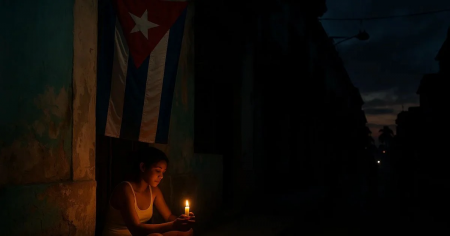
The Cuban leaders, Miguel Díaz-Canel and Manuel Marrero, led a meeting on Thursday with leaders from all provinces and the Special Municipality of Isla de la Juventud to discuss the severe electricity and water supply crisis affecting the Cuban population.
The meeting took place via videoconference from the Palace of the Revolution. Both leaders affirmed that, despite the circumstances, "we are going to move forward" and emphasized that their government team is "projecting the future".
They recognize the seriousness of the electrical system
During the meeting, the Minister of Energy and Mines, Vicente de la O Levy, acknowledged that the National Electric Power System (SEN) is experiencing a critical moment, exacerbated by the shutdown of several plants such as Felton and one unit in Mariel.
He announced that "Felton should be coming in on Saturday," but he admitted that the country continues to face significant disruptions during the nighttime peak.
Regarding fuel supply, he stated that “it has been addressed through various alternatives,” while work is being done on repairing transformers.
Díaz-Canel urged the Electric Union to be more equitable in scheduling blackouts.
"I know it’s complicated, but we have observed that we protect the provincial capital with comfortable areas, while another municipality faces 25 hours of blackout. That cannot be." he said.
Water: another collapsed service
The 50% of the issues with water supply are due to a lack of electricity. The drought and equipment failures further exacerbate the situation.
The drought crisis is so severe that in Santiago de Cuba, wells are being activated, water is being distributed by truck, and plans are even being made to use rail transport to move water.
"We are exchanging with the population in the places we are going to," declared Antonio Rodríguez, president of the National Institute of Hydraulic Resources.
Mobilization of delegates in the face of collapse
In Havana and other provinces, emergency measures have been taken such as freeing the Delegates of Circumscription from their regular jobs so they can focus on assisting the affected population.
Marrero asked the delegates to be in the neighborhoods. "Municipal directors must stand alongside the delegates so they can enter the neighborhoods providing information to the population. Talking directly with people is the most effective thing of all," he said.
This measure comes in the context of increasing citizen protests in the capital and in cities in the interior of the country, such as Santiago de Cuba and Gibara. The population is dissatisfied with the crisis and sees no solutions. They have begun to demand their rights without fear of the regime.
Critiques of social discontent and emphasis on surveillance
Díaz-Canel explained that the country has experienced a "context of contingencies," but he assured that "the enemy failed to capitalize on social discontent and direct it towards their interests of social upheaval."
In his view, the key to surviving those alleged attacks has been the "cohesion between the Party, the Government, and the mass organizations." He thus omitted the fear that thousands of Cubans feel about expressing themselves due to state repression.
He also emphasized the need to "increase revolutionary vigilance in these times" and to maintain direct dialogue with the population: "Everything needs to be explained, every day."
Towards the end of the meeting, he reiterated his speech on resistance and social repression. "No one is going to give up here," he said.
However, the leader did not provide concrete short-term solutions for the prolonged power outages that have been affecting the country for years. Despite lacking a clear strategy, he insisted that "we are projecting the future."
The meeting takes place after Cuba experienced its fifth nationwide blackout in less than a year and amid citizen reports of power outages lasting over 24 hours in several provinces.
Frequently Asked Questions about the Energy and Water Crisis in Cuba
What is the current situation of the electrical system in Cuba?
The National Electric Power System (SEN) of Cuba is in a critical state, with frequent blackouts lasting over 24 hours in several provinces. This collapse is due to the shutdown of several key plants and outdated infrastructure.
How does the electricity crisis affect the water supply in Cuba?
50% of water supply problems are due to a lack of electricity. The drought and equipment breakdowns further exacerbate the situation, leaving nearly a million people affected daily by water supply issues.
What measures has the Cuban government taken to address the energy crisis?
The Cuban government has prioritized investments in solar parks to try to improve the situation of the SEN. However, these measures have not effectively resolved the energy crisis, and the population continues to suffer from prolonged blackouts.
What has been the government's response to social discontent due to the crisis?
The government has emphasized the need for "revolutionary vigilance" and direct contact with the population, but has not provided concrete short-term solutions. Díaz-Canel has stated that "the enemy did not manage to capitalize on social discontent," omitting the citizens' fear of expressing themselves due to state repression.
Filed under: