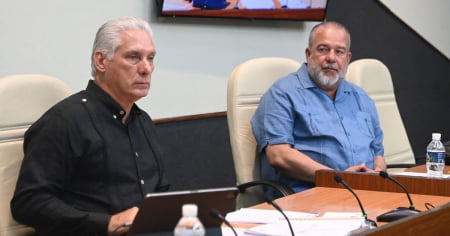
The Cuban ruler Miguel Díaz-Canel called on Thursday to "perfect the electrical programming" so that power outages are distributed more equitably across the country, acknowledging that there are "disproportions" among provinces, municipalities, and capitals.
From the Palace of the Revolution, and through videoconference with authorities from the Communist Party, the Government, and social organizations across all provinces and the special municipality of Isla de la Juventud, Díaz-Canel addressed the worsening situation regarding electricity and water supply, emphasizing the need to better explain to the public what actions are being taken on both fronts.
"The issue of electrical programming is important. I know it requires a lot of effort, but we have also observed that there are disparities. Sometimes we protect the provincial capital so much that it ends up with a relatively comfortable cycle, while there’s a municipality experiencing 25 hours of blackout. It can't be like this," he stated.
The leader urged local authorities to act swiftly in response to the people's demands, to seek solutions from the communities, and to consistently communicate the actions being taken: “It is essential to inform through all possible channels about the efforts being made in both the water resources sector and the energy sector to overcome this complex situation.”
At another point, he referred to crimes that affect electrical infrastructure, such as the theft of transformers or cables, and stated that these acts should be punished: “Revolutionary vigilance, comrades. There are things here that cannot be tolerated and must be severely sanctioned. Anyone who threatens an electrical line, transformers, a substation, or engages in the theft of transformers, oil, or cables is undermining the stability of the country and harming the nation.”
At another point in his speech, he reiterated a message of resilience: “With the caliber they have used against us to kill us, and yet we are alive, projecting a future, preparing for a congress, and discussing solutions [...] it is a clear expression that no one here is going to surrender.” He also stated that “after everything, we will remember all the bitterness of these times, but we will also remember with great satisfaction the strength we had to resist and the will we had to overcome.”
Prolonged blackouts and a system in crisis
Díaz-Canel's statements come in the midst of a national energy crisis that on Thursday left a deficit of 1826 megawatts (MW) during peak evening hours, according to official figures from the Unión Eléctrica (UNE). By Friday morning, the deficit was at 1190 MW, with a mere availability of 1660 MW against an estimated demand of 2820 MW.
The UNE warned that the interruptions could extend to affect 1760 MW at night, nearly half of the national consumption.
In this scenario, complaints about the unequal distribution of power outages have multiplied. While some areas of the country have accumulated more than 30 consecutive hours without electricity service, in Havana, the outages have been less severe. Just this Thursday, the Electric Company of the capital reported 16 hours and 23 minutes of power outage, affecting all six districts of the city.
A system deteriorated by breakdowns, fuel issues, and lack of maintenance
The collapse of the electrical system is due to multiple structural factors. This Thursday, several generation units —including Felton, Mariel, Santa Cruz, Nuevitas, and Céspedes— were out of service due to breakdowns or maintenance. Additionally, 53 distributed generation plants were idled due to lack of fuel, while others were halted due to a shortage of lubricants.
In addition, the government itself recently admitted that the Antonio Guiteras thermoelectric plant will need to go out of service soon for maintenance, which will further worsen the impact. The plant, one of the country's main facilities, has been operating for years without the necessary care, as acknowledged by sector authorities.
Communication, political control, and promises without deadlines
During the meeting, Prime Minister Manuel Marrero Cruz also spoke, praising the work of the technicians in the electrical sector and urging local authorities to support the constituency delegates in their direct contact with the population.
The official discourse emphasized external responsibility. Díaz-Canel linked the energy crisis to the "interference of the U.S. government in Venezuela" and to the "escalation of the U.S. blockade," which he accused of seeking to "destroy the Revolution."
Meanwhile, millions of Cubans continue to face prolonged blackouts and the uncertainty of an electric system that, according to the government's own data, has no immediate solution.
Frequently Asked Questions about the Energy Crisis in Cuba
Why does Miguel Díaz-Canel ask for a better distribution of blackouts in Cuba?
Miguel Díaz-Canel has called for a more equitable distribution of power outages in Cuba due to the current "disproportions," where some areas experience prolonged blackouts while others enjoy a more "comfortable" cycle. This request comes amid an energy crisis that has led to outages of up to 30 hours in some provinces.
What is the main cause of the energy crisis in Cuba?
The energy crisis in Cuba is due to multiple factors, such as the deterioration of electrical infrastructure, lack of maintenance, and fuel shortages. The Cuban electrical system is technologically outdated, with thermoelectric plants that have exceeded their useful life, and it has not received the necessary investments for modernization.
What measures has the Cuban government proposed to resolve the energy crisis?
The Cuban government has proposed several measures, including investment in renewable energy such as the installation of solar panels and the recovery of distributed generation. However, these measures have not had a visible impact due to a lack of fuel and structural problems within the energy system.
How has the Cuban population reacted to the blackouts?
The Cuban population has reacted with increasing discontent to the prolonged blackouts. Protests and demonstrations have been reported in several provinces, reflecting the citizens' frustration. The lack of electricity has contributed to a climate of social unrest, exacerbated by the scarcity of food, water, and basic services.
Filed under: