
Related videos:
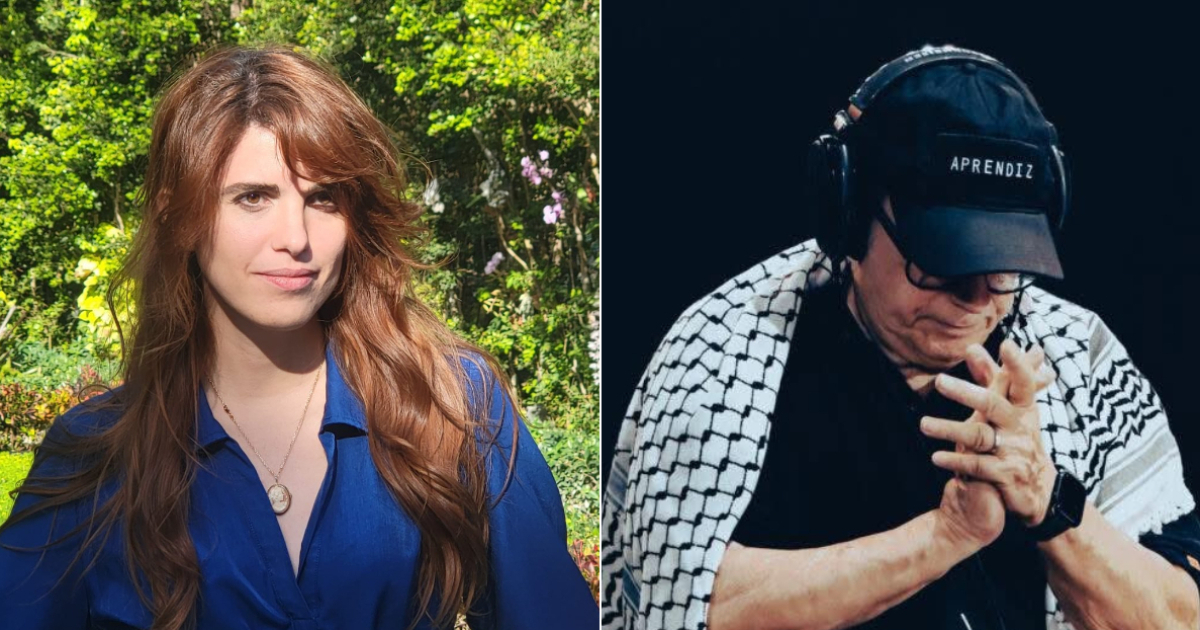
Carolina Barrero, Cuban art historian and activist in exile, has stirred public debate once again by harshly criticizing the troubadour Silvio Rodríguez following his latest concert.
In a message shared on social media, the opposition figure questioned that the singer-songwriter used symbols from another country on stage, instead of the national flag, in a context where —as she recalled— there are prisoners in Cuba for displaying the national emblem.
“Why isn't the Cuban flag being displayed? Are there people in Cuba imprisoned for using our flag, like Luis Manuel [Otero Alcántara] and the mambisa Agramontina?”, he wrote. For Barrero, Silvio's gesture is not a genuine act of solidarity with the Palestinians, but rather “a political exploitation of the tragedy, glaringly obvious.”
The activist, who for years has denounced the repression of the Cuban regime and has become one of its most visible critical voices abroad, accompanied her condemnation with a bleak diagnosis of the national reality.
He stated that the human and social crisis facing the island “surpasses that of almost all countries in the hemisphere,” marked by hunger, scarcity, illness, helplessness, and constant repression. In his opinion, this is not an inevitable fate nor an external problem, but rather the “extractive nature of the elite that Silvio associates with and protects.”
In this regard, Barrero pointed directly to GAESA, the military conglomerate that controls a significant part of the Cuban economy, and stated that its resources are abundant enough to address the energy crisis and the hunger of millions of Cubans, but they are used for purposes of enrichment and political control.
The criticism of Silvio fits into a narrative consistent with the allegations that Barrero has maintained in recent months.
Recently, she accused the military group GAESA of managing around eighteen billion dollars that are not allocated to health or electricity, and demanded that the European Union adopt direct sanctions against the leadership of the Communist Party to curb the regime's impunity.
In his speech, the contrast between official symbols and daily hardships is central: the flag, poetry, or artistic discourse lack value if they do not correspond to a genuine commitment to the people.
Barrero emphasized that this is not a debate about whether artists have the right to be neutral. In his view, that neutrality is a fallacy.
“Some say that Silvio doesn’t need to have a political stance as an artist; there is no greater fallacy than this idea. His political stance is very clear, and it is on the side of tyranny,” he stated.
With these words, the historian pointed to what she considers a calculated ambiguity of the troubadour, a balancing act that, in practice, ultimately aligns him with those who uphold the system.
Barrero's words confront the complex figure of Silvio Rodríguez, who in recent times has issued unusual criticisms of the Cuban government.
The troubadour himself has acknowledged the material and spiritual wear of the nation, the need for greater dialogue and sincerity, and even has criticized the ostentation of the elites amid poverty.
However, he has never renounced his identification with the so-called "Cuban revolution", and on several occasions, he has insisted that socialism still seems to him a more humane alternative than capitalism. This tension between loyalty to ideals and criticism of the present is what fuels debates like the one currently stirring Barrero.
The activist, who has turned her exile into a platform for denunciation, insists that the time for ambiguity is over. For her, Cuban artists cannot uphold foreign symbols while their own country sinks into scarcity and fear.
The poet said, “it reflects back like a mirror to the troubadour to show him his own deformity.” In that mirror, Barrero sees a Silvio who continues to choose to stand with power, even if he sings uncomfortable truths.
His reproach reveals something deeper: the demand for consistency between the public voice and the reality that millions of Cubans live.
In that regard, Barrero leaves no room for maneuver. International solidarity, he asserts, only makes sense when it does not become a pretext to divert attention from hunger, repression, and the lack of freedoms within Cuba.
Filed under: