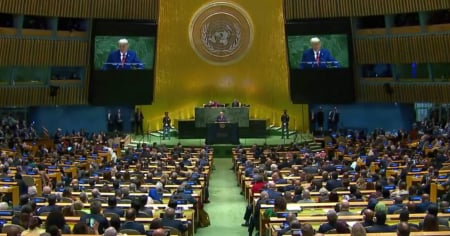
The President of the United States, Donald Trump, delivered a strong message on Tuesday at the UN General Assembly, where he accused several European countries of indirectly funding the war in Ukraine by continuing to purchase Russian oil and gas.
"China and India are the main financiers of the ongoing war, but unacceptably even NATO countries have not cut back much. They are buying Russian energy while fighting against Russia. It's shameful," stated Trump, who urged Europe to "immediately cease all energy purchases from Russia."
The leader warned that if Moscow is not willing to negotiate, his administration is prepared to impose "a very strong round of powerful tariffs" aimed at curbing the bloodshed, something he has been promising since mid-July but has not fulfilled despite the
However, he conditioned the effectiveness of that measure on European nations adopting the same sanctions. "Europe must intensify its efforts. We have an ocean in between; they are much closer to the city," he said, referring to the geographical proximity of the conflict.
Trump's statements come at a time of heightened tension following the downing of Russian drones over Poland, which led Warsaw to invoke Article 4 of NATO. In recent days, the president had already conditioned new U.S. sanctions on the requirement that European allies act first, generating criticism for his transactional approach.
The Secretary of the Treasury, Scott Bessent, supported the White House's stance by stating that “if the United States and the European Union partner together, the Russian economy will completely collapse and Putin will have no choice but to negotiate.” Bessent defended the tariff strategy as a driver of internal economic growth, despite the legal setbacks faced by some of Trump's measures.
Washington's pressure on Europe aims to shut down one of the main sources of income for the Kremlin. However, the energy dependence of countries like Hungary or Slovakia makes it difficult to reach a common stance within the European Union and NATO, leaving uncertainty about the West's ability to respond united to the Russian escalation.
The ambiguity of Trump and the European background
Although President Trump demanded that European countries "immediately cease all energy purchases from Russia," he refrained from directly pointing out the main culprits within NATO: Hungary and Slovakia, two members that maintain a high dependence on Russian oil and whose governments have taken openly pro-Russian positions.
In the case of Hungary, Prime Minister Viktor Orbán has refused to terminate contracts with Moscow, claiming that the country cannot easily replace the supply from the Druzhba pipeline.
In Slovakia, the government of Robert Fico presents a similar argument: the Bratislava refinery is adapted to Russian oil, and changing its technology would entail a huge cost. Both leaders have blocked harsher sanctions within the European Union, fueling the perception that they act as internal brakes against initiatives targeting the Kremlin.
Trump, however, chose not to mention them at the UN. Analysts interpret this silence as a deliberate gesture towards Orbán, a political ally with whom he has cultivated a close relationship.
This ambiguity also reflects Trump's transactional style: he raises the demand to cut Russian imports in general terms, but avoids holding specific countries accountable, which allows him to maintain diplomatic flexibility.
By tying any U.S. measures to joint action from Europe, it also conveys the idea that Washington will not bear the cost of new sanctions alone.
Critics of his strategy argue that this ambiguity indirectly benefits Moscow. By not exerting specific pressure on Hungary and Slovakia—the two weakest links in the European chain—and by tying sanctions to a consensus that is unlikely to be achieved, Trump gives Russia some respite amid the war in Ukraine.
A strategic ambiguity that favors Russia?
Analysts agree that Trump's generic discourse on ending Russian energy purchases—without identifying Hungary, Slovakia, or other specific governments—is not coincidental, but rather part of a calculated diplomatic and political strategy.
Mark Harrison, emeritus professor of economics at the University of Warwick, argues that some of the recent decisions made by the Trump administration “have directly benefited Russia, both in the war in Ukraine and in its economic confrontation with Europe.”
In statements to France 24, Harrison warned that “if Washington suspends critical military support or introduces exceptions to previously strict sanctions, it undermines global pressure on the Kremlin.”
Furthermore, reports about Hungary describe how its Prime Minister justifies the continuation of Russian oil imports with arguments related to energy security and existing infrastructure, while dismissing stricter sanctions as incompatible with national realities.
Hungary has been identified as one of the few NATO countries that publicly resists cutting those flows, partly supported by recent decisions from the White House that ease sanctions or waivers under the Trump administration.
This silence from Trump regarding specific countries serves several purposes: to preserve ideological allies like Viktor Orbán, to avoid open criticism within the Atlantic Alliance, and to condition tough actions on coordination that will likely be difficult to achieve.
For some specialists, this combination of strong rhetoric with selective application is precisely what allows Vladimir Putin to maintain maneuverability with at least some European buyers still in play.
In that context, the president's request at the UN for Europe to "cut all energy purchases from Russia" can be interpreted not just as a demand but as a strategic challenge. It is a call that, while raising the tone, also provides enough ambiguity for governments like those of Hungary or Slovakia to avoid immediate consequences by not being directly mentioned.
Filed under: