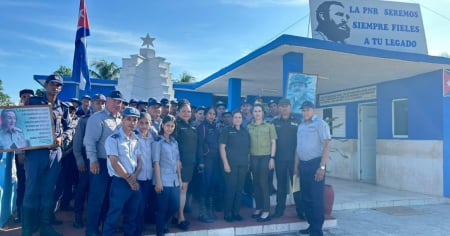
Since the weekend, the National Revolutionary Police (PNR) has intensified acts of revolutionary reaffirmation in various provinces, following the violent death of Captain Leonel Mesa Rodríguez, the sector chief in Caibarién, which has triggered a political and media offensive by the Cuban regime that presents the crime as a threat to the country's stability and a reason to tighten social control.
Mesa Rodríguez, 62 years old, was found dead in the early hours of Friday on a stretch of road between Remedios and Caibarién, with six stab wounds and a gunshot to the head. Next to his body was the official motorcycle he used for his work.
The alleged perpetrator was arrested in the city of Remedios and, according to the Ministry of the Interior (MININT), the official's service pistol and the knife used in the crime were seized.
Acts of Revolutionary Reaffirmation
According to Canal Caribe, just minutes before entering service in the Patrol Brigade of the General Directorate of Police, a ceremony took place where “the overwhelming support of the people” was reaffirmed and “the enemy's attempts to subvert order and tranquility” were condemned.
In Havana, all the capital's municipalities held similar ceremonies, reported Tribuna de La Habana, as part of a national movement to honor the murdered officer and to support the MININT.
On social media, the official profile Minint Hoy displayed images of police officers in Sancti Spíritus holding photos of Raúl Castro and reading statements of political commitment, a gesture that reinforces the ideological nature the regime has sought to impose on this crime.
The official reaction extended beyond the police force. The ruler Miguel Díaz-Canel also seized the opportunity to reinforce the discourse of social control.
During the beginning of the IV National Exercise for the prevention and combat of crime, he urged the need to ensure "citizen tranquility, social discipline, and respect for public order," at a time when protests are escalating across the country due to the economic crisis, blackouts, food shortages, and the collapse of basic services.
"The fight against crime must be a daily task," said the ruler in a message that coincides with the repression of peaceful protests, where dozens of Cubans have received sentences ranging from three to nine years in prison for shouting slogans like "Freedom" or "Homeland and Life."
Frequently asked questions about the situation in Cuba following the murder of Captain Leonel Mesa Rodríguez
What measures has the Cuban government taken following the assassination of Captain Leonel Mesa Rodríguez?
The Cuban government has strengthened social control and has organized acts of revolutionary reaffirmation in several provinces. Furthermore, the leader Miguel Díaz-Canel has called for ensuring “citizen tranquility, social discipline, and respect for internal order” in a context of growing social discontent due to the economic crisis, blackouts, and food shortages.
Who was responsible for the assassination of Captain Mesa and what is their current situation?
The alleged perpetrator of the murder was arrested in the city of Remedios and found in possession of the official's service pistol and the knife used in the crime. The Ministry of the Interior (MININT) has assured that a rigorous criminal process will be carried out in accordance with revolutionary justice.
How has the Cuban population reacted to the assassination of Captain Mesa?
The death of Captain Mesa has generated mixed reactions among the population. Some citizens have expressed support for the officer, highlighting his work in detaining criminals, while others have pointed to his involvement in repressive acts against the people, which has resulted in the imprisonment of individuals for their political beliefs opposing the regime.
What is the context of violence in Cuba in which Captain Mesa's murder occurred?
The murder of Captain Mesa occurs against a backdrop of rising violence and crime in Cuba, exacerbated by the economic and social crisis. The rates of theft, assaults, and homicides are increasing, and the public perceives a lack of effective action from the authorities, despite their efforts to project control through speeches and police deployments.
Filed under: