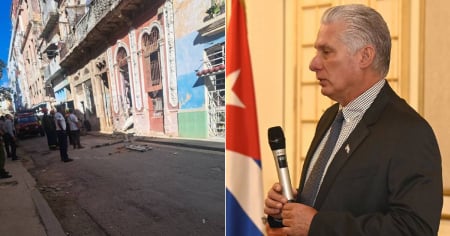
Miguel Díaz-Canel once again showcased the closeness of his Government to Beijing at an event held this Monday at the Palace of the Revolution, where he commemorated the 65th anniversary of the establishment of diplomatic relations between Cuba and China.
In a speech filled with praise, the leader defined the bilateral relationship as an "iron friendship" and praised the achievements of the Asian power, but avoided any reference to the problems that weigh heavily on Cubans daily.
"The Cuban people persist in the construction of socialism under extremely complex conditions. Creative resistance is our formula against attempts at suffocation," said Díaz-Canel, before proclaiming, "Long live the iron friendship between China and Cuba!"
While the leader expressed gratitude for Chinese cooperation in sectors such as biotechnology, energy, and security, he remained silent about the reality on the Island, where endless blackouts, a collapse of transportation, shortages of supplies in hospitals, and salaries that barely cover the basic needs persist.
A narrative disconnected from the street
The contrast between official rhetoric and the daily lives of Cubans is becoming increasingly evident. While Díaz-Canel spoke of the "deep friendship" with China and joint projects for the future, millions of families are struggling to cope with power outages lasting over 10 hours, facing endless queues to obtain food, and the uncertainty of not knowing how to survive the next month.
The speech is also framed within the intensification of ties with Beijing. Just one day earlier, Xi Jinping described the relationship with Cuba as "a model of solidarity among socialist countries" and assured that China is willing to strengthen cooperation in all areas. Havana, for its part, seeks economic and political support in this alliance, amid international isolation and growing internal discredit.
Frequently asked questions about the relationship between Cuba and China and the situation in Cuba
Why does Díaz-Canel emphasize so much the "iron friendship" with China?
Díaz-Canel highlights the "iron friendship" with China as a model of solidarity among socialist countries, in an effort to strengthen economic, political, and military cooperation. This relationship is essential for the Cuban regime amid internal crisis and international isolation. China emerges as a key ally providing economic, technological, and political support, allowing Cuba to seek relief from the severe economic situation it is facing.
How does the Cuba-China relationship affect the daily lives of Cubans?
Despite the praises for cooperation with China, the daily life of Cubans continues to be marked by blackouts, food shortages, and a lack of medical supplies. Although the Cuban government seeks to showcase the benefits of its relationship with China, the population has not seen significant improvements in their living conditions. The contrast between the official narrative and the reality on the island is becoming increasingly evident, deepening social unrest.
Why doesn't the Cuban government address internal issues during its international speeches?
The Cuban government tends to focus on its international relations and achievements in cooperation with countries like China, avoiding open discussions of internal problems such as the economic crisis, blackouts, and shortages in its official speeches. This approach aims to project strength and stability on the international stage, though in doing so it overlooks the immediate needs and concerns of the Cuban people, generating criticism and discontent.
What are the implications of military cooperation between Cuba and China?
The military cooperation between Cuba and China strengthens the strategic alliance between both countries, which may have significant implications for the balance of power in the region. This military approach has raised international concerns, particularly in the United States, due to the potential presence of Chinese military facilities on the island. The cooperation includes personnel exchanges and the elevation of military relations to a new level, which could further consolidate the authoritarian governance model in Cuba.
Filed under: