
Related videos:
The National Electric System (SEN) awoke this Tuesday with a deficit of over 1,100 megawatts (MW) and a forecast of blackouts of up to 1,840 MW during peak hours, marking the end of September as the most critical month of the year.
According to the official report from Unión Eléctrica (UNE), the peak impact on Monday reached 1,798 MW at 8:00 PM, with outages occurring throughout the day and into early this morning. At six in the morning, the availability of the National Electric System (SEN) was 1,670 MW, against a demand of 2,840 MW, leaving over 1,196 MW of consumption without support.
The report details that the Felton Unit 2, Nuevitas Unit 5, and Renté Units 3 and 5 remain out of service, while Santa Cruz Units 1 and 2 and Carlos Manuel de Céspedes Unit 4 in Cienfuegos are undergoing maintenance. Additionally, thermal limitations account for another 385 MW out of service.
Additionally, there is a lack of fuel: 43 distributed generation plants are inactive (398 MW), and 181 MW are unavailable due to a lack of lubricants, representing a total loss of 579 MW.
Although the 31 solar photovoltaic parks delivered 3,006 MWh on Monday with a peak of 597 MW, this contribution is insufficient to meet the growing demand.
The UNE forecasts that during the peak hours this Tuesday, the availability will be just 1,780 MW, compared to a demand of 3,550 MW, resulting in a deficit of 1,770 MW and blackouts of up to 1,840 MW if the expected conditions persist.
In the capital, the Electric Company of Havana reported on its social media that on Monday, the service was affected for more than 23 consecutive hours, with a maximum interruption of 170 MW at 8:50 PM.
Although the schedule anticipated rotating outages by blocks, the company acknowledged that all six blocks were affected, making it impossible to adhere to the established plan. At the end of the report, 40 MW were still out of service, and the entity reminded that these outages depend on the overall conditions of the SEN and do not always align with the planned schedule.
A September of collapses and protests
Official data confirms that September was the most challenging month of the year for the SEN. From the first week, blackouts of nearly 2,000 MW were reported, with outages lasting throughout the day and night.
On September 8, there was a partial blackout that left much of the eastern part of the country without electricity. Just two days later, on September 10,
The fifth collapse of the SEN in less than a year took days to resolve, highlighting the extreme vulnerability of the system. However, the leader Miguel Díaz-Canel proudly stated that they had managed to restore the SEN in "record time".
Throughout the month, daily deficits frequently exceeded 1,700 MW, with ongoing 24-hour outages. Breakdowns were compounded by fires and malfunctions at the main thermoelectric plants: Antonio Guiteras in Matanzas, Felton in Holguín, Renté in Santiago de Cuba, Máximo Gómez in Mariel, and Carlos Manuel de Céspedes in Cienfuegos.
Each incident took hundreds of megawatts out of service and forced reliance on distributed generation, which also could not be sustained due to a lack of diesel.
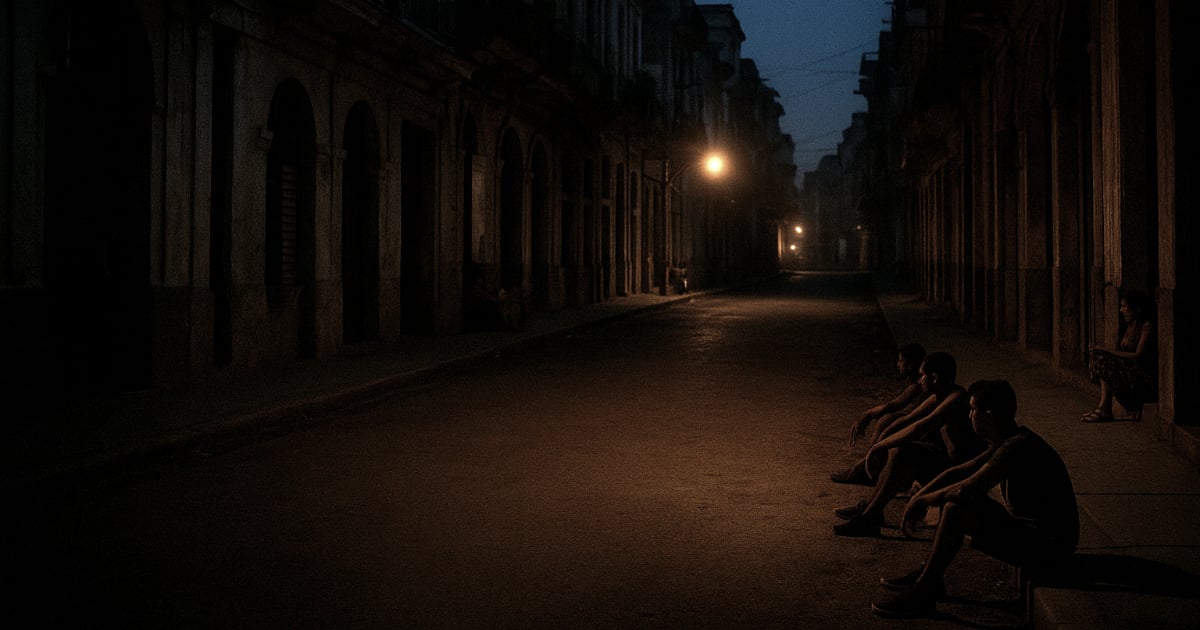
The decline in electrical service also sparked protests in various provinces. In neighborhoods of Havana, Santiago, and Holguín, residents took to the streets to demand the restoration of service after blackouts that exceeded 20 hours.
The sound of pots and pans, roadblocks, and shouts of “We want light!” multiplied during the most critical nights, under heavy police surveillance. Repression was swift and in Gibara, for example, arrests occurred along with the usual threats from State Security.
A system on the edge
With the end of September, the SEN is on the brink of technical and social collapse. The repeated general and partial blackouts, the escalation of deficits, and the inability to keep the main thermal plants operational reflect a system with no margin for immediate recovery.
The population, increasingly afflicted by the darkness, closes the month with the certainty that power outages will continue to define daily life in Cuba, as the energy crisis deepens without clear prospects for a solution.
Filed under: