
Related videos:
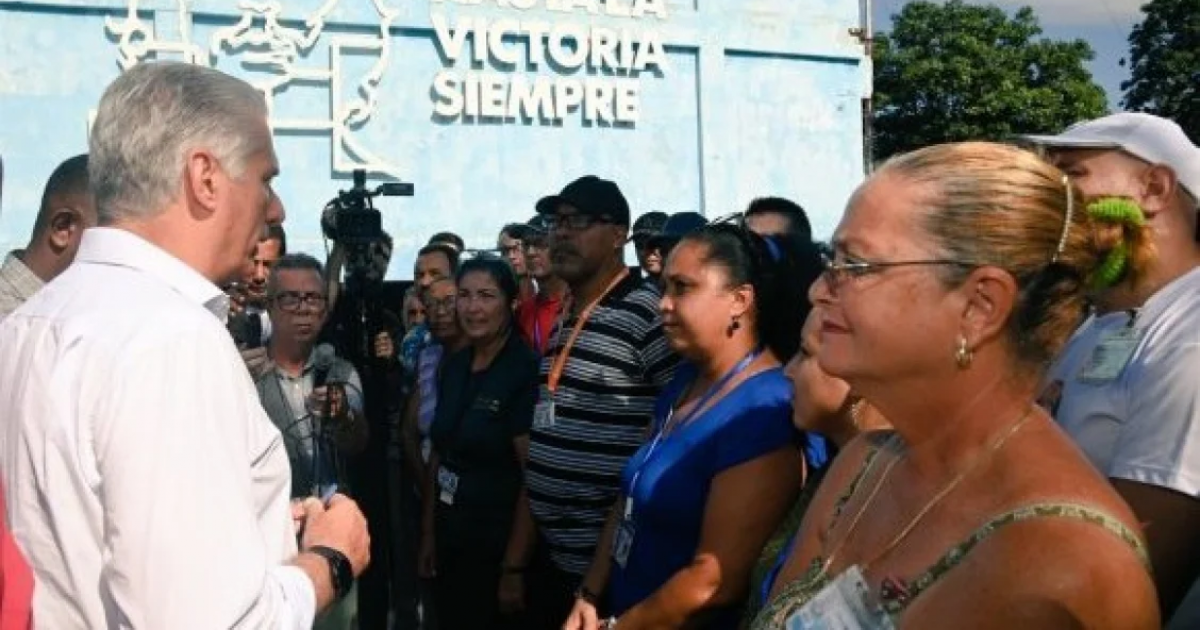
The Cuban leader Miguel Díaz-Canel visited the Diez de Octubre thermoelectric power plant, located in Nuevitas, Camagüey, and described it as a "source of pride" for its contribution to the national electrical system.
The plant had to stop last weekend due to limitations with demineralized water and then because of a breakdown in the transformer at the pumping station.
However, the newspaper Granma emphasizes its "encouraging image" following beautification efforts, the responsiveness of its staff, and the supposed robustness of its machinery, which is approaching four decades of operation.
But behind the shine of the institutional note, there are concrete issues that disprove that complacency: a lack of supplies and parts, repeated breakdowns, and units that do not come close to achieving the power for which they were designed.
All of this occurs while the country is undergoing a profound energy crisis that leaves Cubans with power outages that, according to public reports, exceed 20 hours a day in many areas.
Plant situation (according to official data)
According to official information, Diez de Octubre is currently supplying just over 150 MW to the National Electric System.
This contribution comes from two units with very different performances: Unit No. 5 was reconnected after being halted due to limitations in the supply of demineralized water and a malfunction in the transformer at the pump house, and today it provides 60 MW.
Unit No. 6, which theoretically has a nominal capacity of 120 MW, continues to generate a steady 95 MW.
The Ministry of Energy and Mines also announced an extended partial maintenance on Unit No. 5, with work scheduled to last about four months, during which that block will reduce or stop its output in order to "recover more capacity." However, it is explicitly acknowledged that once the work is completed, the block will not reach its nominal capacity of 120 MW.
The government speaks of external limitations: machines that have been in operation for nearly 40 years, the inability to import specific parts—the official reason attributed to the "blockade"—and the necessity to sustain operations thanks to the creativity of technicians and researchers.
Failures, stops, and promises
The institutional coverage displays the visiting protocol: the leader was briefed by executives on the organization and the "beautification" of the facility.
That festive narrative, however, avoided any serious diagnosis of the national energy gap, the accumulated energy deficit, and the tangible reality of massive blackouts affecting the population.
Worse yet, it is casually acknowledged in advertisements that Unit No. 5 will undergo maintenance for about four months, leading to another prolonged reduction in capacity, which will affect the electricity supply to homes, workplaces, educational institutions, and businesses.
Taking a block out of service for several months under the current conditions is not just a simple "technical job"; it is a decision that has direct consequences on the daily lives of millions.
What the numbers say: less power, greater risk of blackouts
The concrete figures must be read without euphemisms. If Unit 6 only delivers 95 MW against a nominal of 120 MW, and Unit 5 operates at 60 MW and will undergo a long-term shutdown, the total indicates a plant far from its projected performance.
That gap is not neutral: it reduces the country's installed capacity just when demand remains, and the "islands" of distributed generation are insufficient to cover deficits.
Furthermore, the recent incidents—stoppages due to a lack of demineralized water, breakdowns in transformers, and limitations on importing spare parts—suggest a pattern that does not appear to be coincidental.
The aging of the infrastructure, reliance on makeshift solutions, and the inability to maintain critical spare parts explain why outages and disruptions are recurring and spreading.
The figures and the failures highlight structural decisions that have been postponed: sustained investment in renovations, purchases of critical spare parts, international maintenance contracts, genuine diversification of the power matrix, and verified plans to reduce reliance on obsolete thermal power plants.
Meanwhile, the population continues to bear the cost of inaction with prolonged blackouts and intermittent public services.
Scheduled maintenance, imminent social bill
The presidential visit and the praise for the teams and workers do not change a fundamental fact: Diez de Octubre, rather than being a reason for acclaim, is an example of the system's fragility.
The upcoming shutdown for maintenance of Unit No. 5 for several months and the limited performance of Unit No. 6 indicate that the generation supply will decrease even further, amid the ongoing power crisis.
In the absence of a public and transparent plan to replace or repair what is essential, the official response is limited to proclamations and symbolic acts, while leaving the blackouts that affect citizens' daily lives unanswered.
If there is a genuine will to address the structural problem, the way forward involves prioritizing real investments, ensuring transparency in generation and demand balances, and making decisions that go beyond mere appearances.
Frequently Asked Questions About the Nuevitas Thermoelectric Plant and the Energy Crisis in Cuba
Why is the Nuevitas thermoelectric plant considered a "source of pride" according to Díaz-Canel?
Díaz-Canel described the Nuevitas thermoelectric plant as a "source of pride" for its contribution to the National Electric System despite the limitations and malfunctions it faces. During his visit, he emphasized the "encouraging" image of the plant and the responsiveness of the staff, although these statements contrast with the realities of repeated breakdowns and reduced generation capacity.
What is the current situation of the Diez de Octubre thermoelectric plant in Nuevitas?
Currently, the Diez de Octubre thermoelectric plant is supplying just over 150 MW to the National Electric System. Unit No. 5 contributes 60 MW after being offline due to breakdowns, while Unit No. 6 generates 95 MW, although its nominal capacity is 120 MW. A four-month maintenance period has been scheduled for Unit No. 5, which will further reduce its output.
What are the causes of frequent blackouts in Cuba?
Power outages in Cuba are the result of outdated thermoelectric plants, a lack of supplies and parts, and a deficit in electricity generation. The situation is worsened by the inability to import spare parts due to the "blockade" and reliance on makeshift solutions. These conditions have led to electrical outages exceeding 20 hours a day in several regions.
What measures is the Cuban government taking to address the energy crisis?
The Cuban government has announced investments in photovoltaic generation, repairs in thermal power plants, and the use of distributed generation. However, these measures have not yet managed to stabilize the electric system. Additionally, salary increases and food deliveries have been implemented for workers in the electric sector to curb labor exodus.
Filed under: