
Related videos:
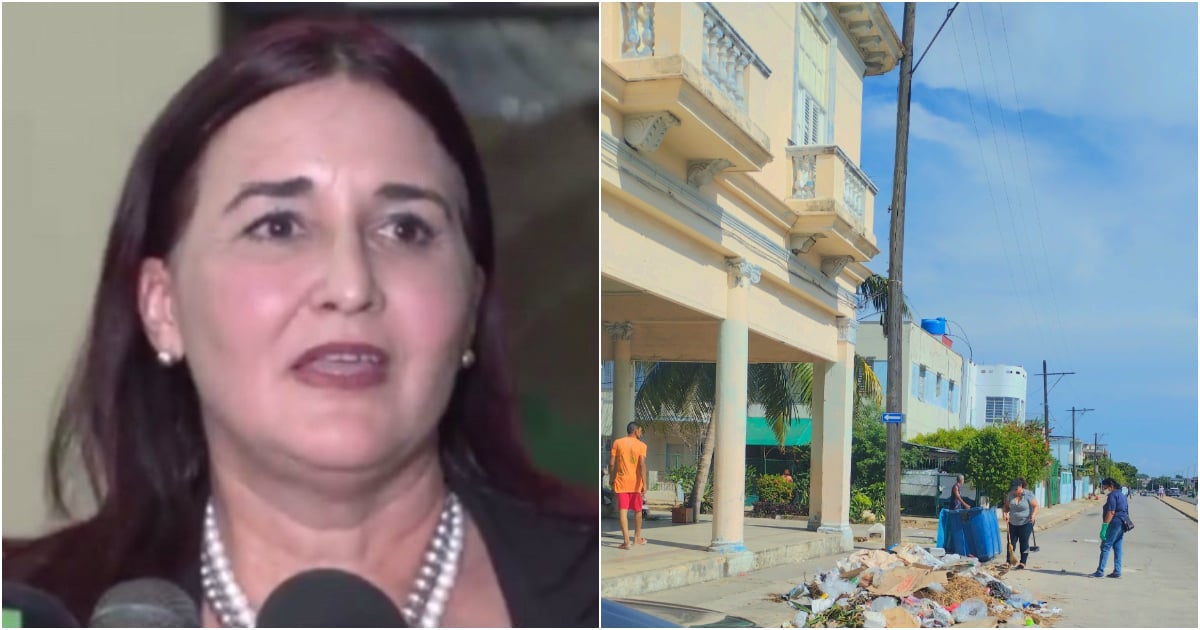
The Deputy Director General for the United States at the Ministry of Foreign Affairs (Minrex), Johana Tablada, participated today in a volunteer cleanup activity in Havana, where she shared photos and reflections on the day.
The gesture, presented as a demonstration of civic commitment, contrasts with her own statements from last August, when she publicly downplayed the garbage issue in Cuba.
“Today many colleagues from the Ministry of Foreign Affairs joined in volunteer work to clean up areas of the city... I am very glad to have felt useful,” Tablada wrote on his Facebook profile, where he described how officials from Minrex cleaned part of 31st Avenue in the capital municipality of Playa.
In his post, he acknowledged that there has been "a large garbage pile at the corner for months" in his own neighborhood and that the collection truck "doesn't come as often as needed," which prevents residents from maintaining cleanliness.
The contrast is striking: in August, during an interview on the video podcast Alma Plus, the diplomat downplayed the accumulation of waste, stating that “Cuba is not the country with the most trash in the world.”
En ese momento, culpó a medios independientes y a las políticas de Estados Unidos por la “demonización” del tema.
It is true that there is garbage on the streets, but we are not the only city with hygiene problems, he stated.
Her recent participation in the cleanup takes place amidst a sanitary and environmental crisis affecting all of Havana, where micro-dumps, uncollected waste, and overflowing pits are accumulating in numerous neighborhoods.
Despite repeated citizen complaints, the authorities have insisted that the situation is more about "social indiscipline" than structural failures in the sanitation system.
The publication by Tablada—featuring "before and after" photos of a particularly dirty corner—provoked mixed reactions: some applauded the initiative, while others reminded him of the need for the Comunales Company to fulfill its role on the days when there is no volunteer work.
In this regard, Tablada herself emphasized: “Exactly, and that is what is failing the most, in addition to the good habits of people who throw waste anywhere.”
In any case, the official seems to have transitioned from justifying the mess to trying to sweep up what wasn't accomplished with words.
The ruler Miguel Díaz-Canel presided over an emergency meeting with senior leaders of the Communist Party and the Armed Forces, where the energy crisis, accumulated garbage, and water supply were discussed, triggering public outrage.
In this regard, authorities declared this Saturday a "clean-up day" and have mobilized recruits, police officers, and state workers with the aim of cleaning a capital overwhelmed by trash.
Recently, the Minister of Science, Technology, and Environment (Citma), Armando Rodríguez Batista, publicly acknowledged the seriousness of the health crisis in the capital by admitting that “this trash is not contained: it is scattered all over Havana.”
In this regard, the official journalist Ana Teresa Badía was emphatic in stating that “Havana smells like garbage”, through a post on her Facebook account in which she criticized the accumulation of tons of waste in streets and corners without timely collection.
In his brief reflection, Badía stated that "there is a rampant institutional indifference. Let’s not blame only the blockade; there are things like empathy, hard work, and respect for citizens that do not depend on any blockade."
Filed under: