
Related videos:
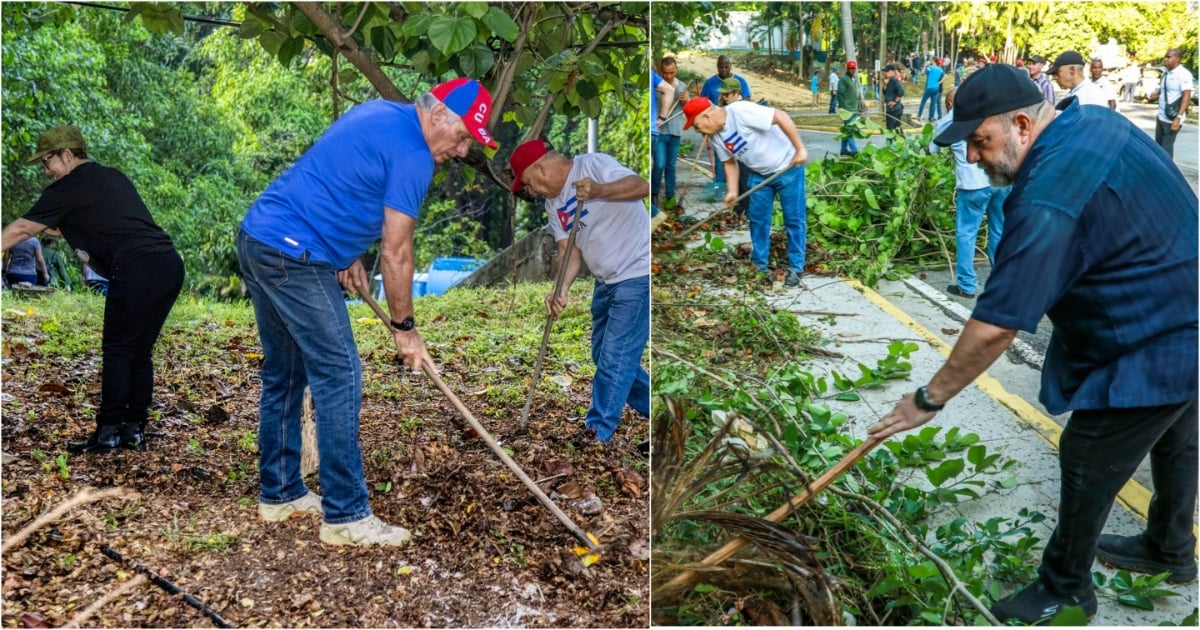
The ruling Miguel Díaz-Canel and the regime's Prime Minister Manuel Marrero Cruz wanted to appear in the photo and "participate in the cleaning campaign" called in Havana amidst the health crisis.
"President Díaz-Canel participated this morning in the cleaning efforts in Havana, alongside workers from the Palace of the Revolution and the Central Committee, Prime Minister Marrero Cruz, the Secretary of Organization, Dr. Roberto M. Ojeda, and other leaders of the country,” reads in a thread on X from the Presidency of Cuba.
According to the images, this is yet another example of the disconnection between the ruling elite and the Cuban people: Díaz-Canel attended the volunteer work wearing Lowa boots (German) worth over $200, while Marrero donned a pair of Sketchers sports shoes, a U.S. brand that likely costs between $80 and $90.
The government convened this weekend for a campaign to clean the streets of a Havana flooded with garbage, mobilizing recruits, police officers, and state workers. Nevertheless, Díaz-Canel acknowledged that the turnout was not as he had hoped.
"But it's not all rosy. A large part has mobilized, but some have not shown up and believe that others should solve the problem," he said.
The leader hopes that his call will mobilize the country: "I also believe that now the people driven by Havana will do their part in each territory. In the end, what multiplies is the effort of Cubans for the well-being of all," the president emphasized.
However, the structural crisis does not appear to have a solution: "The issue has not only been about sanitation. There is a strong effort underway to address the electrical situation, and significant work is being done to improve water supply to the population in the city," it was justified.
For many Cubans, Díaz-Canel's gesture is just another charade from the elite while the country sinks without them offering any solutions.
“They started cleaning the Palace, but the trash is you,” said a Cuban; “Sunday theater,” another one declared.
The streets of Havana have become a visible symbol of national decay. The piles of accumulated waste, the persistent stench, the endless blackouts, and the scarcity of drinking water paint a daily picture of a capital engulfed in chaos.
This is joined by the recent protests and noise demonstrations reported in neighborhoods such as Centro Habana and Regla, where residents took to the streets to demand solutions due to the lack of electricity and water for several consecutive days.
Frequently Asked Questions about the Sanitation Crisis and Management in Cuba
What motivated the sanitation day in Havana led by Díaz-Canel and Marrero?
The sanitation campaign in Havana was prompted by the crisis of unsanitary conditions in the city, with piles of garbage accumulating in the streets. The Cuban government, led by Miguel Díaz-Canel and Manuel Marrero, organized this initiative in response to the increasing buildup of waste and the criticism over the lack of effective management. However, the involvement of the leaders was seen by many Cubans as another act of propaganda without real solutions to the structural deterioration of the country.
What are the main criticisms of the Cuban population towards the government regarding the management of the health crisis?
The main criticisms from the Cuban population towards the government focus on the lack of effective solutions and the tendency to blame the people for structural problems. Citizens accuse the regime of hiding its inefficiency behind the U.S. embargo, while corruption and state neglect proliferate. Furthermore, the repression against those who protest due to the lack of basic services such as electricity and water generates increasing social discontent.
How has the Cuban government reacted to the recent protests in Havana?
The Cuban government has responded to the protests with warnings of repressive measures and an increased military presence in the capital. Miguel Díaz-Canel has labeled the demonstrations as "unacceptable" and has ordered the mobilization of the Revolutionary Armed Forces and the Ministry of the Interior to control social discontent. However, this response has been criticized for criminalizing civic protest and not addressing the underlying causes of the demonstrations, such as prolonged blackouts and a lack of water.
What structural problems is Havana currently facing?
Havana is facing serious structural problems, including prolonged blackouts, a shortage of drinking water, and a sanitation crisis with piles of garbage accumulating in its streets. These issues have been exacerbated by outdated infrastructure and a lack of investment in basic services, leading to an increase in social discontent and protests in various neighborhoods of the capital.
Filed under: