
Related videos:
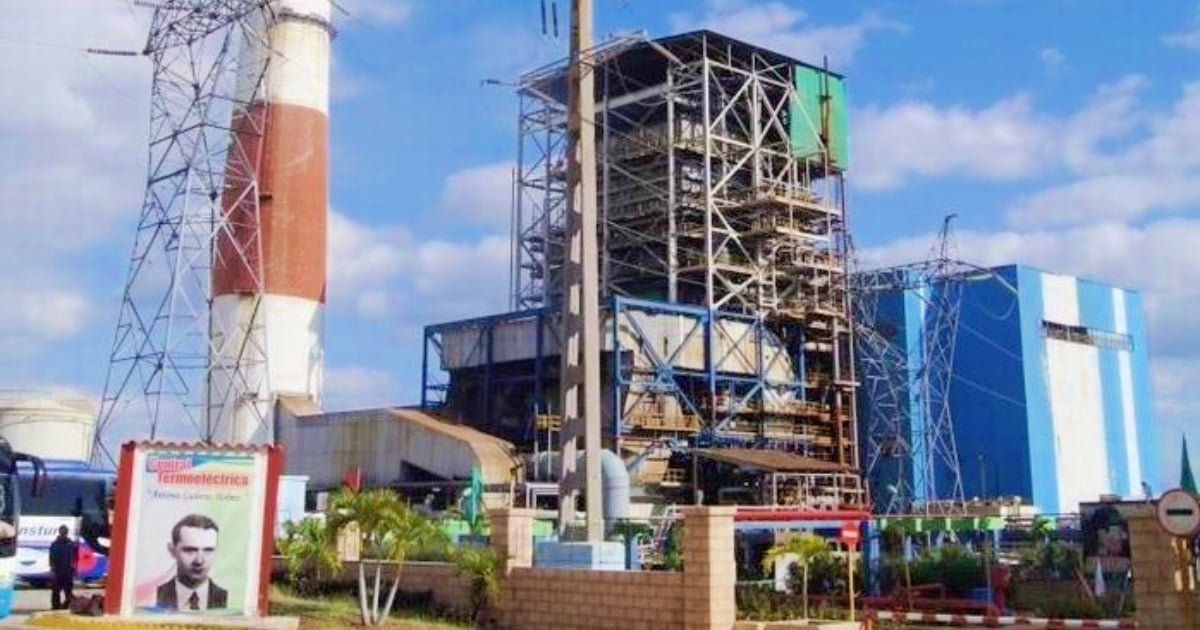
The Antonio Guiteras power plant, the most important in the country, went offline from the National Electric System (SEN) on Tuesday morning, as reported by the Electric Union (UNE) in a brief post on social media.
The UNE only stated that the Guiteras went offline due to a "boiler failure."
The breakdown occurred at 9:28 a.m. (local time).
Up to the closing of this note, no further details have been released regarding the circumstances surrounding the latest failure of Cuba's most important thermoelectric plant.
The worst part is that a couple of hours before the departure of the Guiteras from SEN, UNE reported the departure at 6:55 a.m. (local time) of Unit 6 of Energás Jaruco.
In that case, the reason stated was the presence of "sargassum in the entrance channel of the BC-4705."
Before the two incidents, the forecast for power outages today was 1,740 MW.
After the two reported breakdowns now, the forecast for electrical interruptions could rise significantly.
According to the UNE, the service was disrupted for 24 hours yesterday and remained affected throughout the early morning today.
The highest impact due to generation capacity deficit yesterday was 1,765 MW at 7:40 PM, with demand exceeding what was planned.
The energy production from the 32 new photovoltaic solar parks was 3,271 MWh, with a maximum output of 591 MW during peak hours with this energy source.
The availability of the SEN at 6:00 a.m. was 1,680 MW, while the demand was 2,730 MW, resulting in a capacity deficit of 1,082 MW. During peak hours, an estimated impact of 1,150 MW was anticipated.
Before the Guiteras exit and unit 6 of Energás Jaruco, they were out of the SEN:
Outage: Unit 2 of the Felton CTE, Unit 3 of Santa Cruz, Unit 8 of Mariel, and Units 3, 5, and 6 of the Renté CTE.
Maintenance: Unit 1 and 2 of the CTE Santa Cruz and Unit 4 of the CTE Carlos Manuel de Céspedes in Cienfuegos.
Thermal limitations: 307 MW out of service.
Problems due to lack of fuel: 54 distributed generation plants with 270 MW and 229 MW unavailable due to lack of lubricant, resulting in a total of 499 MW affected by this issue.
For the peak, the recovery of 50 MW in distributed generation engines that are offline due to fuel is estimated.
With this forecast during peak hours, a capacity of 1,730 MW is estimated against a maximum demand of 3,400 MW, resulting in a deficit of 1,670 MW. Therefore, if the anticipated conditions persist, a shortfall of 1,740 MW is predicted during this time.
The blame is on the "Blockade."
At the end of September, Miguel Díaz-Canel held the U.S. embargo responsible for the prolonged blackouts affecting millions of Cubans.
In a video shared on Facebook by Díaz-Canel, the director of the Antonio Guiteras Thermoelectric Plant, Rubén Campos, stated that the Guiteras "is the industry in Cuba most affected by the intensification of the blockade."
The ruler accompanied the recording with a message in which he stated that the explanation was "simple, concrete, and graphic" regarding the harsh daily life of the workers at Guiteras, in an attempt to directly link the electricity crisis to the sanctions from Washington.
Campos reported that the situation changed drastically in 2015, when the American multinational General Electric acquired the French firm Alstom, which was originally responsible for manufacturing and maintaining the plant. As he explained, Alstom's exit from the financing and supply scheme left Guiteras without support for critical parts.
The executive presented specific examples: bombs and valves returned from Jamaica to France for containing parts of U.S. origin, speed regulators valued at one million dollars that were not delivered despite being paid for, and foreign specialists who canceled their trip to Cuba at the last minute due to pressures.
"You may have money, but if you don't have a bank to work with, it's like you have none at all. It's very difficult. There is constant surveillance from the empire regarding us [...] That is the reality of the blockade, and believe me, I am not exaggerating at all," the executive concluded.
The official discourse is repeated
The words of Campos and the publication by Díaz-Canel add to a long string of official justifications.
In May, the Deputy Minister of Energy and Mines, Argelio Jesús Abad Vigoa, stated in the Mesa Redonda that “blackouts are a consequence of the criminal American blockade, it’s not just talk”.
The director of the Electric Union acknowledged in that same forum that the situation of the system was "serious," and that they could not rotate the circuits due to the magnitude of the deficit.
More recently, Díaz-Canel requested to "improve the electrical scheduling" to distribute power outages more equitably, acknowledging that some provinces experience more than 25 consecutive hours without electricity, while others face fewer interruptions.
Frequently asked questions about the energy crisis in Cuba and the Antonio Guiteras thermoelectric plant
Why is the Antonio Guiteras thermoelectric plant so important to the Cuban electrical system?
The Antonio Guiteras thermoelectric power plant is crucial for the Cuban electrical system because it is the most important plant in the country, with a significant generation capacity exceeding 200 megawatts. Its departure from the National Electric System represents a considerable decrease in the operational capacity of the system, worsening the energy crisis in Cuba.
What is the most recent cause of the shutdown of the Antonio Guiteras power plant?
The most recent cause of the Antonio Guiteras thermoelectric plant's departure from the National Electric System was a "boiler failure." This type of malfunction is recurrent and reflects the deterioration of Cuba's energy infrastructure.
What impact do thermal power plant failures have on blackouts in Cuba?
The breakdowns at the Antonio Guiteras power plant intensify blackouts in Cuba, as its shutdown drastically reduces the country's energy generation capacity. This results in prolonged and widespread blackouts, impacting millions of Cubans daily.
What is the Cuban government's response to the current energy crisis?
The Cuban government has blamed the U.S. embargo for the prolonged blackouts, arguing that the sanctions hinder the acquisition of parts and services necessary for the maintenance of thermal power plants. However, this official explanation has been criticized by many, as the deterioration of the electrical infrastructure is evident.
Filed under: