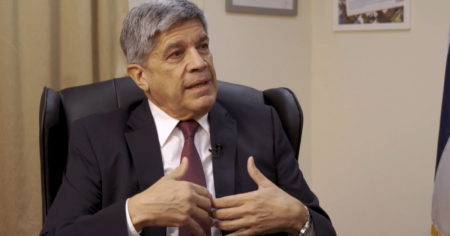
The Minister of Defense of Venezuela, Vladimir Padrino López, announced that the Armed Forces are conducting maneuvers “in response to the hypothesis” of a possible “military aggression” from the United States, whose naval deployment in the Caribbean Sea is regarded by Caracas as a “threat” and an attempt to instigate a “regime change.”
The statements were made during a broadcast on Venezolana de Televisión (VTV) where the Chavista leader stated that he is not seeking “alarmism,” but “realism,” and urged the public to prepare for tense scenarios.
Padrino López stated that, as a military leader, he must “always assume the worst-case scenario” and justified the exercises as part of comprehensive defense. The government interprets the presence of U.S. ships and aircraft as an attempt to promote a “regime change.”
The maneuvers extend across strategic areas, with an emphasis on the island axis and the western borders.
In Nueva Esparta (Margarita Island), a coastal defense exercise was conducted—including maritime patrols, reconnaissance flights, and paratrooper drops—that led to a temporary restriction on maritime traffic to the north of the island.
In the Zulia state, the regional government reported that more than 15,000 officials are participating in coordinated deployments with the FANB and police forces to enhance surveillance in municipalities bordering Colombia, while monitoring oil facilities and pipelines.
In Táchira, military commanders highlighted communication and control exercises with directing bodies in the 29 municipalities, and reaffirmed that the border crossings operate during their usual hours.
The state of Apure reinforced security presence with 2,500 officials along nearly 800 kilometers of border, focusing on migration, citizen control, and commercial transit.
In the eastern part of the country, the operation "Cumanagoto 200" in Sucre reported the destruction of 14 logistical bases linked to drug trafficking, the detention of 12 vessels, and the seizure of fuel and weapons.
Falcón activated integral defense organs in its 25 municipalities to plan and coordinate protection actions, while on the central coast there was mobilization and training at critical points such as the Maiquetía airport and the La Guaira port.
The official of the Maduro regime insists that “nobody wants war” and that he will continue the diplomatic route in regional and multilateral forums, although he will not neglect training.
So far, the total duration of the maneuvers and the means involved have not been detailed, beyond regional reports of deployment and the coordination between civil and military authorities.
Currently, the United States maintains at least eight warships in the region, in addition to a fast attack nuclear submarine and over 4,500 soldiers, as part of an operation in the Caribbean Sea.
Washington has also deployed state-of-the-art F-35B fighter jets in Puerto Rico to strengthen operations against drug trafficking from Venezuela and other South American countries, a claim that Caracas rejects and considers an act of hostility.
Frequently asked questions about Venezuela's military maneuvers and tensions with the U.S.
Why is Venezuela conducting military maneuvers in the Caribbean?
Venezuela conducts military maneuvers in the Caribbean in response to what it sees as a threat of military aggression from the United States. According to Defense Minister Vladimir Padrino López, the U.S. military deployment in the region is viewed as an attempt to instigate a regime change in Caracas. The maneuvers focus on the comprehensive defense of the country, particularly in strategic areas such as the island axis and the western borders.
What is the U.S. response to the Venezuelan military deployment?
The U.S. has strengthened its military presence in the Caribbean with warships, submarines, and F-35 aircraft, arguing that its operations focus on the fight against drug trafficking. However, Caracas interprets these actions as a provocation and a threat to its sovereignty, denouncing that they aim to pressure for a regime change in Venezuela. The Trump administration has authorized military actions in the region with the goal of combating drug trafficking, but with clear political implications.
What measures has Venezuela taken at the borders with Colombia?
Venezuela has deployed over 15,000 officials in coordination with the Bolivarian National Armed Force and police bodies along the borders with Colombia to enhance surveillance. These actions are part of national defense exercises in response to the alleged U.S. threat, and they also aim to monitor and protect oil facilities and combat drug trafficking.
What is the Cartel de los Soles and what is its relationship with the Venezuelan government?
The Cartel of the Suns is an organization designated by the U.S. as a narcoterrorist group and is accused of being led by high-ranking officials of Chavismo, including Nicolás Maduro. Washington asserts that the Venezuelan government uses state institutions to traffic drugs to the U.S. In response, the Trump administration has intensified military actions and sanctions against Maduro's regime, aiming to apply pressure for political change in Venezuela.
Filed under: