
Related videos:
At a time of growing tension in the Caribbean, the Ministry of Foreign Relations of Cuba (MINREX) released a statement reiterating “the firm and unwavering support” for the regime of Nicolás Maduro, while warning that a pretext for direct military aggression against Venezuela might be developing.
According to Havana, the accumulation of U.S. military assets in the southern Caribbean, combat incursions into Venezuelan airspace, the destruction of civilian vessels, and the announcement of operations in land areas represent a deliberate pattern with interventionist aims.
The statement used language that appeals to International Law and the United Nations Charter, asserting that an unauthorized military action against Venezuela would violate the purposes and principles of the international community.
In that regard, Havana maintained that a direct aggression would not only undermine Venezuela's sovereignty but would also trigger a regional conflict with incalculable consequences for peace, security, and stability in Latin America and the Caribbean.
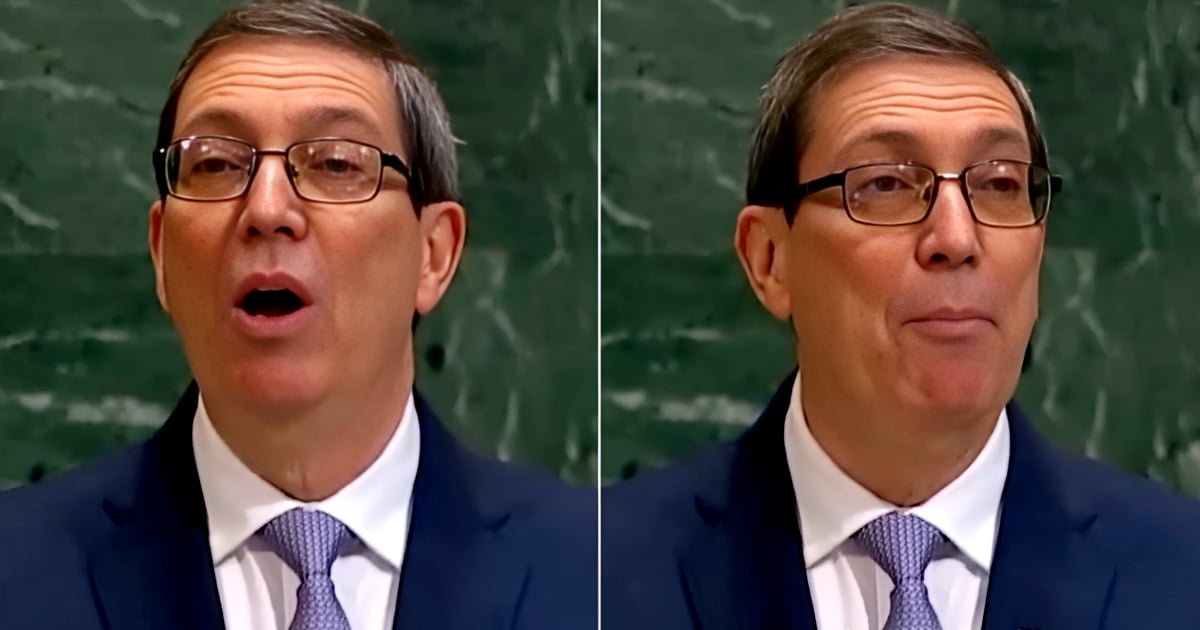
However, this statement does not emerge without contradictions or internal differences. In recent weeks, the Cuban Foreign Minister Bruno Rodríguez Parrilla gave an interview to CNN, during which he reaffirmed Cuba's support for the Venezuelan government in the face of what he described as a "direct threat" from the U.S.
However, when asked if that support could possibly include military intervention in the event of a U.S. aggression, Rodríguez avoided giving a clear answer: “It is a hypothetical case. When you inform me that a U.S. military intervention has occurred, I will tell you,” he stated.
Its ambiguity created room for doubts about to what extent Cuba would be willing to shift from diplomatic support to actual military backing.
For his part, the Cuban Deputy Foreign Minister, Carlos Fernández de Cossío, was more direct and, while expressing "great concern" over the possibility of a military conflict between the United States and Venezuela, dismissed the hypothetical involvement of Cuba in the war.
Cuba will not go to war with the United States, it will provide total political support to Venezuela, solidarity support,” said Fernández de Cossío in an exclusive interview with Mehdi Hassan from Zeteo during the United Nations General Assembly in New York.
Analysts assess the statements from Havana as a “salon-based anti-imperialism”, a rhetorical stance disconnected from the revolutionary epic committed to combat and more akin to a propaganda ritual for internal consumption: “lots of symbolism, elaborate staging, empty rhetoric, and no real capacity to respond” to increasingly bold U.S. actions.
According to these analyses, the "solidarity" signature campaign initiated by the Cuban regime in support of its main ally in the region becomes a demonstration of the disconnect between rhetoric and actual power.
Meanwhile, in Caracas, the Bolivarian regime has enacted decrees such as the one for “external commotion” to grant special powers to the Executive in the event of an external aggression, which indicates the level of internal unease.
In parallel, the U.S. maritime and aerial deployment —which includes destroyers, nuclear submarines, and next-generation fighters— has been officially justified by Washington as part of its strategy against drug trafficking, although critics argue that such operations exceed any plausible framework for combating organized crime.
In this context, the statement from the Cuban Foreign Minister represents a reaffirmation of the political and ideological pact that Havana maintains with chavismo, but it does not clarify whether this pact would entail military or strategic sacrifices in the event of an escalation.
The question remains open: is Cuba willing to risk an armed conflict against the United States over Venezuela, or will its support be limited to speeches, statements, and symbolic acts?
In the face of a possible direct military escalation, Havana plays its remaining old and worn-out cards: agitation and propaganda, statements of condemnation, and the victimization it resorts to whenever it feels its statu quo is threatened.
Filed under: