
Related videos:
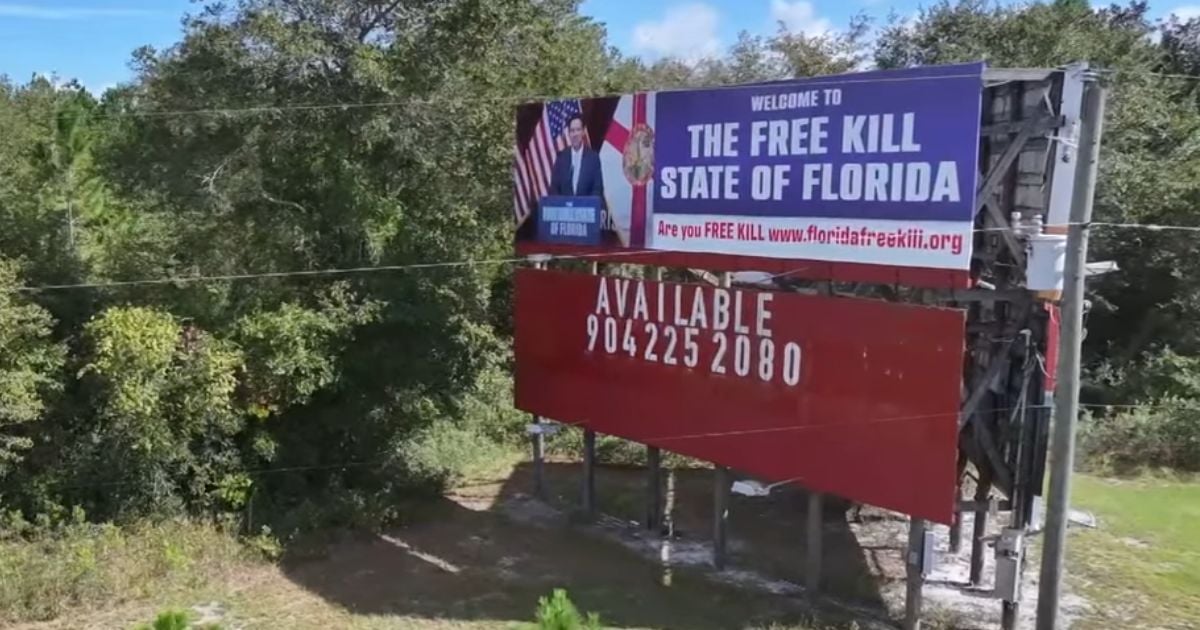
A sign at the border of Florida welcomes travelers with the message: “Welcome to the state of free murder,” a direct denunciation of the legal system that denies justice for medical deaths.
According to the news portal Florida Politics, a law in effect in the state since 1990 prevents certain families from suing for non-economic damages when a loved one dies due to medical negligence.
If the victim is 25 years old or older, is single, and has no minor children, the State considers that their relatives do not have a legal right to claim for pain, mourning, or loss of companionship.
The measure, which is part of an exemption to the state's Wrongful Death Act, was designed to protect insurers and healthcare providers, according to activists' claims.
This year, the Florida Legislature voted overwhelmingly to eliminate that exception, but Governor Ron DeSantis vetoed the law, arguing that it could drive up healthcare system costs.
In response, Daryl Perritt, a restorer from St. Augustine whose son Cameron died at 33 in a hospital where he had previously warned about his condition, decided to launch a public campaign against the law.
It was he who paid for a billboard placed on the I-95 highway, just before the Florida Welcome Center, where it reads: “Welcome to the Free Kill State of Florida.”
Perritt stated that millions of residents are unaware that they lose rights simply by reaching a certain age.
“Adults with Down syndrome and autism rarely get married or have children, but when they turn 25, they lose all their rights in medical facilities in Florida,” he said.
She also reported that her mother-in-law, when moving from New Jersey, unknowingly lost legal protections.
Another critical voice is Cindy Jenkins, the mother of Taylor Jenkins, a young woman who died due to medical negligence three months after turning 25.
The hospital misdiagnosed the cause of death, according to a private autopsy paid for by the family.
“If Taylor had died three months earlier, I could have sought justice,” lamented Jenkins, who added: “This law treated her life and her death as if they had no value.”
Jenkins and Perritt are part of a campaign to install more signs throughout the state and to pressure lawmakers who opposed the repeal.
Representative Dana Trabulsy has already reintroduced the bill as HB 6003 for the upcoming legislative session, which begins in January. Her version does not include compensation caps.
Republican Senator Clay Yarborough had proposed an amendment with a cap of up to one million dollars in compensation, but it was rejected by a single vote. He has already indicated that he will not resubmit the initiative in 2026.
"Opposition to 'free kill' is not partisan," said Jenkins, who also emphasized: "93% of legislators voted to eliminate this injustice. But DeSantis only talked about the economic cost, not the human cost."
Frequently Asked Questions about the Wrongful Death Law in Florida and Its Impact on Legal Rights
What is the exception to the Wrongful Death Act in Florida?
The exception to the Wrongful Death Act in Florida is a law that prevents certain families from suing for non-economic damages when a loved one dies due to medical negligence, if the victim is over 25 years old, single, and has no minor children. This measure protects insurers and healthcare providers and has been criticized for limiting access to justice for many families.
Why did Governor Ron DeSantis veto the proposal to eliminate this exception?
Governor Ron DeSantis vetoed the proposal to eliminate the exception to the Wrongful Death Act, arguing that it could drive up healthcare costs. This decision has been criticized for not considering the human impact and the injustice it represents for the affected families.
What actions are the families affected by this law in Florida taking?
The affected families are organizing public campaigns, such as putting up posters to denounce the injustice of the law and to pressure legislators to revoke the exception. These actions aim to raise public awareness and mobilize support to change the current legislation.
How does this law affect adults with disabilities in Florida?
Adults with disabilities such as Down syndrome or autism, who rarely marry or have children, lose legal rights upon turning 25 in Florida under this law. This leaves their families without the option to seek justice in cases of medical negligence.
Filed under: