
Related videos:
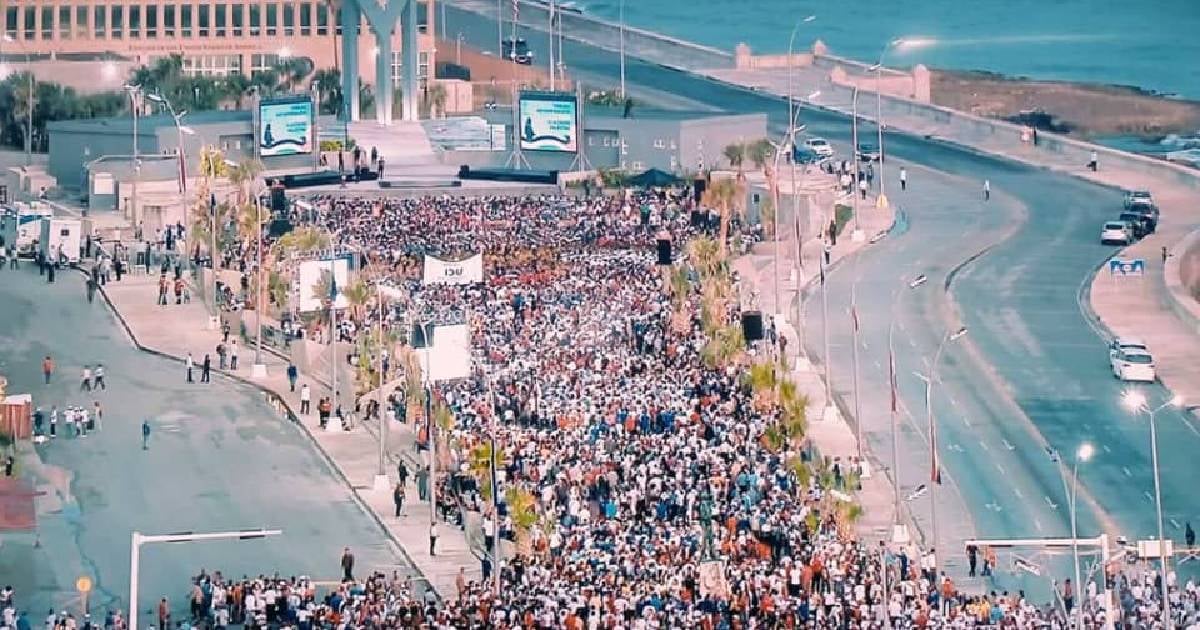
The Cuban regime claimed on Thursday that more than 100,000 Havana residents participated in an official demonstration held at the José Martí Anti-Imperialist Tribune in front of the United States Embassy in Havana. However, independent estimates based on aerial images of the event suggest that the actual number could be three to six times lower.
In its official account on X, the government wrote: “More than 100,000 people from Havana, on behalf of the people of #Cuba, raised their voices at the historic Anti-Imperialist Tribune to denounce the genocide perpetrated by the Zionist regime of Israel with the complicity of the U.S., in #Palestine.”
On its part, the newspaper Granma, the official organ of the Communist Party, repeated the same figure in its headline: “More than 100,000 Havana residents, on behalf of the people of Cuba, raised their voices to denounce the genocide against Palestine,” stated the media outlet, highlighting the presence of Miguel Díaz-Canel and the country’s top leadership at the event.
The images contradict the official figure
However, an independent visual estimate based on a panoramic photograph of the event contradicts the government's version. According to an analysis conducted with the help of Artificial Intelligence looking for crowd density criteria, the area occupied by the attendees measured approximately 200 to 250 meters in length and 30 to 40 meters in width, which amounts to an area of around 8,000 square meters.
Applying international crowd calculation standards: High density (4 people/m²): approximately 32,000 people, while at medium density (2 people/m²) the figure would be 16,000.
According to those parameters, the actual attendance would have ranged between 15,000 and 30,000 people, a figure well below the 100,000 claimed by state media.
Propaganda and image control
The event was led by Díaz-Canel and included the participation of young pioneers, Palestinian students studying Medicine in Cuba, and representatives of the so-called “socialist civil society.” The government presented it as a demonstration of support “from the Cuban people” for the Palestinian cause and as a denunciation “against Israeli genocide with the complicity of the United States.”
However, numerous observers and users on social media questioned the spontaneous nature of the mobilization, noting that many of these gatherings are organized under the guidance of workplaces, schools, and universities, and that attendance is often mandatory.
The difference between the official figures and independent estimates once again reflects the manipulation of the official Cuban discourse surrounding popular participation. While the regime seeks to project an image of cohesion and support, the images and objective calculations reveal the gap between propaganda and reality.
Cuban government mobilizes transportation amid fuel shortages
The other point is that there is no fuel in Cuba, but from early in the morning, participants gathered at the Antimperialist Tribune "José Martí." Amid a deep economic and energy crisis, with frequent blackouts and halts in public transportation in many areas of the country, the event featured a notable display of state media.
In fact, there were multiple reports on social media about the use of school and work buses to transport attendees, while thousands of citizens daily lack transportation for their everyday activities.
Frequently Asked Questions about the Officialist Demonstration in Cuba and the Anti-Imperialist Tribune
How many people actually attended the pro-government demonstration in Cuba?
Independent estimates suggest that between 15,000 and 30,000 people attended, far below the 100,000 claimed by the Cuban regime. This event took place at the José Martí Anti-Imperialist Tribune, and the government stated that it was a show of support for Palestine. However, analysis of images and calculations based on crowd density contradict the official figures, once again exposing the manipulation of data by the Cuban government.
Why is the use of the Anti-Imperialist Tribune for political events controversial?
The use of the Anti-Imperialist Tribune for political events is controversial because it has become a symbol of official propaganda, while practically, its infrastructure has been subject to significant expenses and the possibility of renting it for private events has been raised, highlighting a contradiction between its original purpose and its current use. These decisions have sparked criticism regarding the waste of resources in a country experiencing a deep economic crisis.
How does the energy crisis in Cuba affect the political mobilizations organized by the regime?
Despite the energy crisis in Cuba, with prolonged blackouts affecting the population, the regime continues to prioritize its political mobilizations. For these activities, the government has allocated resources, such as transportation, which are scarce for the daily needs of citizens. This has generated outrage among the population, who are facing difficulties due to the lack of basic services while the government dedicates efforts to political events.
What is the perception of Cubans regarding the demonstrations organized by the government?
The general perception among Cubans is one of skepticism and criticism towards the events organized by the government. Many believe that these mobilizations do not represent genuine support from the people, but rather are the result of mandatory calls through state institutions. Furthermore, in a context of economic and social crisis, such events are viewed as a disconnection from the true needs of the Cuban people.
Filed under: