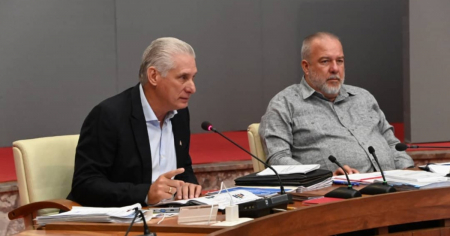
The Cuban leader Miguel Díaz-Canel assured that the photovoltaic park installation program is ongoing and that thanks to these investments, the energy deficit has been "lower."
His statements were made at the Council of Ministers, amid an energy crisis that has subjected the population to more than five years of continuous blackouts, many lasting over 20 hours a day.
“The concept is that we are moving forward, and we will overcome this,” he stated. He also emphasized that new solar parks should begin operating before the end of the year. They are expected to generate 1000 MW in 2025 and a similar figure in 2026.
"Photovoltaic parks have become the backbone of electricity generation during daylight hours. This is an ongoing program that we have underway because the resources are available in the country, and the installation of those planned for the remainder of the year has already begun," he emphasized.
However, the Council of Ministers acknowledged that the population still does not perceive significant improvements in their daily lives, as the blackouts are becoming longer in many provinces.
In direct reference to the national electric system, the president insisted that the recovery of some capabilities in distributed generation has not been sufficient to reverse the current situation.
Díaz-Canel emphasized that without investments in photovoltaic energy, “the situation would be much more difficult.”
The prolonged energy crisis in Cuba has impacted not only the residential sector but also industry, agriculture, trade, and basic services.
The lack of maintenance, the obsolescence of the energy infrastructure, and the absence of real investments have worsened the situation of the country's thermoelectric plants.
The government's bet on renewable sources, such as solar energy, is an emergency exit in response to the collapse of the electrical system.
Frequently Asked Questions about the Energy Crisis in Cuba and Solar Parks
What is the Cuban government's strategy to address the energy crisis?
The strategy of the Cuban government is to invest in the installation of photovoltaic solar parks as a solution to mitigate the energy crisis. However, this strategy has not managed to resolve the problem of prolonged blackouts due to technological limitations and a lack of fuel for other traditional energy sources.
What has Díaz-Canel said about the blackouts in Cuba?
Díaz-Canel has acknowledged that power outages are a persistent problem and has justified the current situation by pointing to the increased electricity consumption and the lack of fuel as primary causes. Despite this, he insists that investments in photovoltaic energy have been appropriate, even though they are not yet reflected in immediate improvements for the population.
How many solar parks have been installed in Cuba so far?
As of now, 27 photovoltaic solar parks out of the 51 planned for this year have been synchronized, which represents 53% of the projected plan. However, the impact of these parks on the reduction of blackouts has been limited due to the inadequacy of other energy sources.
Why hasn't solar energy solved the energy crisis in Cuba?
Solar energy has not resolved the energy crisis in Cuba because, although there have been advancements in photovoltaic generation, it only covers a fraction of the total energy deficit. Furthermore, outdated infrastructure and the lack of storage systems limit the impact of solar energy on the national electrical system.
Filed under: