
Related videos:
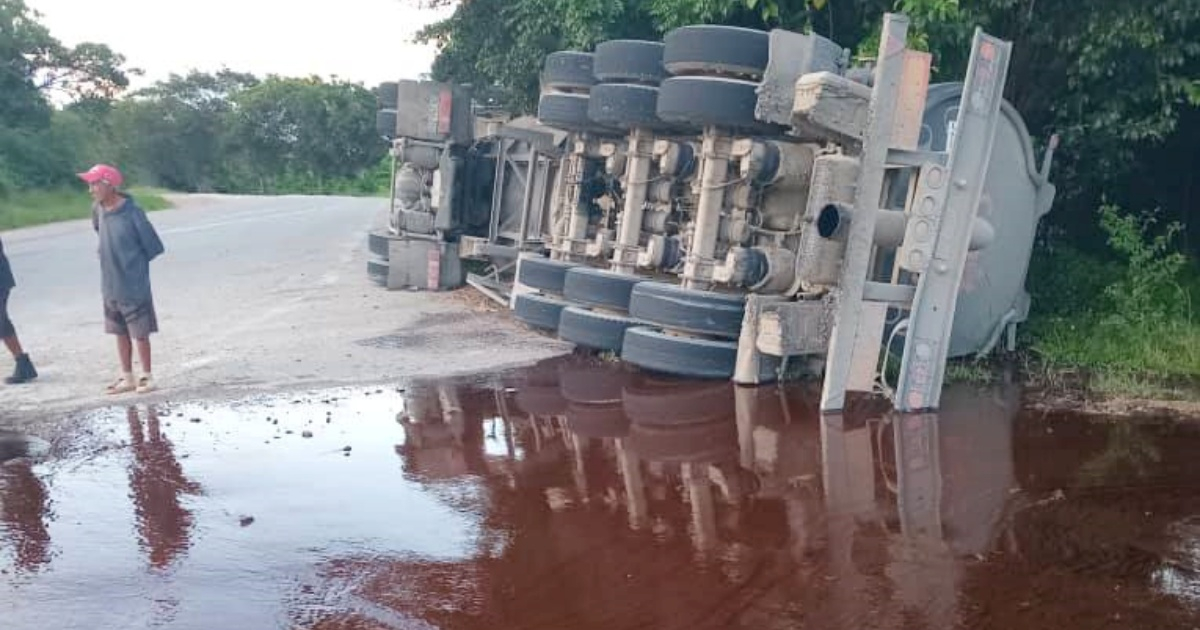
A tanker truck belonging to the state-owned company TRANSCUPET overturned on the afternoon of October 20, 2025, on the Vía Blanca, near the turnoff to Puerto Escondido, in the province of Mayabeque, causing a spill of over 31,000 liters of crude oil.
According to information from the company Cuba Petróleo (CUPET) on its official Facebook profile, the accident occurred at around 6:40 p.m., when the driver of the vehicle, a truck with license plate B 256192, lost control while merging onto the secondary road that leads to the coastal town.
The driver, who was transporting fuel from the wells to the battery at Puerto Escondido, was injured but not in life-threatening condition.
The injured person was immediately taken to a medical center in Santa Cruz del Norte, where they are receiving specialized care.
Spill and emergency response
The impact caused the truck to overturn completely, resulting in an oil spill on the road. Within minutes, specialized teams from the CUPET system were mobilized to contain the leak and recover some of the spilled fuel.
The authorities from the Ministry of the Interior (MININT) and executives from the oil company visited the site to oversee the cleanup efforts and assess the causes of the incident, which are still under official investigation.
The company stated that "efforts are being made to mitigate the consequences caused by the spill", although details regarding the extent of the environmental impact in the area have not yet been provided.
Reactions
CUPET's post generated dozens of comments from users, many of whom expressed relief for the driver's life, although there were also criticisms regarding the road conditions and the state of the vehicles.
"The most important thing is that there were no human losses," wrote an internet user, reflecting the widespread sentiment.
"The best part of it all was preserving life," pointed out another, while messages of gratitude and prayers flowed in: "Thank God the driver was not harmed. Lord, pour your mercy upon our Cuba."
However, there were also comments that questioned the training of the drivers and the technical conditions of state transportation.
“I think that drivers do not have the necessary qualifications to operate vehicles with liquids; it is different from static loads”, stated a user.
"That only happens due to speeding", another pointed out, while someone else requested "to check the GPS and see at what speed it was moving since it was carrying more than thirty tons."
Poor road conditions and work fatigue
An important part of the debate focused on the precarious conditions of Cuban roads, particularly in the Mayabeque area.
"Given how bad the road is and how slick those tires are, it's a good thing the damage wasn't worse," commented an internet user.
“The causes are the poor conditions of the streets and highways in Cuba… right there, you can see a pothole filled with crude oil,” added another, who also pointed out the exhaustion of the drivers after long shifts: “They drive all day, and when they get home, they can’t rest, without electricity, in the heat, and with mosquitoes.”
Others recalled that this is not the first time a similar accident has occurred in that area.
“Common accidents on that stretch; I worked at the company and lost colleagues under the same conditions,” wrote a user.
"That's quite a pothole there," another agreed, while someone noted that "the tires couldn't be more worn."
Amid the concern, several comments reflected the ironic and resigned tone with which many Cubans confront the energy crisis.
"In a country with not even a little bit of oil to light the coal, it's unbelievable that an entire pipeline is being wasted," lamented a commentator.
This is not the first time such an accident has occurred in this stretch. Drivers and former workers from the oil sector point out that the area of Puerto Escondido is particularly dangerous, due to the deterioration of the pavement, deep potholes, and lack of signage.
According to testimonies gathered on social media, accidents are frequent, and transporters must contend with long routes, inadequate rest, and poor maintenance of their vehicles, factors that increase the risks.
As of the closure of this report, CUPET has not provided any new details regarding the causes of the accident or the material losses. The company stated that recovery and remediation efforts are ongoing until the risks associated with the spill are eliminated.
The case is under joint investigation by the Ministry of the Interior and technicians from the oil company, who will need to determine whether the incident was caused by a mechanical failure, excessive speed, or human error.
Filed under: