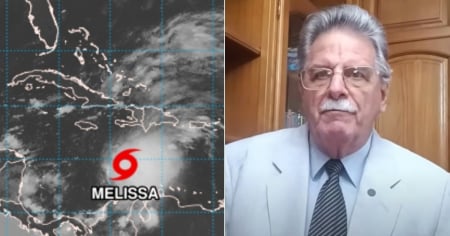
Dr. José Rubiera, an iconic figure in meteorology in Cuba, returned to national television this Wednesday in a special segment to warn about the potential development of tropical storm Melissa, which remains stationary in the central Caribbean.
Habitually active on his YouTube channel, Rubiera made this television appearance to warn about the complex weather scenario that could develop for Cuba in the coming days.
"It's a very difficult forecast", he admitted from the start, emphasizing the uncertainty associated with the trajectory and development of the system.
However, he made it clear that the situation could become complicated for the island starting Sunday or Monday if the most unfavorable scenarios come to pass.
A system with a deceptive appearance
Rubiera explained that, although Melissa may appear organized from the satellite images due to the thick cloud cover surrounding it, the center of circulation is offset from the convective core.
"It seems that it's very good, but it's not good," he said.
According to the expert, this is due to the strong vertical shear at high levels of the atmosphere, meaning wind currents that push the cloudiness eastward, separating it from the center of the system.
As a consequence, “the column is tilted” -an inclined structure between the surface and the upper levels- and as long as it does not manage to align vertically, the system will not be able to develop fully or intensify.
Furthermore, due to insufficient height, the storm has not been "captured" by the trough currently located north of the Dominican Republic, which also limits its movement.
"The solution of crossing through Haiti or the Dominican Republic does not seem to be coming to fruition," Rubiera clarified.
Slow movement and without a clear direction
Melissa only moves very slowly, which for practical purposes is akin to an almost stationary system.
This extreme slowness is due to the lack of guiding currents in its environment: there are no phenomena to propel its trajectory.
Hence, the traditional probability cone used by meteorological services to indicate the possible future trajectory is more of a circle in this case.
The wide variety of solutions offered by weather models further complicates the forecast.
"There is uncertainty about the future trajectory because right now Melissa does not have a pull current," Rubiera insisted.
What can change Melissa's course?
The doctor Rubiera noted that by Sunday, a radical change in the behavior of the system could occur.
During that period, a decrease in vertical wind shear is expected, which would allow the center of circulation and the cloud mass to align.
In such a scenario, Melissa could rapidly intensify. The western Caribbean Sea has a very high heat content, which is why Rubiera did not rule out the possibility of the storm evolving not only into a hurricane but even into a major hurricane.
"The intensity is literally going to explode when it reaches that area south of Cuba," he warned.
With this strengthening, the system would also gain vertical structure and size, making it more susceptible to being influenced by large-scale systems.
The key, according to Rubiera, will be a trough moving in from the southwest of the United States. Unlike the current one, this trough would have the ability to “capture” Melissa.
“If it captures it, then the movement could tilt towards the north or northeast,” he explained.
And he added emphatically: “And what is to the north and northeast? There is Cuba. Therefore, this is a potential danger for our country.”
Although it cannot be stated with certainty what the final course of the storm will be, Rubiera urged maximum attention and vigilance, especially between Sunday and Monday, when it will become clearer whether Melissa poses a direct threat to the national territory.
Call for vigilance without alarmism
The veteran meteorologist concluded his remarks by reiterating that this is a challenging forecast due to the numerous variables at play. However, he insisted that the risk should not be underestimated: Cuba must remain vigilant and prepared for the possibility of a direct impact.
His return to television is not only a sign of potential meteorological danger, but also a reminder that in times of uncertainty, Rubiera's experience and voice remain a trustworthy guide for the people of Cuba.
What does the National Hurricane Center say?
The tropical storm Melissa continues to move slowly over the central Caribbean Sea and could become a hurricane in the next 48 hours.
At 5:00 a.m., the center of Melissa was located at latitude 15.0N and longitude 74.9W, about 390 km south-southeast of Kingston, Jamaica, and 485 km southwest of Port-au-Prince, Haiti.
It is moving slowly to the west-northwest at 6 km/h and maintaining sustained winds of 85 km/h.
Although its center is not moving directly toward Cuba, the eastern part of the country could face heavy rain and strong waves, according to a warning from the National Hurricane Center (NHC) of the United States.
Although Cuba is not under an official storm or hurricane alert, the NHC emphasizes that areas in eastern Cuba, including provinces such as Guantánamo, Santiago de Cuba, and Granma, may be affected by the waves generated by Melissa over the next few days.
This phenomenon may pose risks to small vessels, low-lying coastal areas, maritime infrastructures, and fishing activities, in addition to increasing the potential for erosion on south-facing beaches.
There is also a warning regarding the possibility of rains associated with the outer bands of the storm, particularly in the eastern provinces; however, the intensity will depend on the evolution of its trajectory in the next 48 to 72 hours.
Filed under: