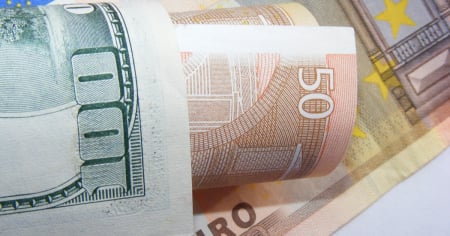
The informal currency market in Cuba starts the week in calm.
This Monday, the dollar, the euro, and the Freely Convertible Currency (MLC) have held the same prices for the third consecutive day.
The dollar has been priced at 490 CUP since Friday.
The euro, on the other hand, remains at 540 CUP since Thursday, while the MLC holds steady at 200 CUP for several days now. Despite the unfavorable predictions for the virtual currency created by the Cuban regime, it is currently holding strong.
Exchange Rate Evolution
Exchange rate today 10/27/2025 - 7:45 a.m. in Cuba:
Exchange rate of the dollar USD to CUP according to elTOQUE: 490 CUP.
Exchange rate of the euro EUR to CUP according to elTOQUE: 540 CUP.
Exchange rate of MLC to CUP according to elTOQUE: 200 CUP.
According to the October report from the Observatory of Currencies and Finances of Cuba (OMFi), for the remainder of the month, the dollar could even exceed 500 CUP if the current extreme environment persists.
According to the same forecast, the euro could reach 551 CUP, while the MLC would be around 215 CUP.
The sustained rise of the dollar and the euro in the Cuban informal market represents a direct blow to the domestic economy.
elTOQUE denounces a coordinated campaign to discredit its exchange rate
Since October 22, a campaign has been circulating on social media organized against the media outlet elTOQUE, falsely accusing it of being responsible for the rise of the dollar in the informal market due to its publication of the Informal Market Representative Rate (TRMI). On Facebook and WhatsApp, dozens of fake and anonymous accounts have been detected sharing the image "No to TOQUE," without context or text, in an attempt to create a perception of widespread rejection.
According to the outlet, this is a strategy similar to those that the government has used before to attack independent media: "a mix of unsubstantiated accusations, manipulation of facts, and coordinated dissemination on social media."
There have also been publications from groups associated with small and medium enterprises and captures indicating the involvement of officials in Havana, which reinforces the hypothesis of a non-spontaneous action.
elTOQUE emphasizes that the TRMI "does not cause market movements, it merely reflects the actual behavior of currencies based on digital supply and demand," and that its methodology is public, verifiable, and supported by economists.
In response to false accusations that it is part of GAESA or that it is "a foreign page," the outlet reiterates that it is an independent project, made up of Cuban journalists in exile.
The offensive occurs amidst an acute crisis in Cuba, with persistent devaluation, shortages, and growing social unrest. “Far from discrediting us, this type of campaign confirms the need for transparent, evidence-based information,” concludes elTOQUE.
In a context where most essential goods and services depend on foreign currency—either through imports or their sale in MLC—the increase of 25 pesos in just eight days immediately raises prices in the domestic market.
Every increase in the informal rate translates into a rise in the cost of living: food, hygiene products, medicines, and even transportation or repair services are rising in price almost at the same pace as currencies.
For families that rely on state salaries or pensions, whose incomes remain fixed in Cuban pesos, this phenomenon signifies an accelerated loss of purchasing power.
Meanwhile, households that receive remittances or manage foreign currency are able to maintain a certain level of consumption, widening the gap between those who have access to the dollar and those who do not.
This disparity fuels social tensions and drives many Cubans to seek alternative sources of income—whether through the informal market, jobs abroad, or even emigration—as the only way to withstand the economic decline.
In broader terms, the rise in the value of the dollar reflects a lack of confidence in the Cuban peso and the absence of effective measures to stabilize the national currency.
The increasing de facto dollarization further erodes the state's ability to control prices and plan the economy, while inflation feeds back into a cycle that punishes the most vulnerable.
Equivalence of United States Dollar (USD) to Cuban Peso (CUP), according to the exchange rates of October 27:
1 USD = 490 CUP.
5 USD = 2,450 CUP.
10 USD = 4,900 CUP.
20 USD = 9,800 CUP.
50 USD = 24,500 CUP.
100 USD = 49,000 CUP.
Equivalence of Euro bills (EUR) to Cuban Peso (CUP):
1 EUR: 540.
5 EUR = 2,700 CUP.
10 EUR = 5,400 CUP.
20 EUR = 10,800 CUP.
50 EUR = 27,000 CUP.
100 EUR = 54,000 CUP.
200 EUR = 108,000 CUP.
500 EUR = 270,000 CUP.
Meanwhile, Cubans are wondering what happened to the "floating rate" announced since late 2024 by Manuel Marrero, in order to attempt to bridge the gap between the official and informal value of currencies.
Filed under: