
Related videos:
The Minister of Energy and Mines of Cuba, Vicente de la O Levy, assured this Monday that the line crews are already prepared to undertake the recovery efforts for the electrical system in the eastern region of the country following the passage of Hurricane Melissa.
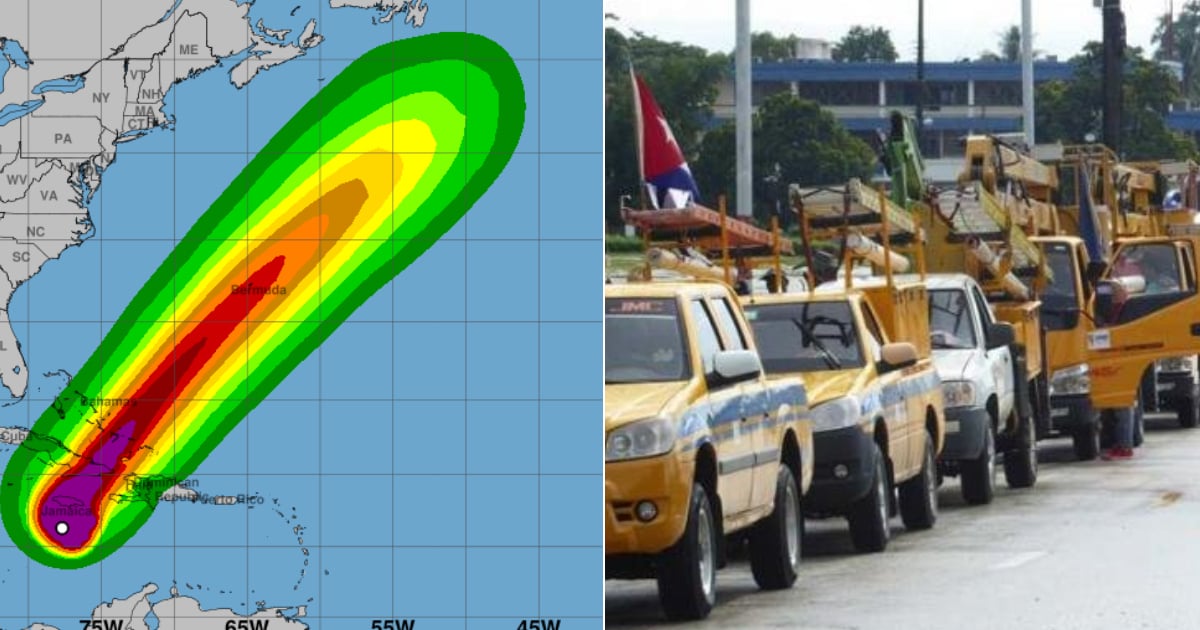
The announcement was posted on the social media platform X, accompanied by an image showing a caravan of trucks, buses, and electrical workers with Cuban flags. "Commitment and courage cannot be blocked," wrote the official.
The post, also shared by the Electric Union (UNE), is part of the official narrative regarding preparations for the imminent impact of the hurricane, which has already reached Category 5. From Guantánamo, the Provincial Defense Council released images of a symbolic ceremony for the flag-raising of a rescue and salvage military brigade, reinforcing the government’s message of pre-disaster organization.
However, the citizen reaction on social media has been characterized by skepticism and criticism. For many Cubans, the official announcement contrasts sharply with a reality in which power outages have become chronic, even without the presence of a weather event. "The only thing you have blocked is the electric power," commented one user. Another directly questioned, "What you need to do is restore the electricity, damn it."
The tone of the comments ranges from frustration to mockery. "They're going to have a major disaster, because with how fragile the electrical system is, there won't be a puppet left standing," noted an internet user.
Some people made ironic comments about the timing of the announcement: “They're definitely prepared to cut the power for two weeks,” and “That's so the public thinks they care about restoring electricity once the hurricane passes. A well-orchestrated circus.” Others doubted the authenticity of the images, claiming that “that photo is older than the person who posted it” or “that's from Google.”
Complaints are also coming from specific neighborhoods. In Santa Amalia, Havana, residents reported constant outages: "All night it goes off and on, and we still have no power." From Holguín, a woman wrote: "We've been in blackout since last night and Melissa still hasn't come. According to the Civil Defense, they were going to prioritize the east, but it seems the priority is on blackouts where they are prioritizing." In Camagüey, interruptions have already exceeded 14 consecutive hours, with no signs of improvement.
This is compounded by the frustration over the sudden availability of resources. “How quickly the fuel appeared, and even buses... but when you need transportation, they pass by empty and don’t even look at you,” lamented a citizen. The widespread feeling is that the regime only shows efficiency when it comes to propaganda, but not in daily services: “For half an hour of electricity, there’s no rush,” another person quipped. “They’re going to take advantage of the massive blackout in the east to take Guiteras offline and continue with the same power outages as always,” remarked another comment reflecting a recurring suspicion.
The most recent bulletin from the National Hurricane Center, issued this Monday at 8:00 a.m., confirms that Hurricane Melissa maintains sustained winds of 260 km/h, with a central pressure of 913 hPa. The center of the cyclone is located about 515 kilometers southwest of Guantánamo and continues to move slowly west at 6 km/h.
It is expected that the core of Melissa will pass over Jamaica tonight and Tuesday, making landfall in eastern Cuba during the night of Tuesday or the early hours of Wednesday. Authorities have issued hurricane alerts for Granma, Santiago de Cuba, Guantánamo, and Holguín, and a tropical storm alert for Las Tunas.
According to the forecast, the cyclone could bring up to 500 millimeters of rain to mountainous areas, cause landslides, generate storm surges of up to 2.7 meters, and lead to severe flooding in the southeastern coast. The destructive winds and the size of the system suggest that there will be significant impacts even before its eye makes landfall.
Authorities have begun to implement urgent evacuation measures throughout the eastern region. More than 650,000 people are being displaced, classes have been suspended from Guantánamo to Camagüey, and land, sea, and air transportation has come to a halt in the provinces under warning.
The electrical crisis that the country has been experiencing for months worsens the situation even further. On Sunday, the UNE had already reported about severe blackouts nationwide due to a generation deficit exceeding 1,700 megawatts. This has left thousands of homes without electricity, even before the hurricane has touched Cuban soil.
Melissa's arrival coincides with a scenario of high vulnerability for national infrastructure, with no real capacity to respond to an emergency of this magnitude.
In this context, the announcement of "ready" brigades has been received by many as an attempt to cover up the lack of structural solutions. "They will come to fix the fallen cables and posts, but electricity, I doubt it," summarized a user, reflecting the sentiment of a population that is once again facing a major crisis with uncertainty and darkness.
Filed under: