
Related videos:
The hurricane Melissa, which was downgraded to category 4 as it passed through Jamaica this Tuesday, continues to be a powerful cyclone as it moves towards the eastern part of Cuba, where it is already causing strong swells with waves reaching up to 8 meters in height during the early hours of Wednesday.
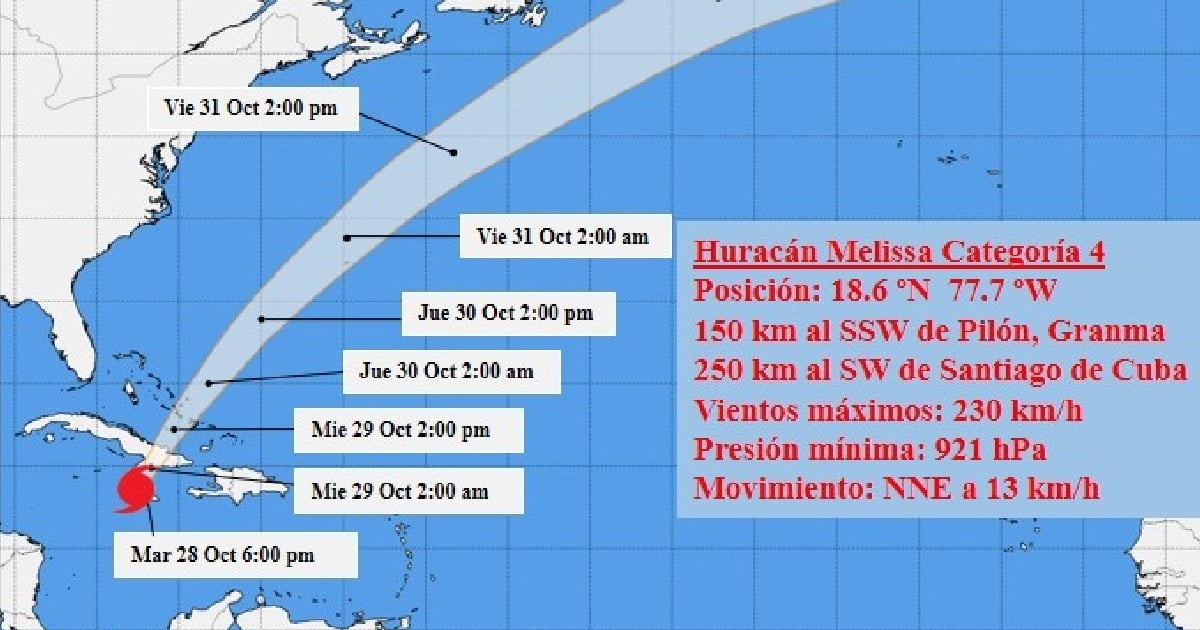
In its Tropical Cyclone Warning No. 20 issued at 6:00 p.m., the Forecast Center of the Cuban Institute of Meteorology (INSMET) reported that, after having passed over the island of Jamaica, the interaction of the hurricane with land has caused "a slight weakening in its intensity," lowering it to category 4 on the Saffir-Simpson scale.
However, Melissa has maximum winds of 230 kilometers per hour, with higher gusts, and its central pressure has risen to 921 hectoPascals, making it a hurricane of great intensity and extremely dangerous for Cuba, towards which it is heading.
In the southern seas of the provinces of Granma, Santiago de Cuba, and Guantánamo, intense swells are being recorded, with waves between 4 and 6 meters, which will continue over the next few hours. However, by early Wednesday morning, the waves are expected to reach heights of up to 8 meters, causing moderate to severe flooding in low-lying areas along this coastline, warned INSMET.
Meanwhile, since the early hours of the night, the winds will increase in the eastern region to tropical storm strength, with speeds between 70 and 95 kilometers per hour, and gusts exceeding that.
The outer bands of the hurricane are impacting the eastern part of Cuba with showers and rainfall, which will gradually increase as it approaches and during its passage through that region. Precipitation will be heavy and intense in some localities, especially in mountainous areas, with accumulations between 200 and 450 millimeters.
The meteor is continuing to move north-northeast at a translation speed of 13 km/h. At six in the evening, the center of Melissa was estimated to be at 18.6 degrees North latitude and 77.7 degrees West longitude, positioning it about 150 kilometers south-southwest of Pilón, in Granma province, and 250 kilometers southwest of the city of Santiago de Cuba.
In the next 12 to 24 hours, Melissa is expected to shift her path more toward the northeast and gradually increase her forward speed.
The powerful hurricane "will be approaching the southern coast of the eastern region of Cuba tonight, making landfall at some point along the southern coast between Granma and Santiago de Cuba." Although it "will experience fluctuations in its intensity," INSMET explained, it will remain a highly intense hurricane as it passes through Cuba.
The Forecast Center of the Institute of Meteorology is closely monitoring the development and future path of this intense hurricane and will issue another advisory on the tropical system at 9:00 p.m. this Tuesday.
The renowned Cuban meteorologist José Rubiera issued an urgent alert regarding the imminent arrival of Melissa in eastern Cuba, warning that the phenomenon “will be destructive” and that residents in that region must protect their lives and those of their families from the extreme danger.
In a broadcast from his YouTube channel, the expert emphasized that the powerful cyclone will impact the eastern region between Tuesday night and Wednesday morning, with hurricane-force winds that will be felt from Camagüey to Guantánamo. He urged the necessity for people to evacuate on time and to avoid staying in fragile homes or near the coast.
"Nobody can replicate life. A house can be built, but without life, nothing is resolved," he emphasized.
According to the National Hurricane Center (NHC) in the United States, Melissa will make landfall in southeastern Cuba tonight, causing storm surges of 8 to 12 feet (2.5 to 3.5 meters) and rainfall totals of up to 25 inches (more than 600 millimeters) in the mountainous areas of eastern Cuba, which could lead to catastrophic flooding and landslides.
The NHC warned that “there are very dangerous hours ahead” and the public should spend the night in safe places until authorities indicate otherwise.
Melissa has already made history by registering among the most powerful hurricanes recorded in the history of the Atlantic. After reaching sustained winds of 295 km/h (185 mph), with even higher gusts, and a minimum central pressure of 892 millibars (hectopascals), the storm joins the select group of extreme category 5 hurricanes, which includes historic "monsters" like Wilma (2005), Dorian (2019), and the Labor Day cyclone (1935).
Filed under: