Cuban television once again became a stage for political propaganda this weekend, when the official journalist Jorge Legañoa Alonso, current president of the state agency Prensa Latina, dedicated an extensive commentary to questioning the humanitarian aid offer from the United States to the Cuban people following the passage of Hurricane Melissa, and presented the regime as the sole guarantor of solidarity and efficiency amidst the disaster.
The segment, broadcasted on the National Television News, mixed figures, anecdotes, and emotional appeals in an attempt to reconstruct the official narrative about international assistance and discredit the actions of Washington and independent media.
The central message was clear: "The United States has not offered anything real" and any controversy regarding this would be "a manipulation of the anti-Cuban machinery".
The commentator adopted a moralizing tone from the beginning, quoting a Martí phrase—"Doing is the best way to say"—to justify the alleged heroic actions of the Cuban state.
From there, he reiterated a script commonly found in the official speeches of recent days: denying Washington's offers, reaffirming the government's “transparency” in managing donations, and blaming the embargo for all the material limitations the country faces.
"Cuba has extensive experience in managing donations and aid with transparency," asserted Legañoa Alonso, mentioning United Nations agencies and religious organizations as witnesses to the state's commitment.
But the message went beyond recognizing that cooperation: it sought to impose the idea that only the Cuban government can manage the aid, denying space to civil society, the Church, or the citizen platforms that have emerged to assist the victims directly.
The journalist also recalled the old memorandum by Lester Mallory (1960), a text frequently cited in Castro's propaganda, to argue that U.S. policy aims to "inflict suffering on the Cuban people."
With that argument, he tried to present Washington's offer of aid as contradictory, concluding that if it really wanted to help, "it should lift the blockade or at least establish humanitarian exceptions."
A discourse designed to deny the evidence
However, the facts contradict the commentator's version. As has been documented in recent days, Secretary of State Marco Rubio publicly announced the United States' readiness to provide “immediate” humanitarian assistance to the Cuban people following the passage of Hurricane Melissa, which devastated several provinces in the eastern part of the island.
The U.S. Embassy in Havana and the State Department confirmed the existence of legal exemptions that allow private donations of food, medicine, and emergency supplies.
Despite this, the Ministry of Foreign Affairs (MINREX) stated that "there has been no concrete offer" and accused the media of "manipulating" the issue.
Days later, the leader Miguel Díaz-Canel declared that Cuba “will accept any help that is honest,” an ambiguous statement that reaffirms the regime's absolute control over any humanitarian channel. He also took the opportunity to call "rats" independent journalists and social media activists who have critical messages regarding his administration.
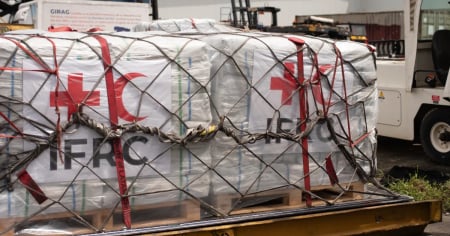
The statement comes as organizations like UNICEF and the UN have already sent shipments of medicines, mosquito nets, and hygiene kits to the affected provinces, without the Cuban government having transparently reported on the distribution of those resources.
Propaganda among the rubble
Legañoa Alonso's comment, far from providing information, turned into a carefully crafted piece of propaganda intended to neutralize the symbolic value of the American gesture and keep intact the narrative of the "besieged square" that the regime has upheld for decades.
From his very first sentences, the journalist took an accusatory tone: he spoke of an "anti-Cuban machinery" that, according to him, manipulates the facts and presented Rubio's announcement as merely a political maneuver without real substance. In doing so, he aimed to discredit the opponent and dissolve the possibility that the offer of assistance would be seen as a genuine act of solidarity.
Legañoa Alonso selected examples to support his version. He spoke of the assistance sent in the past by Washington after the Matanzas fire or Hurricane Ian but avoided mentioning that those donations arrived after months of delays and under the absolute control of the Cuban state, which prevented their direct distribution to the citizens.
With a seemingly informative speech, the regime's spokesperson attempted to uphold the image of an efficient and transparent government. The emotional component also played a central role in the rhetoric. The commentator evoked images of leaders covered in mud and supportive rescue brigades, aiming to elicit empathy and national pride.
In that portrait of popular heroism, the regime presented itself as the only possible savior, while the people appeared united around the supposed leadership of Díaz-Canel. The emotional manipulation was evident: the complexity of the crisis was replaced by an epic narrative in which the people's "heroism" and "loyalty" became a patriotic virtue.
The ideological comparison reinforced the message. Legañoa Alonso recalled the images of Donald Trump throwing rolls of toilet paper in Puerto Rico after Hurricane Maria to contrast the alleged capitalist indifference with the "socialist efficiency" of the Cuban government. The contrast was not coincidental: it aimed to reaffirm the moral superiority of the Cuban system and to frame any external criticism as an attack on national dignity.
Finally, the piece culminated with the most recurring theme of official propaganda: external blame. The embargo once again served as the total and convenient explanation for all the ills.
According to the official narrative, there are no administrative errors or state negligence, but rather a constant conspiracy from the White House aimed at hindering Cuba's progress. This is how the regime's television systematically operates: it seeks once again to turn a humanitarian tragedy into an act of political reaffirmation, where the enemy is always the other, and power absolves itself among the rubble.
Social reaction and civic distrust
While television repeats slogans, Cuban civil society has expressed its distrust of official channels. On social media, many citizens questioned the regime's control over donations without accountability, recalling past experiences in which aid did not reach those in need or was diverted to the black market and military institutions.
Community projects like "Dar es Dar," driven by activists both within and outside the country, have launched campaigns to channel direct aid, but the State maintains strict restrictions on the import of humanitarian materials and the creation of private funds.
In contrast, international organizations and foreign governments —such as Venezuela, Colombia, or India— have already sent shipments that were received with extensive media coverage, while the American offer was downplayed or denied.
The same script, a new setting
The Legañoa Alonso segment was an isolated incident. It fits into a broader communication strategy where the regime attempts to control the narrative about Hurricane Melissa and turn the tragedy into a demonstration of political strength.
The exaltation of sacrifice, the appeal to national unity, and the demonization of the external enemy form a script that the media system repeats whenever the country faces a crisis.
The final message is not only defensive: it aims to prevent the symbolic impact of the U.S. appearing as a supportive actor to the Cuban people. If Washington manages to be seen as a source of help rather than aggression, one of the ideological pillars of Castroism is weakened.
For this reason, beyond the rubble and humanitarian urgency, Cuban television continues to fulfill its most faithful role: defending the power, even when reality contradicts it.
Filed under: